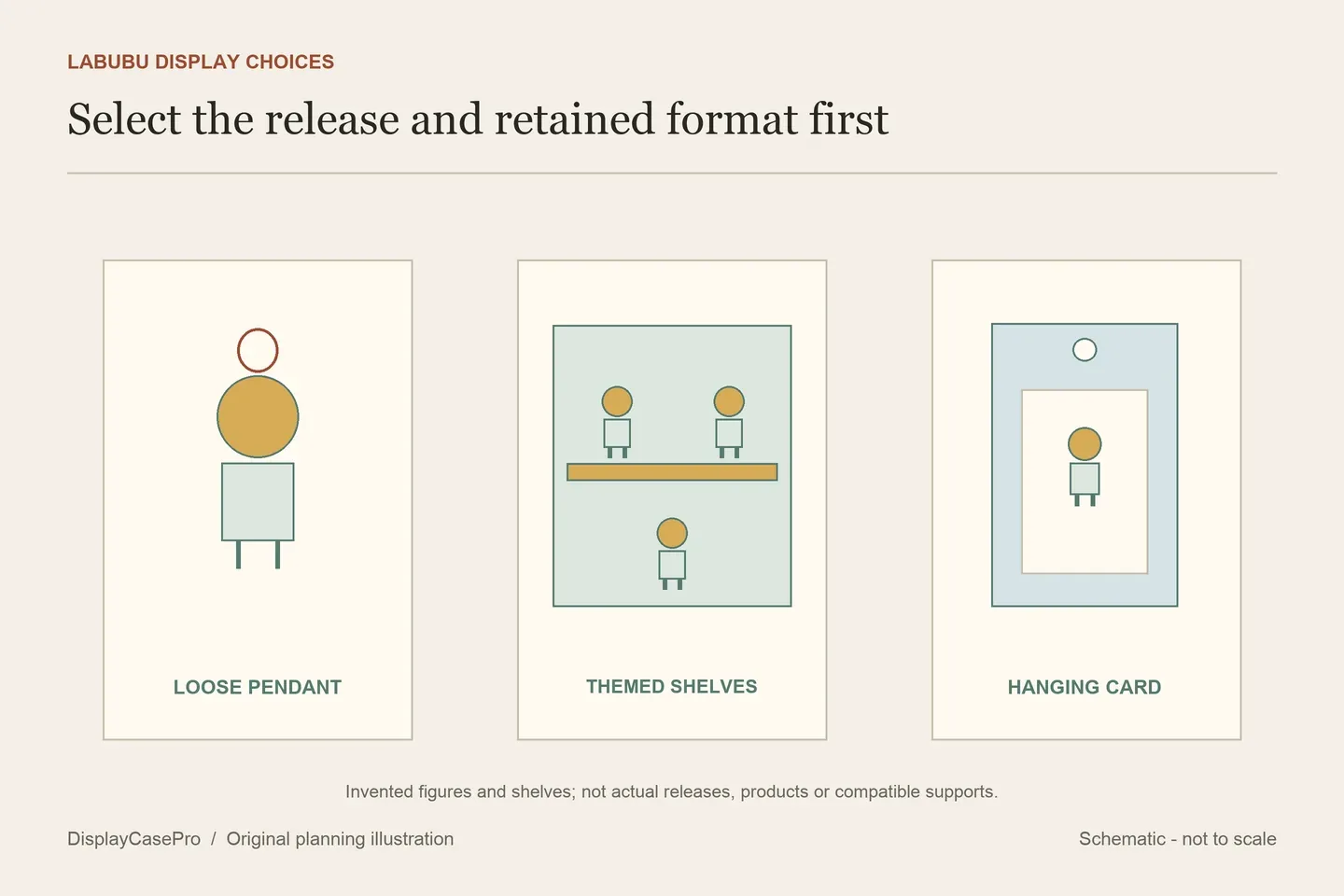
Choose a Labubu display case for the exact release and the way you want to keep it: a loose pendant, a figure in a themed shelf scene, or an intact hanging-card package. These are different receiving tasks. A case sold under the Labubu name may address only one of them.
Start by writing down the series, product form and packaging you intend to retain. Then decide whether the important view is the loose character, its outfit, the original card artwork or a group arranged inside a decorated container. That decision gives you a useful shortlist before comparing case sizes.
Identify more than the character name
Keep the wording from the actual product or your collection record. “Vinyl plush hanging card,” “vinyl plush doll” and a figure retained in a blind-box package are not interchangeable descriptions. Record whether the item has a hanging loop, separate accessories, clothing or a package tab that will remain in the display.
A size label such as S, or a percentage-style format used elsewhere in a character catalogue, is not a measured outline for your release. POP MART’s display-container category spans several character families. A container appearing there does not establish Labubu compatibility or tell you its usable shelf openings.
Choose the display state without changing the collectible to suit a convenient box. If you want to retain an intact package, plan around that package. If the item will be loose, include the outfit, ears, loop and intended support in its complete profile.
Three listings that answer different questions
The following descriptions were read in October 2026. They illustrate product distinctions and missing information, rather than tested fit or a best-case ranking. Keep each size line with its original definition.
| Format and source | Published description | Question before ordering |
|---|---|---|
| Elevenmark S-size enclosure | Lift-off cover; clear or printed rear; L13 × W9.7 × H23 cm. | Inside/outside is not stated. Which exact release and complete supported outline does it receive? |
| Urban Outfitters Wacky Mart container | Built-in shelves and sticker sheet; L13.64 × H15.9 in. | The size line lacks depth and clear shelf openings. What space remains for the chosen group? |
| Display Geek Let’s Checkmate overcase | Fitting guide identifies the vinyl-plush hanging card, excluding the vinyl-plush doll and blind-box packages. | Does the complete retained hanging card match that specific product, opening and receiving space? |
A product name can describe the general style while leaving the decisive dimensions unresolved. Do not turn an unclassified size line into an interior measurement, or copy compatibility from a neighbouring product that happens to use similar photographs.
For a loose pendant, include the loop and support
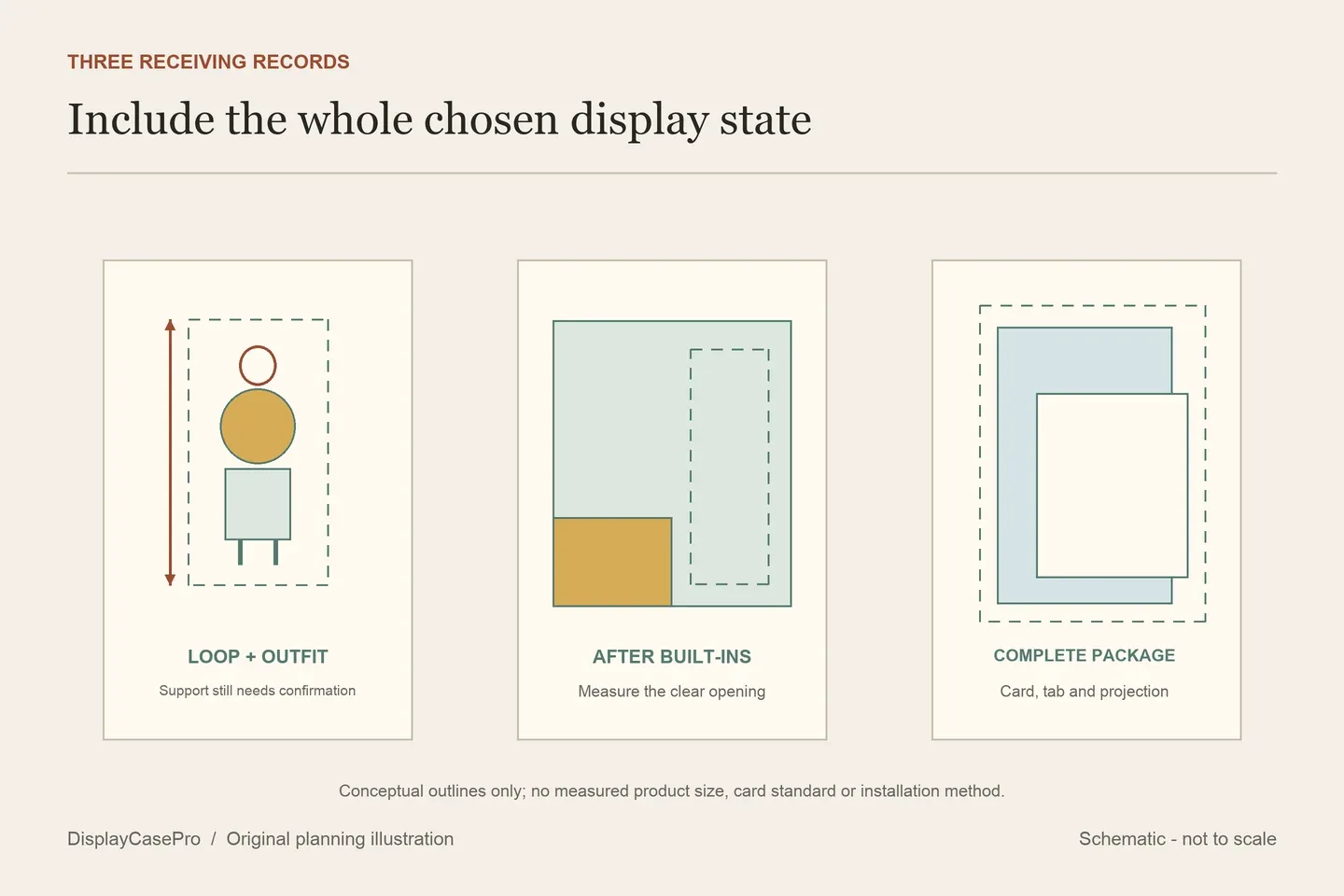
Decide whether your loose item will sit in an intended support or hang from a support designed for it. Record that arrangement before measuring. A suspended pendant can occupy a different vertical outline from the same item with its loop resting behind it.
Follow the collectible and support instructions for the chosen contact method. A visible loop is not, by itself, an instruction to attach it to any hook, cord or adhesive fitting. Ask what the case supplies and how the intended support is retained and released.
Include the ears, clothing and any projecting accessory in the outline without compressing them to obtain a smaller number. Check the widest and deepest parts from the chosen view. The box’s tallest dimension alone cannot tell you whether the front panel will contact an outfit or whether the opening admits the item in its intended state.
Keep a separate route for removing the collectible and for removing the cover. A lift-off enclosure needs room above and beside it; the pendant also needs a suitable handling route once the cover is off. An upper shelf can obstruct the first movement even when the closed case fits neatly beneath it.
For Wacky Mart, plan the occupied shelf openings
A themed container adds a second task: arranging the figures around built-in shelves and decoration. Begin with the characters you want visible and assign them to actual shelf openings. Leave any position unassigned until its clear height, depth and admission route are known.
The Urban Outfitters listing includes a sticker sheet and lists electrical components among the materials. Those statements do not define lighting equipment, a power source or cable clearance. Obtain the instructions and contents for the exact container rather than planning a lighting installation from the theme or a photograph.
Place decoration after the figure positions are resolved. A sticker, prop or label should not hide the release detail you intended to show or obstruct access. For repeated shelves, keep a simple position record so an item can return to the same opening after removal.
A scene’s outer dimensions cannot supply the usable floor at each level. Dividing its height by an assumed number of shelves also misses shelf thickness, shaped openings and fixed decoration. Ask for the actual receiving dimensions instead.
For Let’s Checkmate, keep the fitting-guide exclusion
The Display Geek page is particularly specific about the hanging-card version. Its exclusions remain useful even when another listing or a shortened link describes the item more loosely. Do not treat the same character name as permission to substitute a different package.
Record the complete card, blister or other projecting packaging, including a retained tab. Confirm the insertion direction and how the overcase closes without forcing a corner. Wall thickness describes construction; it does not establish the spare space around that package.
If the package already has a secondary protector, decide whether that layer stays. The protector-to-overcase check then becomes separate from the original package-to-protector check. Preserve the intended collecting state rather than opening or flattening something to match an ambiguous size description.
Use the blank Labubu display record for release wording, retained packaging, support, shelf opening and unresolved questions. Our collection measurement guide covers the general outline method.
Common questions
Will an S-size Labubu case fit every pendant?
Confirm the exact release, complete supported profile and clear receiving space. An S label and one unclassified dimension line do not establish that range.
Is a Wacky Mart container the same as a package protector?
Its shelves and themed arrangement address a group display. A fitted package overcase addresses a particular retained package. Choose for the object and view you intend to keep.
Can I use a printed background as evidence of UV protection?
A printed design describes appearance or production. Check any light-filtering specification separately for the exact finished product; this guide has not tested protective performance.
Comments
Share a display tip or ask a question.