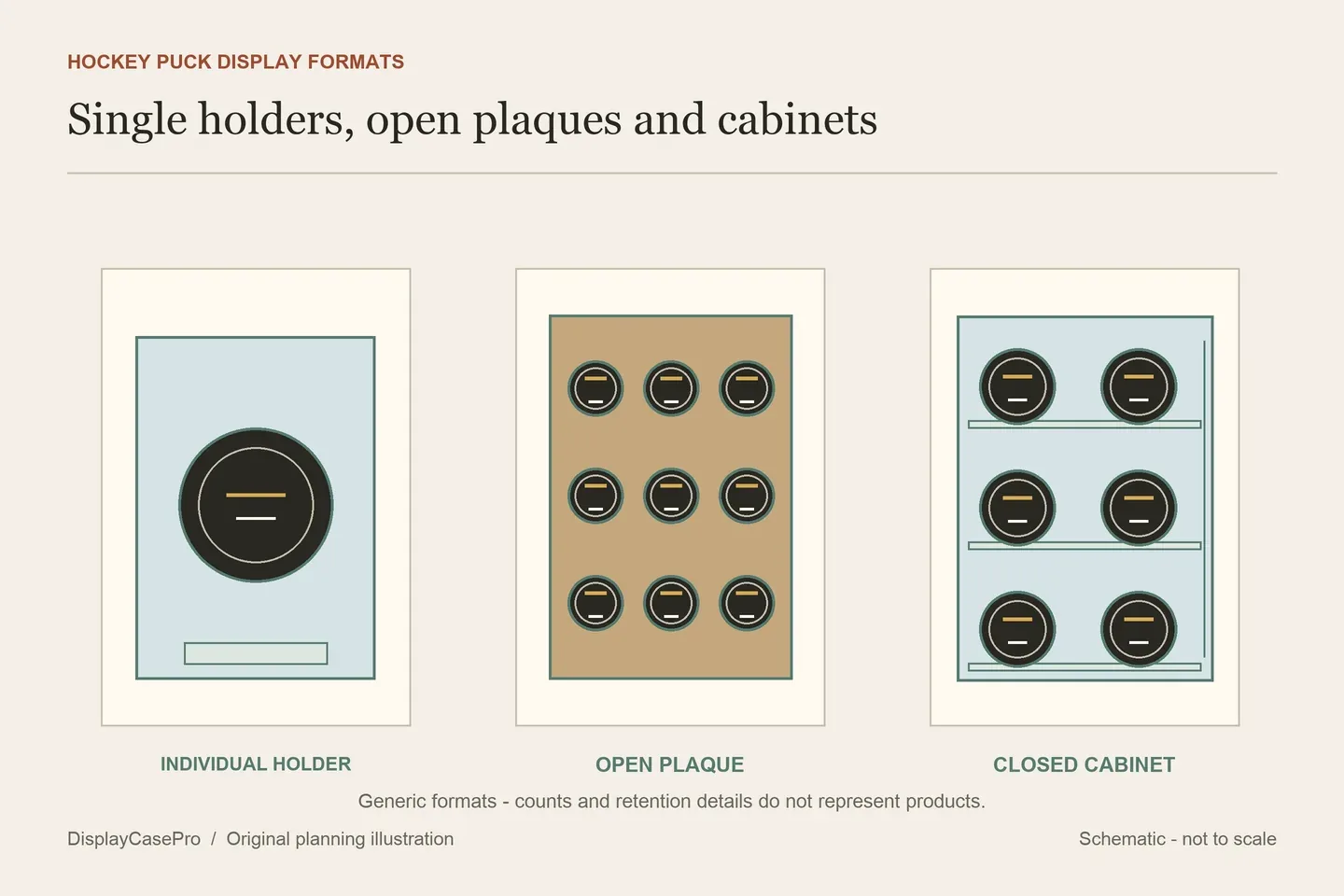
Choose a hockey puck display case by separating three decisions: the puck you own, the face you want visible and the format that holds it. A single square holder, a puck-and-card case, a hole plaque and a multi-puck cabinet do different jobs. Their nominal counts and size labels should not be treated as interchangeable fit specifications.
Start with the puck, including its thickness
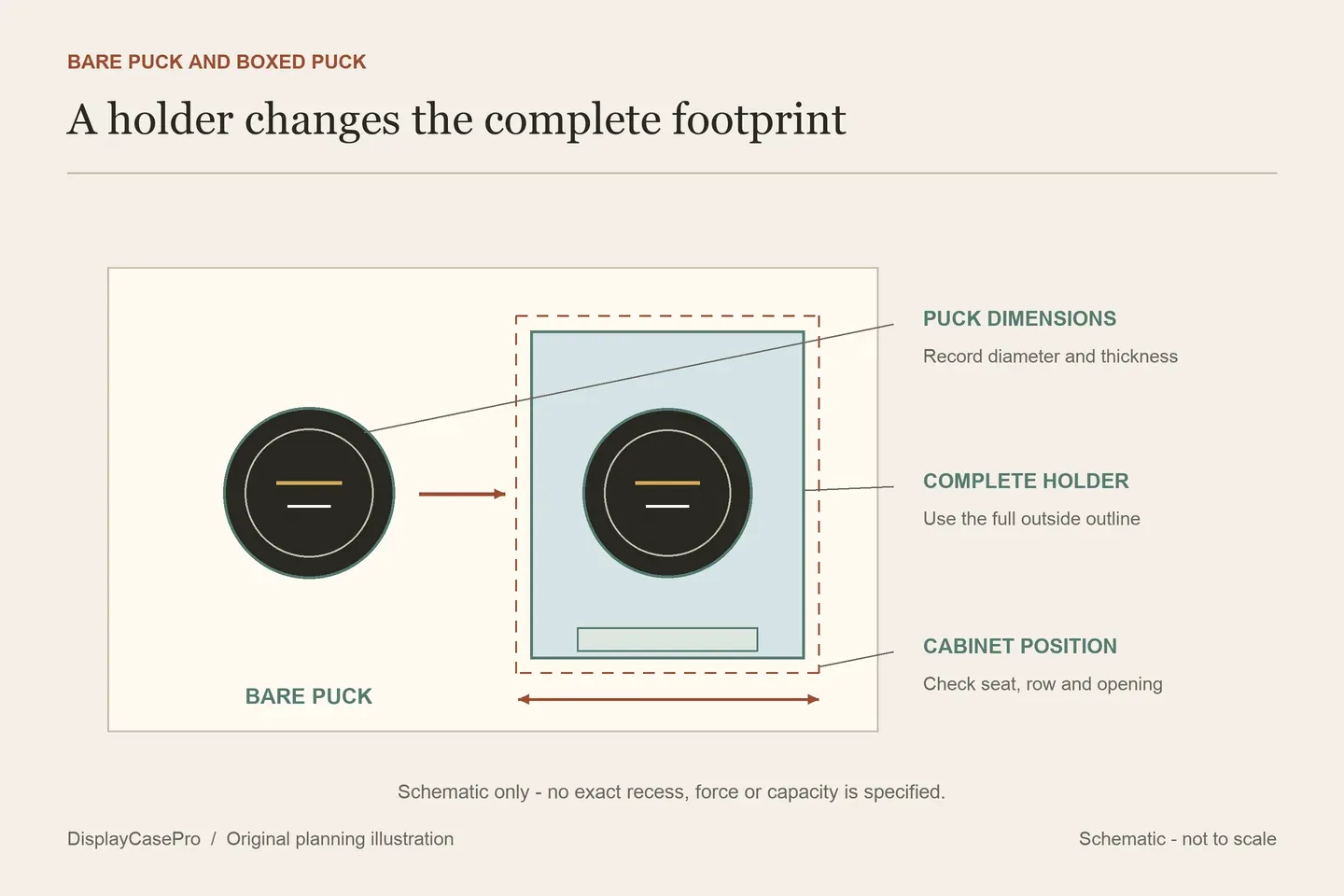
Record whether the item is a playing puck, souvenir, replica or an unidentified commemorative piece. Measure its actual diameter and thickness without including an existing container. If it will remain in that container, record the complete container separately. A holder sold for regulation pucks does not establish the fit of every souvenir or novelty version.
Choose the face that carries the display's meaning: a team design, inscription, signature or event mark. Also note important details on the edge or reverse. A tight individual holder can be convenient, but it may leave one surface hidden unless the entire holder is repositioned.
Keep the puck's identity separate from its display label. A signature, game association or date should follow the evidence you hold; enclosing a puck does not authenticate it. For a group, use a short visible caption and retain the fuller record outside the case.
Individual holders use different kinds of space
BCW's puck-holder catalogue supplies useful examples with distinct measurement definitions. These published specifications were read in October 2026; they are not fit tests performed here.
| Exact model | Published interior | Published exterior |
|---|---|---|
| 1-PH square holder | 3 × 3 × 1 in. | 3³⁄₁₆ × 3³⁄₁₆ × 1⅜ in. |
| 1-PT round tube | 3¼ in diameter × 1³⁄₃₂ in. | 3¼ in diameter × 1½ in. |
| 1-PCH puck-and-card holder | No separate puck recess or card-slot interior given in the catalogue text. | W7⅜ × H4½ × D2⅜ in. |
The square holder and round tube should be compared with the actual puck, while their complete exteriors matter if you intend to put them inside a larger cabinet. A nominal match is not permission to press a thicker item into a snap closure. Confirm the intended product and opening method if the fit is uncertain.
For the card format, ask which card size or existing card holder it accommodates and where the puck sits relative to it. The combined exterior cannot be divided into two guessed interior compartments. Plan both important faces so one object does not hide the other.
Check whether the chosen holder presents the puck flat, upright or on a separate pedestal. That determines what you can see from the intended shelf height. Obtain the actual support arrangement rather than using a neighboring puck or a case wall to keep the disc facing forward.
A hole plaque and a closed cabinet are different purchases
The Inglasco 41-puck plaque describes a 24 × 24-inch wood panel with 41 holes intended for pucks identified as 3 inches wide and 1 inch high. The page directs owners to an insertion and removal video. It does not supply a separate clear enclosing front or a numerical hole-clearance specification in the text read.
That format is worth considering when you want a repeated puck-face composition. Confirm the actual retention method and follow the maker's instructions for inserting or removing your items. The published size alone does not define how to insert or release a puck, and no substitute pressure or removal technique is specified here.
The sfDisplay 40-puck cabinet instead describes eight rows of five pucks on indented shelves behind an acrylic door. Its published outside size is H30 × W16.5 × D4 inches, with 3.25-inch inside depth and 3.25-inch shelf spacing. The door is described as opening from right to left.
Those cabinet figures do not reveal the exact indentation shape or establish that forty individually boxed pucks fit. Ask about the actual seat dimensions and the clear row space for your intended items. Keep a bare-puck capacity distinct from the capacity of a holder-filled display.
| Decision | Hole plaque | Enclosed shelf cabinet |
|---|---|---|
| Retention | Confirm how the actual puck engages the intended hole. | Confirm the shelf seat and any support needed for the selected puck or holder. |
| Visible surfaces | Ask how the chosen face is oriented and how the reverse remains accessible. | Check shelf lips, door reflections and row viewing height. |
| Opening | Follow the documented insertion/removal method. | Allow the door swing and access to each row. |
| Capacity | Hole count belongs to the intended puck format. | Position count belongs to the intended shelf arrangement. |
Separate pack quantity from display capacity
A listing offering twelve holders or seventy-two cubes may describe the number supplied in an order. It does not mean that one enclosure holds that many pucks. Record both the number of individual containers purchased and the number of positions within each complete display.
The same distinction matters when expanding a collection. Ten existing pucks in separate holders need a different plan from ten bare pucks on cabinet seats. Make a list of exceptions, including thicker souvenirs, pedestal displays, card combinations and any container you want to retain.
If some items do not fit the repeated format, give them a separate display position. A coherent row of ordinary pucks can sit beside one larger keepsake case without forcing every object into the same product family. Keep the collection order understandable with identifiers that remain useful when an item moves.
Check the visible face and removal route together
Try a paper position map before filling a wall display. Mark the important face and the caption for each puck. Check whether the top row will be readable from your normal position and whether a shelf edge hides an inscription near the lower rim.
For an individual holder, establish how it opens and where its components will rest while the puck is reached. For a grouped cabinet, check the door movement against nearby walls and frames. A shallow closed footprint does not show the space needed for a swinging door or safe access to an end position.
Keep lighting and protection claims in their proper scope. Clear plastic, a coated front or a UV-related description does not guarantee that signatures will remain unchanged indefinitely. Choose a location and care approach suited to the actual items, and ask for supporting product information where a protective claim matters.
Use the blank puck, holder and display worksheet to record puck dimensions, full holder exteriors, intended positions and unanswered retention questions. The collection measurement guide covers consistent interior and exterior measurements; the extra puck-specific work is matching disc thickness, presentation and retention.
Common questions
Will a regulation holder fit every souvenir puck?
Compare the actual item with the exact holder's usable space. The regulation label does not define every commemorative puck or attached decoration.
Can a 40-puck cabinet hold forty cubes?
Its intended bare-puck count does not establish that. Compare complete cube exteriors, seats, row clearance and access.
Is a plaque an enclosed case?
Confirm the supplied panels. A panel with puck holes and a cabinet with a clear door provide different physical arrangements.
Comments
Share a display tip or ask a question.