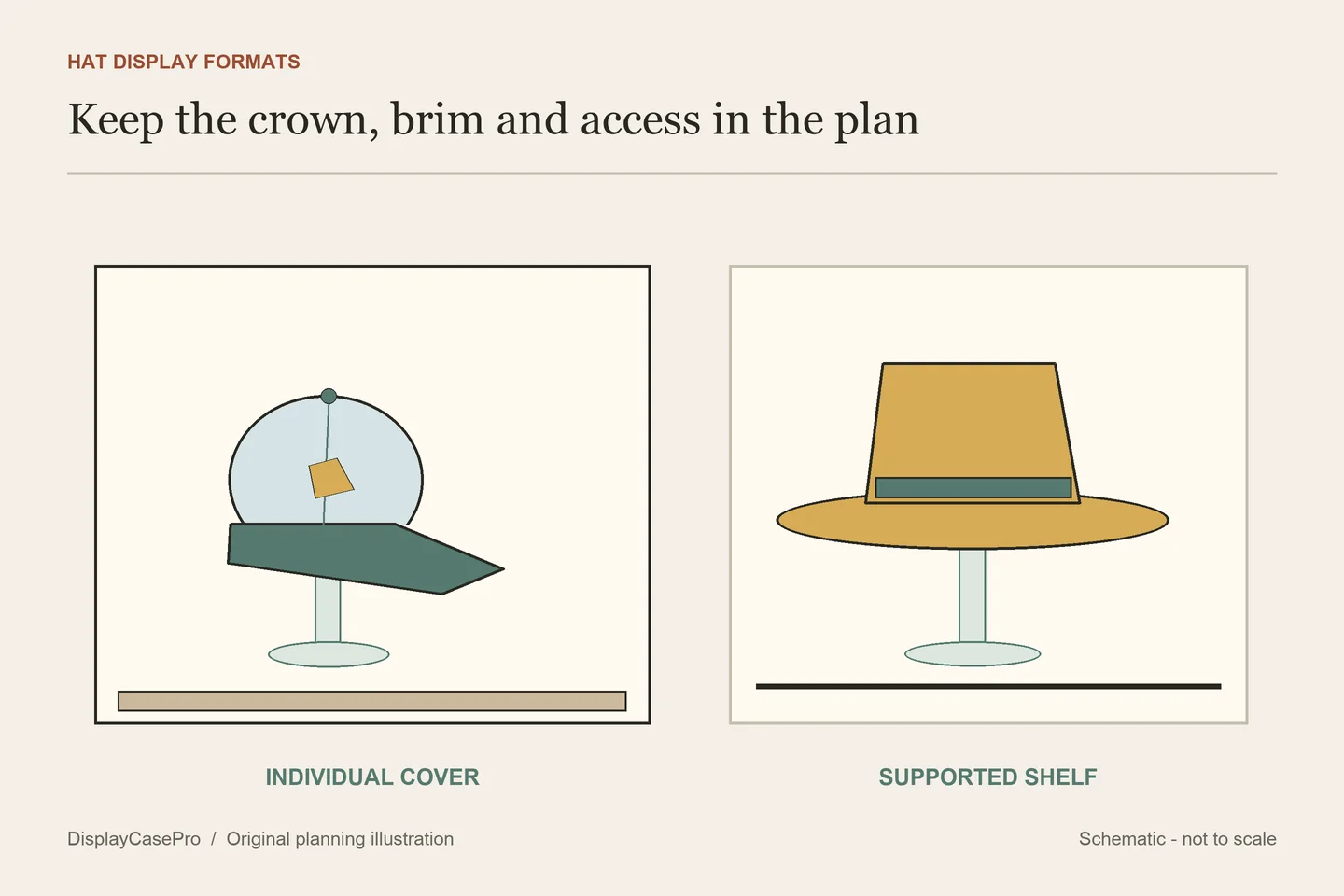
Choose a hat display around the shape you want to retain: the crown, brim, peak and decoration all need room in the finished arrangement. An individual cover can suit a keepsake cap, while a supported shelf or cabinet may work better for wide brims. An open rack is another option for wearable hats when its contact points suit the items.
Four hat display case ideas and open alternatives
1. One keepsake cap under a separate cover
A single cap can carry a small tabletop display when the front logo, signature or event history is the focus. Arrange its crown and peak on an appropriate support, choose the viewing angle, then size the cover around the complete assembly. Keep a caption beside the cap rather than draping other memorabilia across it.
A lift-off cover needs a clear upward route and a place to set it down. Check projecting trim and the cap's rear strap along that route. Choose an enclosure that accommodates the intended shape without flattening the crown or bending the peak to close it.
2. A supported shelf for a wide-brim hat
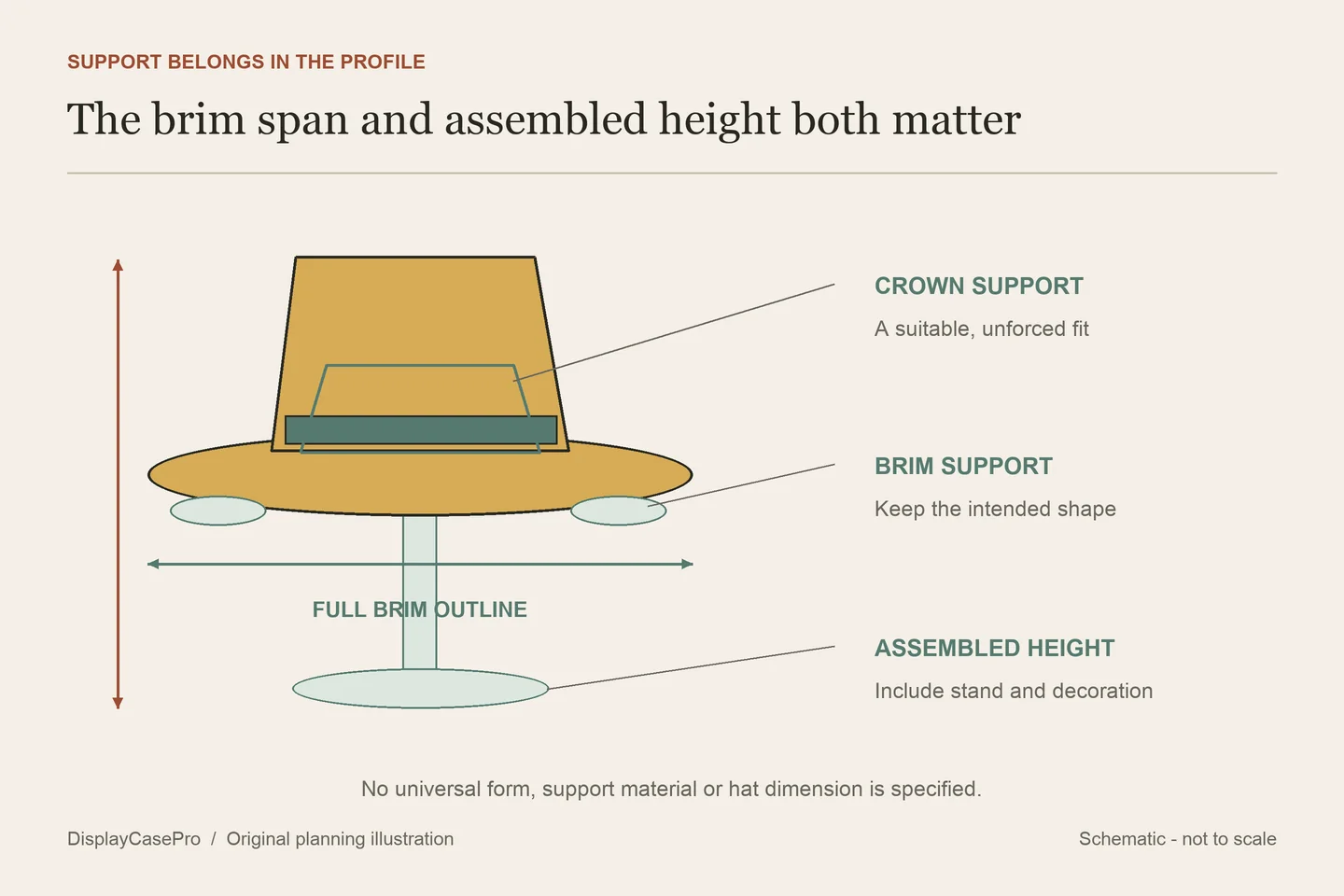
A brimmed hat often needs a wider footprint than a cap, even when their head sizes are similar. Plan the supported crown and the full brim outline together. Choose a case or shelf that allows the outline to remain visible from the normal viewing position.
If the brim needs additional support, include that support in the layout before choosing the shelf depth. A tall stand can reveal the hat clearly but also raises the complete assembly. Check the height under an upper shelf or transparent cover after the support is in place.
3. A cabinet with separate bays for different profiles
Group caps, brimmed hats and unusually decorated pieces in positions suited to their profiles. Adjustable shelves or separate bays can accommodate differences more effectively than a uniform grid. Keep the tallest decoration and the broadest brim visible in your plan.
Use a theme such as maker, team, occasion or period when it helps explain the collection. Leave each hat's outline readable. A row that overlaps neatly from the front may conceal contact between a brim and the neighboring crown.
4. An open rack for hats you regularly wear
An accessible rack or a set of suitable supports can make sense for a changing wearable collection. Check the actual contact point and the hat maker's storage advice. A hook, clip or peg that suits one modern cap may crease, stretch or mark another item.
Keep fragile keepsakes separate from the high-turnover group. Avoid making a display attractive by clamping an unsupported brim or hanging from a delicate trim attachment. An open display also brings more exposure to dust and routine handling, so choose its location accordingly.
Check the crown, brim and decoration separately
The Canadian Conservation Institute's Storage for Costume Accessories describes support for both hat crowns and brims, with forms that receive the hat without force. This is guidance for costume collections. It is a useful reference for a fragile collectible, while a wearable modern hat also needs care suited to its maker and materials.
| Part of the hat | Planning question | Include in the display profile |
|---|---|---|
| Crown | Does the support maintain the intended shape without stretching it? | Crown plus support height and contact area |
| Brim or peak | Can it retain its shape without bearing an unintended load? | Full front, rear and side projections |
| Flaps or rear strap | Where will they rest, and can they catch during removal? | Their actual position in the finished arrangement |
| Trim or decoration | Does it project beyond the basic crown or brim? | Highest and widest details, with a clear cover route |
A stand should suit the actual hat rather than require the hat to stretch over it. Check the stability of the combined hat and support on the chosen surface. For a valuable, delicate or unusually constructed piece, have a suitable mount planned instead of copying a decorative stand solely from a photograph.
Published hat and case dimensions still need matching definitions
A concrete cap example appears in KAAG9's Cotton Baseball Cap listing. Its labeled dimensions are 26.7 cm long, 19.7 cm wide and 13.3 cm high. These are the seller's product figures, not our measurements, and they describe that listing rather than every baseball cap.
A display support, the chosen peak shape and projecting decoration can change the complete profile. Record your actual hat in the intended arrangement. A head circumference or fitted size describes how the hat is worn; it does not supply the enclosure's required width and depth.
On the enclosure side, Perfect Cases' Baseball Hat Display Case lists 8 × 9 × 6 inches and a lift-off glass cover. That dimension line does not explicitly label the usable interior or its axes. Obtain those definitions from the maker before comparing it with a cap profile. The two listings here are examples of the information to collect, not a recommended pairing.
Use one unit system for the comparison and retain the original specification beside any conversion. Check the opening as well as the interior: a hat may require a different angle to enter, and fragile trim should not be used to guide it past a tight frame edge.
Arrange a group with each supported outline visible
Make paper footprints of the supported hats before loading a cabinet. Mark the direction of the front, the full brim and any projecting trim. Position those outlines on the shelf so you can identify overlaps while the hats remain out of the way.
Check the view from the height at which you will normally see the display. A brim can hide a smaller cap behind it. Raising the rear support may reveal the cap, but it also increases the assembly's height and changes how you remove it. Try a separate bay when a raised rear row makes access awkward.
Keep a concise visible label for an occasion, maker or documented story. Put the fuller record elsewhere, including materials as known, acquisition details and condition notes. Describe an autograph or association according to the evidence you hold rather than using the display itself as proof of authenticity.
Download the blank supported-hat display worksheet. It separates crown fit, brim support, decoration and the complete assembled profile. The general measurement guide explains how to compare that profile with usable case space.
Give wearable hats and keepsakes different access plans
A hat you take out every week needs a straightforward removal route. You should be able to release it from the support without dragging it past another brim or lifting the whole group. Keep the support's position easy to restore so the hat returns to the intended arrangement.
A keepsake display may be opened less often, but it still needs access for inspection. Check for pressure points, unintended shape changes and contact with neighboring items. A transparent enclosure can reduce casual contact; it does not make every lining, support material or lighting condition suitable.
Choose a location away from direct sunlight, heat and frequent knocks. Keep plants, drinks and decorative props separate from the hat supports. Follow care guidance for the actual materials, including trims and signed areas, rather than applying a general washing or reshaping recipe.
Common questions
Can one display case hold every kind of hat?
Choose from the supported profiles you actually own. Caps, wide brims and tall decoration can require different widths, heights and access routes. A case described as “full-size” leaves those details unresolved.
Should hats be displayed on their brims or upside down?
Use a position and support suited to the particular hat. Neither orientation is a universal rule for a mixed collection. Consider the crown, brim, materials and trim together, especially for a fragile keepsake.
Are stacked hats a good way to display a collection?
Stacking hides some of the collection and can place one hat's load on another. For a display where shape and individual visibility matter, separate supported positions are usually more useful. Follow the maker's guidance for any hats you store together between uses.
Comments
Share a display tip or ask a question.