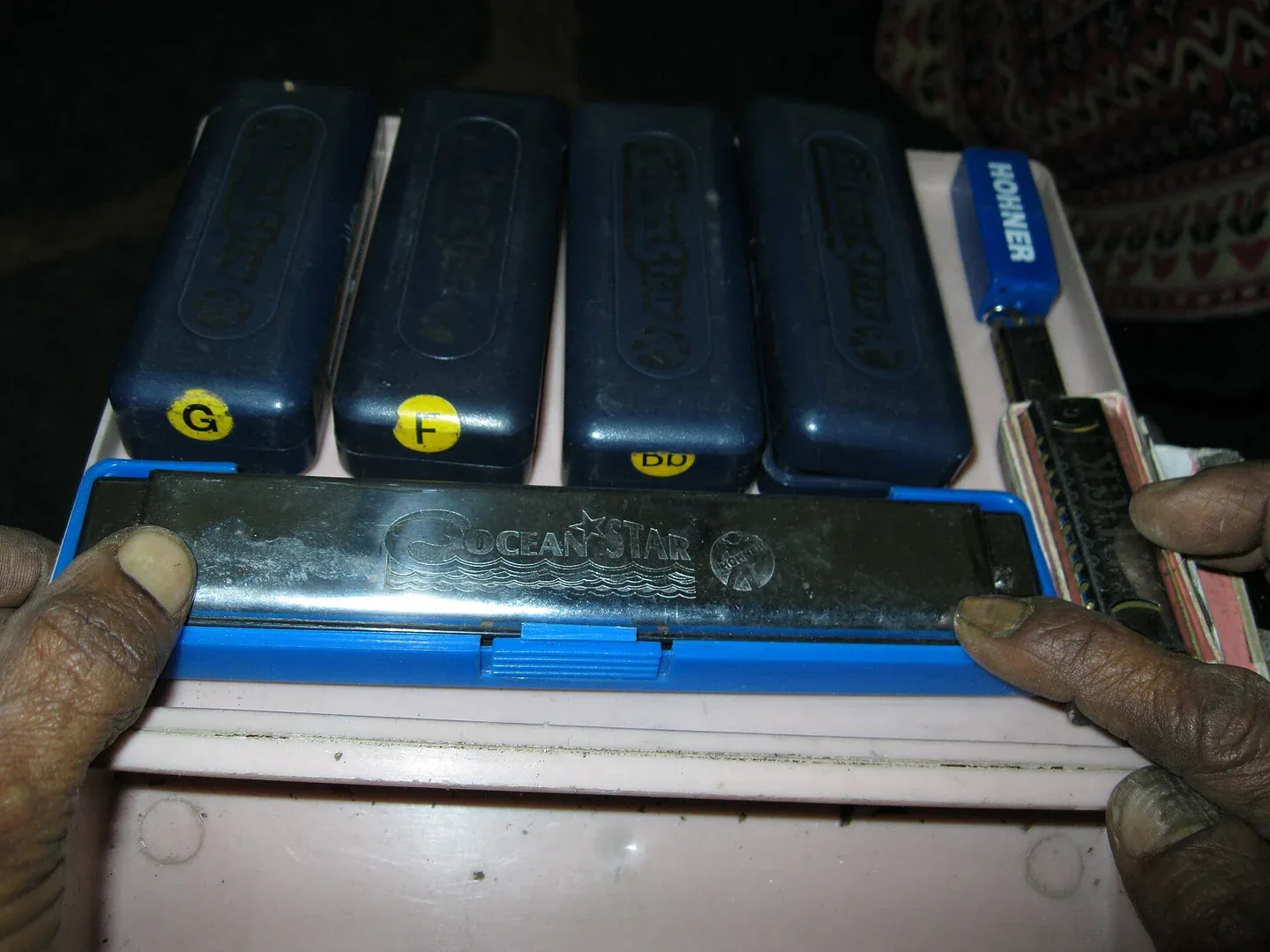
Choose a harmonica display around the instruments you want to see and the ones you regularly play. An open tray, a transparent collector cabinet and a carrying case have different jobs. A historic Hohner shop display is another collectible in its own right, with its own opened footprint.
Keep model, key and instrument type together
Begin with a position list containing each instrument's maker, model and key as marked. Add its tuning or type where documented. Similar cover plates can hide meaningful differences, so a repeated row should still let you identify the instrument without removing several others.
Separate diatonic instruments from chromatics, tremolo models, miniatures and other unusually shaped pieces in your collection. Record the complete outline in the intended position. For a chromatic instrument, include the slide button and any projection beyond the main body; the cover plate's length alone can miss it.
Decide whether each original box stays around the instrument, sits alongside it or is stored elsewhere. A closed individual box may show the model and key while concealing the harmonica itself. Photograph the relationship before separating an instrument from its packaging, and retain uncertain pairings as uncertain.
Choose continuous viewing or playing access
| Format | Useful purpose | Check before choosing |
|---|---|---|
| Open display tray | A keyed playing group that is easy to identify and retrieve. | Actual resting positions, supports, slide projections and the route to each instrument. |
| Transparent cabinet or cover | A collection intended to remain visible when enclosed. | Clear cavity, viewing face, contact arrangement and opening around the complete group. |
| Pocketed or divided carrying case | A playing kit with instruments and specified accessories. | Accepted instrument profiles, alternative accessory loads and what remains visible when closed. |
| Historic retail display box | The original shop fixture, its graphics and its presentation mechanism. | The fixture's identity, condition, settled open state and the separate enclosure around it. |
Hurricane Custom Harmonica Cases separates cases, stands, display trays and decorative gift cases. Its home page describes several construction materials and says many cases have an adjustable divider system. Those are useful format choices, but they do not supply numeric receiving dimensions for every instrument or establish a transparent closing front.
HOHNER's FlexCases introduction describes Medium, Large and Extra-Large formats for storage, transport, stage use and travel. Select an exact version for a playing kit. A size name on a transport range does not describe the cavity of a collector cabinet.
Read the Harmo capacity as a particular kit arrangement
The Harmo Pro Case listing at Harmonicaland describes up to fourteen diatonic blues harmonicas in individual pockets. It separately describes lower straps for a twelve-hole chromatic harmonica and a bullet-type microphone, or a sixteen-hole chromatic instrument. A front zipped pocket accommodates accessories such as a cable, tools or tuner.
Keep those lower configurations separate. The sixteen-hole option should not become an additional instrument squeezed beside the twelve-hole instrument and microphone. Likewise, a fourteen-pocket description does not establish fourteen positions for larger chromatics, boxed instruments or every modified model.
The listing broadly names several compatible brands but gives no complete numeric pocket dimensions. Ask about the actual model, its projecting slide and how it is retained. Read the precise construction and opening details with the supplier: the text uses both a vinyl-case description and hard-case wording, so rigidity should not be inferred from a single phrase.
For a room display, establish what the kit looks like when closed. The described pockets and zipped storage do not provide a clear viewing lid. If the case is displayed open, obtain its intended resting arrangement and keep the whole opened footprint available. Follow the instrument maker's post-playing and storage guidance before returning instruments to their selected positions.
A Hohner display box can be the object on show
The following records illustrate two different historic fixtures. Their published overall dimensions describe the objects, rather than a measured receiving cavity. These are attributed records, not measurements taken for this guide.
| Record | Published information | Display question |
|---|---|---|
| Smithsonian nmah_1306708, The Peter Kassan Collection | Stained wood box with three telescoping tiers; wood and metal. Overall sequence 5⅝ × 10 11/16 × 9¼ in; axes are not labelled. | Record the actual fixture and its intended settled state. Overall measurements do not define a receiving cavity or extended footprint. |
| Roadshow Collectibles MUS2E273HAE | Three-compartment folding/stacking display. W11¼ × H5⅞ × D10⅛ in; a separate “Extended” line states 37½ in. | Ask which axis and arrangement the extended figure describes. It is a different record, with no published clear interior. |
Do not transfer one object's dimensions or mechanism to the other because both carry Hohner advertising. An old label's production or sales wording belongs to the artifact record; it is not evidence of current annual sales or a date authentication by this guide.
If the fixture will sit inside another enclosure, include all opened tiers, hinges, advertisement panels and the final support. Establish an appropriate settled configuration for its condition. A specialist may need to assess an old mechanism before it is extended; the purpose of an outline record is not to force the object into a catalogue size.
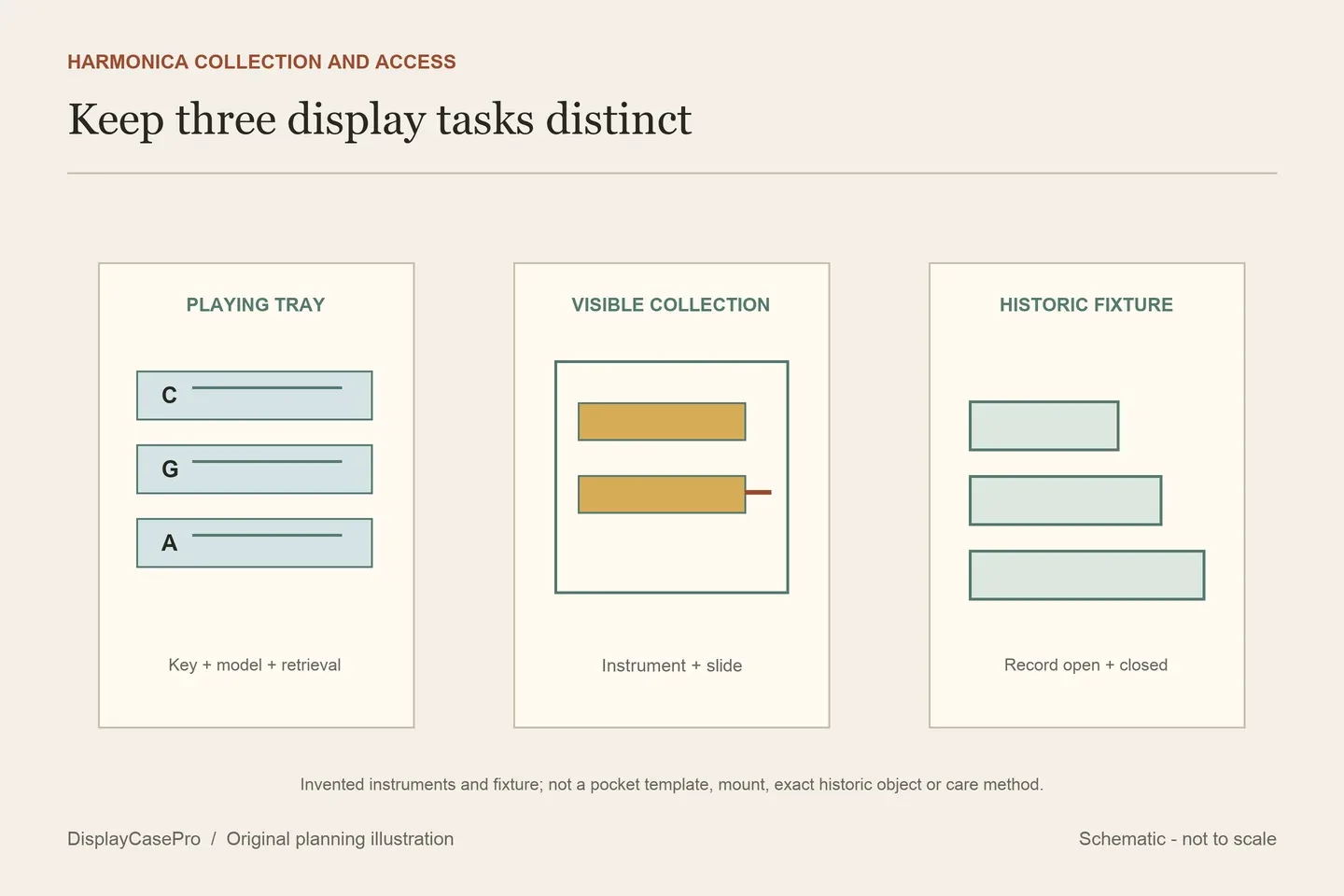
Make the keys readable without hiding the collection
For a playing tray, choose a sequence you can use consistently and record it in a position map. Key labels should remain readable in the intended view. Include the instrument model as well, particularly where you own different tunings or several instruments marked with the same key.
For an enclosed collection, choose whether engraved cover plates, original boxes or a documented set is the main visual subject. Give a miniature or a long chromatic its own suitable position rather than making every item conform to one repeated pocket. Keep separately stored packaging and paperwork linked to the same identifier.
Check how the selected instrument leaves its holder. A neighboring instrument, raised tier or door frame can obstruct that route even when the closed group fits. Use the harmonica collection and access worksheet to record the key, complete outline, original box, use group and retrieval question. The collection measurement guide covers consistent dimensions for the complete arrangement.
Common questions
Will a fourteen-harmonica case hold fourteen chromatics?
The cited Harmo description assigns fourteen pockets to diatonic instruments and describes separate lower chromatic arrangements. Confirm the exact instruments rather than converting one capacity unit into another.
Is a vintage shop display a protective enclosure?
Inspect its actual construction and opening. It may be the collectible you want to exhibit inside a separately selected cover.
Can I use the museum's image because its metadata is CC0?
The Smithsonian record distinguishes reusable metadata from images marked with usage conditions. This article uses a separately licensed collection photograph instead.
Cover photograph: harmonica collection by julian correa, CC BY 2.0. Proportionally resized and converted to WebP; it does not show a compared carrying case. Product descriptions were read on 17 October 2026. No instrument, holder or protective performance was tested for this guide.

Comments
Share a display tip or ask a question.