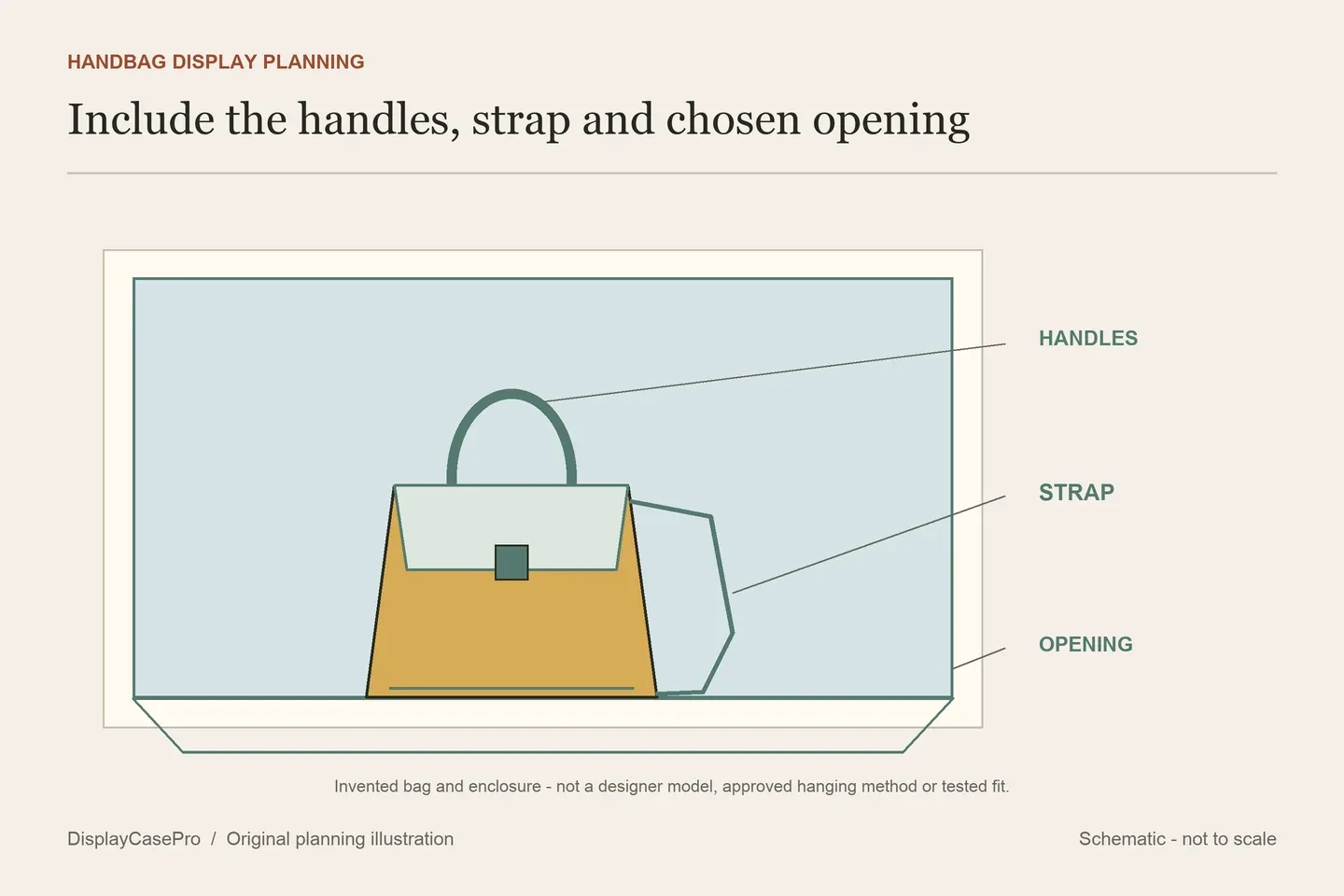
Choose a handbag display case for the bag in its intended supported shape, including handles, straps and projecting fittings. A structured bag, a small crossbody and a clutch can need different floor areas and openings. A display box's outside dimensions or a list of suggested designer styles does not establish fit for your individual bag.
Include the handles and the actual base position
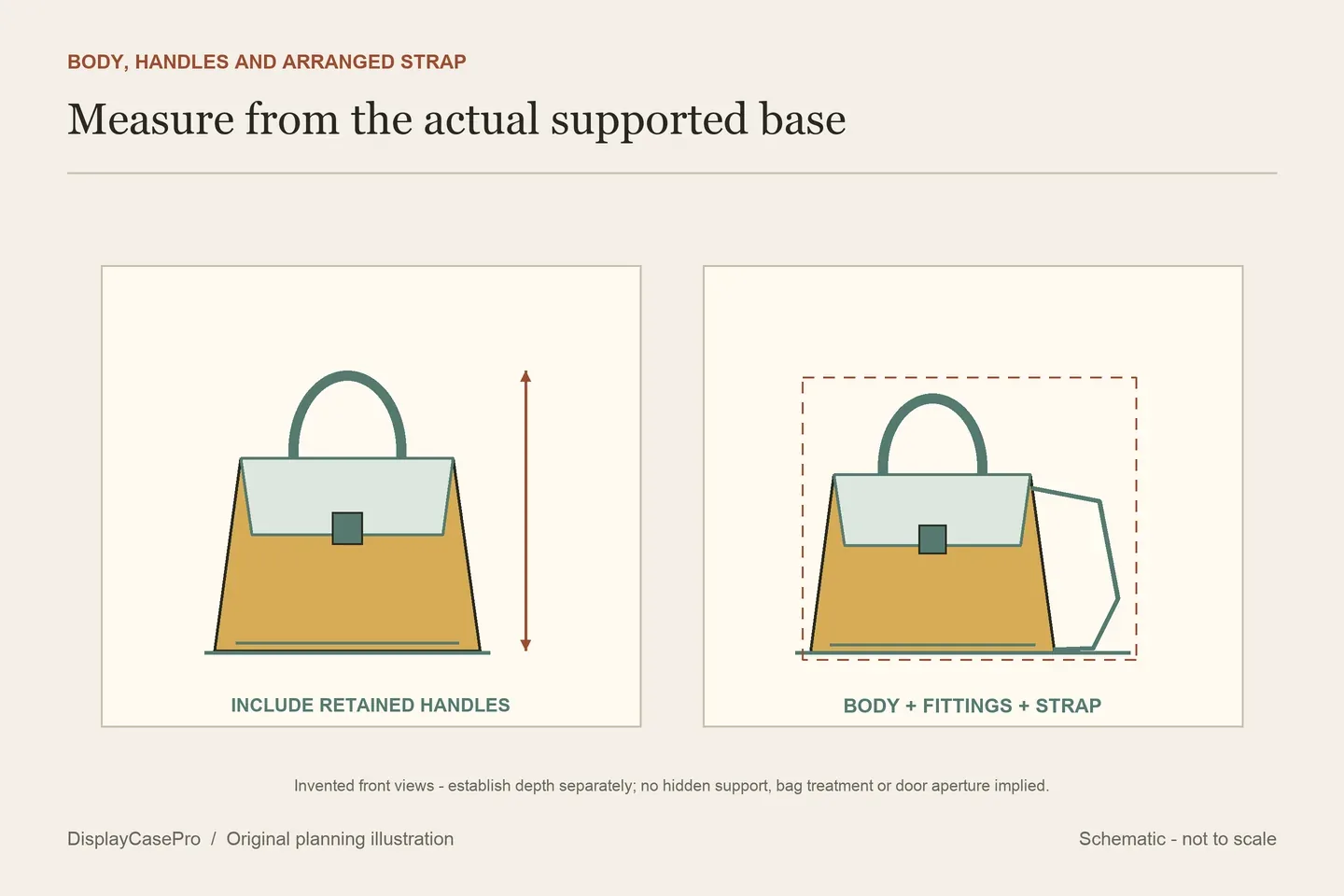
Place the bag in the condition and supported arrangement you intend to show, following the bag maker's guidance. Record the highest retained handle or fitting, the widest point and the front-to-back extent. Keep an attached chain, charm or strap in the measurement if it stays visible.
A bag's catalogue body height may stop below a handle. A flap, clasp or other feature can also project beyond the main body. Record those parts separately so an apparently generous case height is not used up by an unmeasured handle.
For a soft bag, establish the intended support before choosing the enclosure. A silhouette pressed against a clear panel is not a supported resting shape. Do not fold or compress the bag simply to match a product's suggested style list.
For a clutch or wristlet, decide whether it lies flat, stands in a compatible holder or forms part of a group. A holder changes the complete depth and height. A wrist strap laid beside the clutch also occupies space and needs to remain clear of the closing front.
An open handbag stand is a different choice from a clear enclosure
| Arrangement | Format | Check |
|---|---|---|
| One bag with a supported base | An individual clear enclosure. | Usable floor area, retained handle height and opening. |
| A bag shown at a selected hanging height | A purpose-made open handbag stand. | Approved contact arrangement, loaded outline and stand footprint. |
| Several clutches or small bags | Separate holders or divided supports. | Each item's supported depth and the actual space between positions. |
| A larger mixed collection | A glazed cabinet with suitable individual supports. | Clear shelf areas, complete contents' weight and independent removal routes. |
Store Displays' handbag category includes clutch supports, curved bars, U hooks and L-shaped stands. Those fixtures provide different receiving shapes, rather than one interchangeable handbag mounting method.
Palay Display's purse category likewise mixes adjustable stands, clutch displayers and retail security accessories. A security retractor is not a base support or proof that the bag is suitable for long-term hanging. Choose the support function separately from a retail tether.
IKEA's display-cabinet category offers a broader furniture route. Product size headings do not provide clear shelf dimensions or establish a handbag count. Obtain the actual receiving space, shelf conditions and installation instructions for the chosen cabinet.
Keep exterior size, approximate interior and actual bag fit separate
These product descriptions were read on 17 October 2026. Neither enclosure nor any designer bag was physically tested for this comparison.
| Case | Published information | Decision still needed |
|---|---|---|
| Luxury Bag Display C Medium, LBDMCM | Outside L31 × H24.2 × D13 cm. Maker says inside dimensions are approximately 6 mm less than outside. | Confirm the actual receiving space, handle and strap arrangement, lid operation and any intrusion. |
| The Container Store Luxe Acrylic Handbag Case, 10106911 | Exterior L11½ × W16 × H9 inches, explicitly including handles or rims; drop-front opening. | Request clear internal axes and the aperture with the front open. Outside dimensions are not usable bag dimensions. |
The C Medium's approximate six-millimetre difference is the maker's general interior statement, not an exact measured cavity or door aperture. Keep its approximate qualifier and original axes. Do not use arithmetic alone to approve a close fit around a retained handle or raised clasp.
Luxury Bag Display also publishes a suggested bag-style list. Its own disclaimer says it does not have all those bags on hand and has compiled measurements from bag-store websites; it advises measuring your own bag. A familiar model name in that list is therefore a lead to investigate, not a delivered-item fit test.
The Container Store page explains its UV-resistant acrylic in terms of resisting yellowing. That material claim does not independently establish how much UV reaches a bag through the complete case. Keep the case's appearance claim separate from any object-protection requirement.
Neither a clear enclosure nor an included desiccant establishes the storage conditions required by every leather, textile, lining or decorative fitting. Follow the relevant bag maker's guidance and resolve special material or condition questions before selecting the location. This guide does not prescribe moisture-control or desiccant-recharging procedures.
A strap hook does not settle the support of the whole bag
The C Medium description identifies hooks under the lid for hardware such as straps, along with a lift-off lid and handles that also serve as ventilation windows. Confirm what those hooks are intended to carry and how accessories sit while the bag's base remains in its planned position.
Do not assume that an accessory hook is approved to suspend the full bag. Likewise, a retail purse stand's height range does not establish the load or contact suitability of the bag's handle. Obtain the exact intended arrangement from the support and bag makers.
Palay's category gives its curved-arm stand 4220 a 4¾ × 6¼-inch base and a 14–26-inch height range. Those figures describe the fixture. They do not give the complete bag-and-stand outline, the length of a handle drop or an enclosure's required height.
Its clutch displayer 2817 is listed as W4 × D12⅜ × H7⅝ inches, with positions spaced 2⅜ inches apart and a nominal limit of four items. Keep the overall fixture, stated spacing and your actual clutch profiles separate. Four differently shaped bags are not verified merely because the empty holder has four positions.
Choose the opening around the way you use the bag
A lift-off lid needs a clear upward route and somewhere suitable to rest it. If a strap uses a fitting under that lid, establish the intended opening sequence before lifting. Do not discover that relationship while the cover is already moving.
A drop-front opening needs space in front of the box and an aperture that admits the complete supported bag. The 9-inch outside height of the Luxe case is not a measurement of that opening. Check the actual handle and front clasp against the receiving route.
For a bag used often, plan a clear working surface for removal and return. For a collection, give each bag a position and a linked record for detached straps or original packaging. A return position is more useful than squeezing the bag into an unassigned gap between two larger cases.
Plan repeated enclosures from their full outside footprints only after fit is settled. Follow the chosen product's instructions for placement and any permitted stacking; similar-looking boxes do not establish compatibility with one another. Confirm that neighbouring units leave each front or lid accessible.
The bag, support and opening worksheet keeps handles, accessories, approximate specifications and unresolved fit questions together. The collection measurement guide covers the wider location check. Transparent panels, a style list or an open stand do not by themselves certify preservation or protection performance.
Common questions
Does a suggested designer-bag list prove fit?
Check the source's qualification and measure the actual supported bag. The cited C Medium list explicitly uses third-party bag measurements and does not claim to have every model on hand.
Can I ignore the handles if the bag's body fits?
Include the handles in the intended display state. A catalogue body measurement can omit the highest retained part.
Is a stand height range the required case height?
It describes the stand, with its own reference. Establish the complete bag-and-support outline and the opening separately.
Comments
Share a display tip or ask a question.