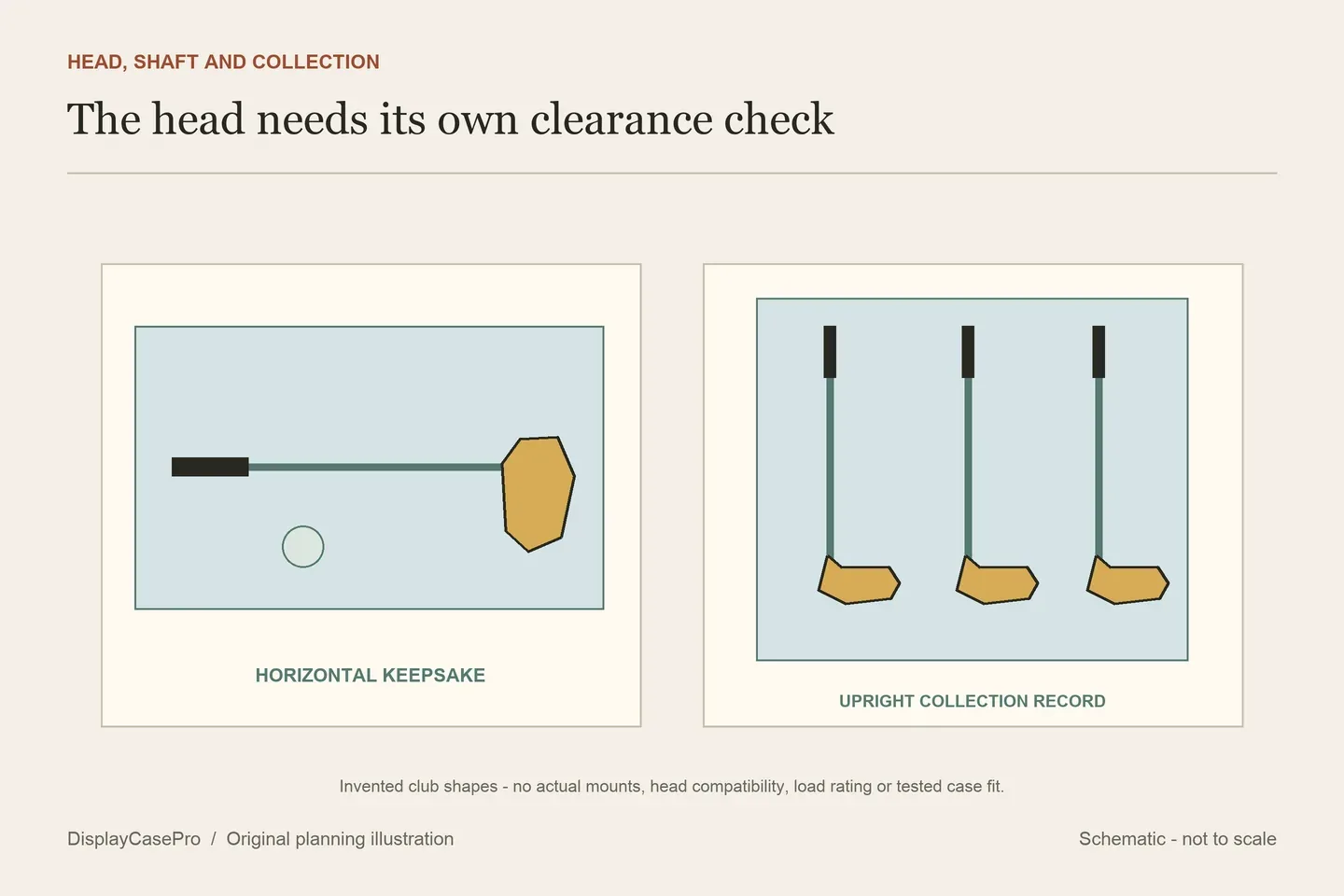
Choose a golf club display case by the club head's projection, the supported shaft and the way you want to see or remove the club. A horizontal keepsake cabinet, an upright collection cabinet and an open rack solve different jobs. Start with the actual club and its story, then check the maker's club-length limit, receiving dimensions, supports and opening together.
Separate a keepsake enclosure from equipment storage
A signed putter, an inherited wooden-shaft club and a current playing set need different handling and viewing plans. Decide whether you want one settled presentation, a visible collection or equipment you remove regularly. That decision narrows the format before finish and lighting enter the comparison.
| Format | Useful arrangement | Key check |
|---|---|---|
| Horizontal keepsake cabinet | One or two clubs with a ball or caption alongside. | Head depth, grip projection, intended mounts and the full supported length. |
| Upright collection cabinet | Several clubs in defined shelf or notch positions. | Actual club-length limit, head spacing and extraction from each position. |
| Open home rack or mounting board | Visible clubs with convenient access. | Intended contact surfaces, retention and complete projection into the room. |
| Retail merchandising fixture | Repeated sets, customer selection and product labels. | Fixture interface, club type, floor footprint and circulation; not an enclosed cavity. |
Great Golf Memories' collection illustrates that spread: floor displays, putter stands, horizontal framed displays, mounting boards and shadow boxes appear together. Its 42- and 48-inch options are nominal product choices, not confirmed clear lengths for every format.
If the reason for keeping a club is a particular signature or an inherited grip, make that feature visible in the layout. An open rack organized for regular play can show equipment clearly while giving less attention to one small inscription. A case selected for a keepsake should have a planned sightline to the detail that matters.
The head creates a depth problem that shaft length cannot answer
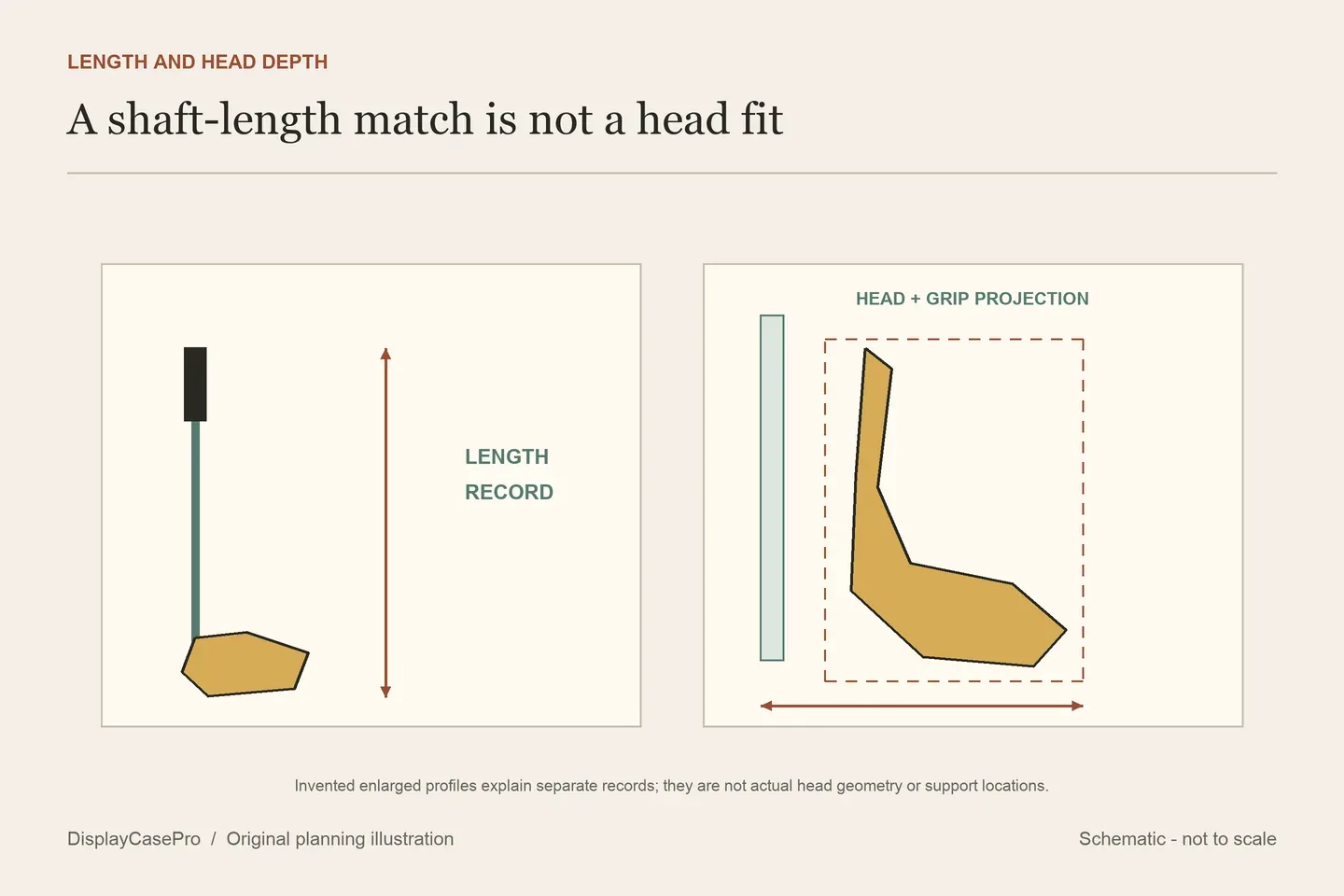
Record the club in the intended pose, including its complete head, hosel, shaft and grip end. A club lying against a wall has an offset head and a projecting grip, not the profile of a simple straight rod. Check the deepest point from the actual support surface toward the cover.
Identify the head type and handedness in the record. A driver, iron and putter should not inherit one another's support assumptions. For an unusual putter head or a club kept in a headcover, include that actual outline rather than using a generic silhouette.
Ask where the intended mounts contact the club and what materials touch it. A decorated shaft, signed grip or fragile inherited club may have a contact restriction that a general-purpose rack does not address. Do not clamp, refinish or replace a grip merely to make a display system fit.
For a horizontal arrangement, record both the club's long dimension and the head's projection in the chosen orientation. Turning the face toward the room can change the required depth even though the club's overall length stays the same. Include the support in that combined profile.
Keep the maker's club limit beside the cavity dimensions
These two enclosed examples come from sfDisplay's golf collection. Their individual descriptions were read on 17 October 2026. They are model-specific published information, not measured fit approvals.
| Cabinet | Published space and contents | Limit to retain |
|---|---|---|
| dc3202, 1–2 clubs | Inside W44 × H10 × D3.25 inches; outside W45 × H11 × D4 inches. Two sets of club mounts and one movable ball holder; front-opening door. | Maker says up to two 44-inch clubs and a ball. Confirm the actual supported heads and entry route. |
| dc3205, upright collection | Inside H44.5 × W16 × D4.25 inches; outside H45.5 × W17 × D4.75 inches. Evenly notched shelf and front-opening door. | Maker says up to ten clubs, up to 44 inches long. Nominal count does not confirm every head arrangement. |
The dc3202 description puts a 44-inch club limit beside a 44-inch interior width. That is not an invitation to treat an exact numerical match as a universal fit. Ask which mounted orientation the description assumes, how the head sits and how the club passes through the opening.
The dc3205's 44.5-inch interior height does not expand the stated club-length limit to 44.5 inches. The maker still describes clubs up to 44 inches. Keep the notch position, grip/head orientation and actual extraction route in the decision instead of replacing the product limit with the cavity height.
Both dimensions sets distinguish interior from exterior. The larger outside depth belongs in the room-placement record; it is not available clearance for the club head. A UV-rated cover statement also does not establish contact suitability, support strength or protection from every cause of deterioration.
Several club heads need their own arrangement
Lay out the intended club order on paper using each club's actual record. Decide whether the heads should align, alternate or follow a documented set sequence. A repeated shaft spacing can look orderly while two larger heads overlap or conceal the important face.
For the two-club cabinet, keep the ball and its holder inside the combined plan. A ball position that works with one club may occupy the place needed by the second head. Movable does not mean that every position remains compatible with the mounts or door.
For an upright cabinet, check each intended position rather than dividing the inside width by ten. The notch layout and usable head room are product-specific. Also establish how one club can be removed without catching an adjacent head, grip or caption.
Retail rack capacity is not keepsake case capacity
DGS Retail's golf fixtures include slatwall or gondola racks for eight or nine irons and four or five drivers or hybrids, plus much larger mobile displays. Those counts describe merchandising formats; they do not describe how many clubs fit behind a protective door.
Barr Display's club category similarly includes putter racks and wood or iron spines for slatwall. Check the required wall system and intended club type. A slatwall attachment is not automatically a complete wall-mounted display for an ordinary room.
Palay's retail fixtures include the SKU 8462 oversized-driver display, listed at H33.5 × W23 × D18 inches for twelve drivers. That is an open merchandising fixture size and capacity claim, not an enclosed interior or proof of fit for twelve particular clubs.
For a room at home, consider the fully loaded outline, walking space and the intended removal direction as well as the rack's base. Keep the actual maker's fixing and support instructions with the selected product. This guide does not substitute another rack's hardware or a generic wall-load calculation.
Use the club head, shaft and case worksheet to connect each club with its support, limit and position. The collection measurement guide covers the complete occupied outline and receiving location.
Common questions
Will a long enough cabinet accept any golf club?
No. Check the head depth, grip, support interface, opening and the maker's club-length limit as well as the long dimension.
Does a ten-club case accept every combination of ten clubs?
The count alone cannot answer that. Confirm the actual heads and intended notch positions with the maker.
Is an open golf rack a display case?
It can display clubs, but it provides a different physical format from a covered cabinet. Choose according to access, presentation and enclosure needs.
Comments
Share a display tip or ask a question.