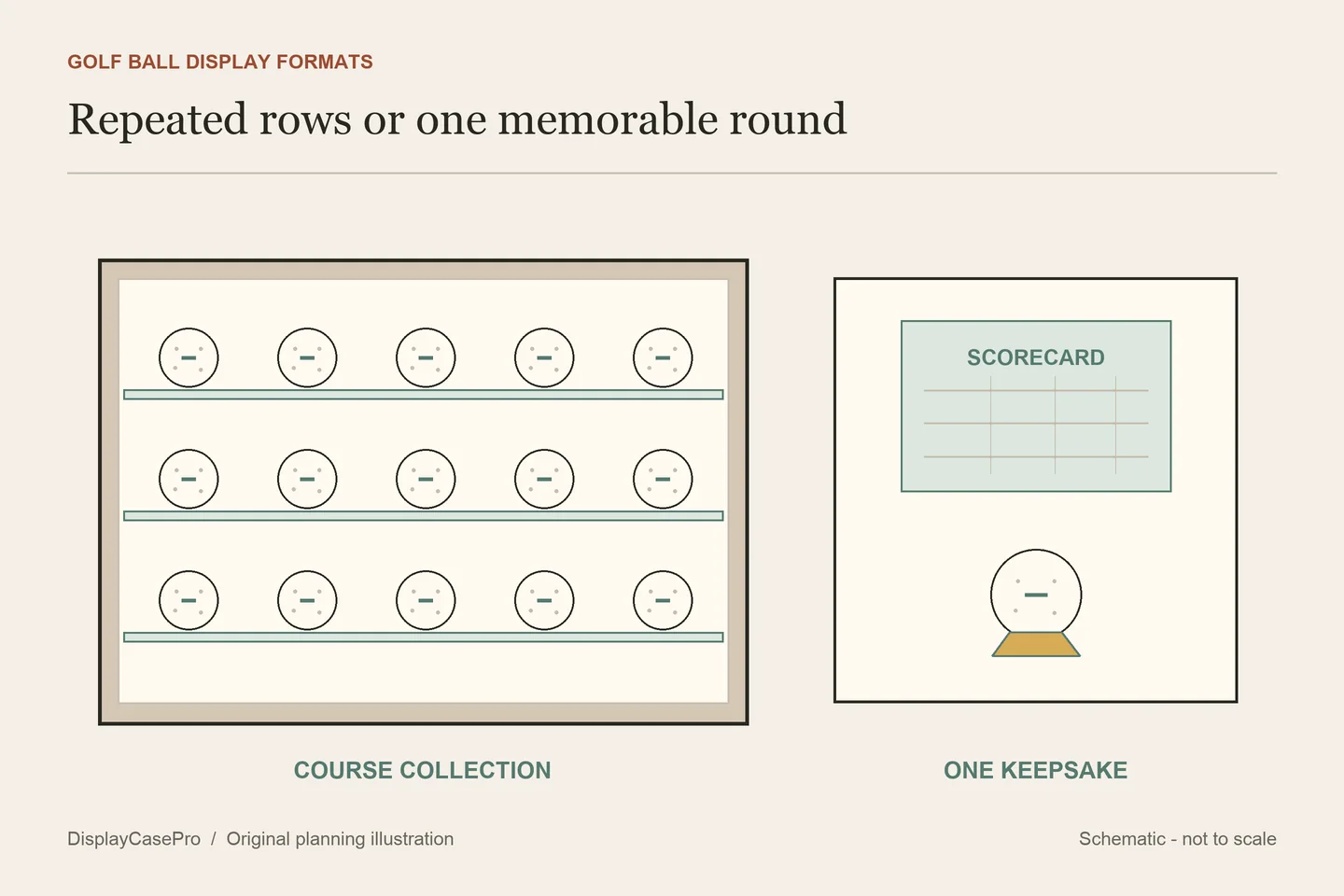
A good golf ball display makes the logo or memory easy to find and keeps each ball in its assigned place. Start with the story you are collecting: courses played, a special round, signed balls or a growing run of souvenirs. That choice determines whether you need one generous compartment, repeatable rows or a small display you can rearrange.
Four golf ball display case ideas, matched to the collection
1. Give one memorable ball its own compartment
A first hole-in-one, a family round or a ball associated with a particular event can carry a display by itself. Place the ball on a holder that supports it without obscuring the important face. Add a short caption with the course, date and the reason you kept it. A small case feels complete when the information belongs to the ball, even if there are no other objects inside.
If you want to include a scorecard, choose that format from the beginning. The card needs a separate support, readable orientation and room of its own; folding it behind the ball may hide the detail that makes the display meaningful. Preserve the original card and use a clearly identified copy for display when that better suits its condition or your handling needs.
2. Use repeatable rows for course-logo balls
Rows make a growing course collection easy to browse. Choose an order you can maintain: trip, region, alphabetical course name or date played. Face each logo toward the usual viewing position. Leave intentional gaps for missing items only when those gaps explain a series; otherwise, keep an overflow list and move to a larger arrangement when necessary.
A wall cabinet can keep many balls visible in one shallow plane. Check whether the lowest and highest rows are readable from where you stand, and whether a shelf edge covers part of the logo. A large advertised count is less useful when the display hangs too high to identify the upper rows.
3. Build a small group around a trip or event
Group a few related balls with one heading, such as a trip name or year. A tabletop case can suit a collection you want to see close up. Individual holders let you angle the faces, while a shared enclosure keeps the group visually together. Use a separate caption strip rather than repeating a long description beneath every ball.
Keep loose tees and markers in their own defined area. They should not act as packing material that happens to stop the balls moving. If the collection includes a signed ball, place its inscription where it can be seen without routinely turning it by hand.
4. Choose an open rack for an informal, changing collection
An open rack gives quick access and can suit ordinary souvenir balls you frequently rearrange. It also leaves the contents exposed to room dust and accidental contact. Decide whether that trade-off is acceptable before choosing the look. A rack positioned beside a busy desk or door needs more consideration than one in a quiet alcove.
DIY racks can use purpose-made ball seats or a designed tee arrangement. Check the support with the actual ball before copying a pattern: tee shape, spacing, material and fixing method all affect the result. A photograph of a successful rack does not establish a universal drilling layout or wall fixing.
Choose how each ball stays in place
A golf ball can roll even when a shelf appears level. Look for an intentional seat, holder or retention feature rather than relying on an arrangement of neighboring objects. The support should also leave the logo, inscription or number visible.
| Support route | What to check | Layout consequence |
|---|---|---|
| Recessed ball seat | Seat shape, ball size, contact area and removal clearance | Positions are usually fixed; confirm logo visibility in each row. |
| Separate cup or holder | Base stability, total height and compatibility with the surface | Flexible positions, but the holder consumes space too. |
| Designed tee support | Number and position of supports, secure mounting and actual ball retention | Useful for an open design; requires its own verified construction. |
| Ball inside a protective cube | Complete cube dimensions, lid access and shelf fit | A cabinet advertised for bare balls may hold fewer enclosed cubes. |
Do not glue a signed or personally important ball into position simply to solve a rolling problem. Choose a compatible support and establish how the ball will be removed. Do not assume putty, adhesive pads or a felt lining are harmless to every printed or signed surface.
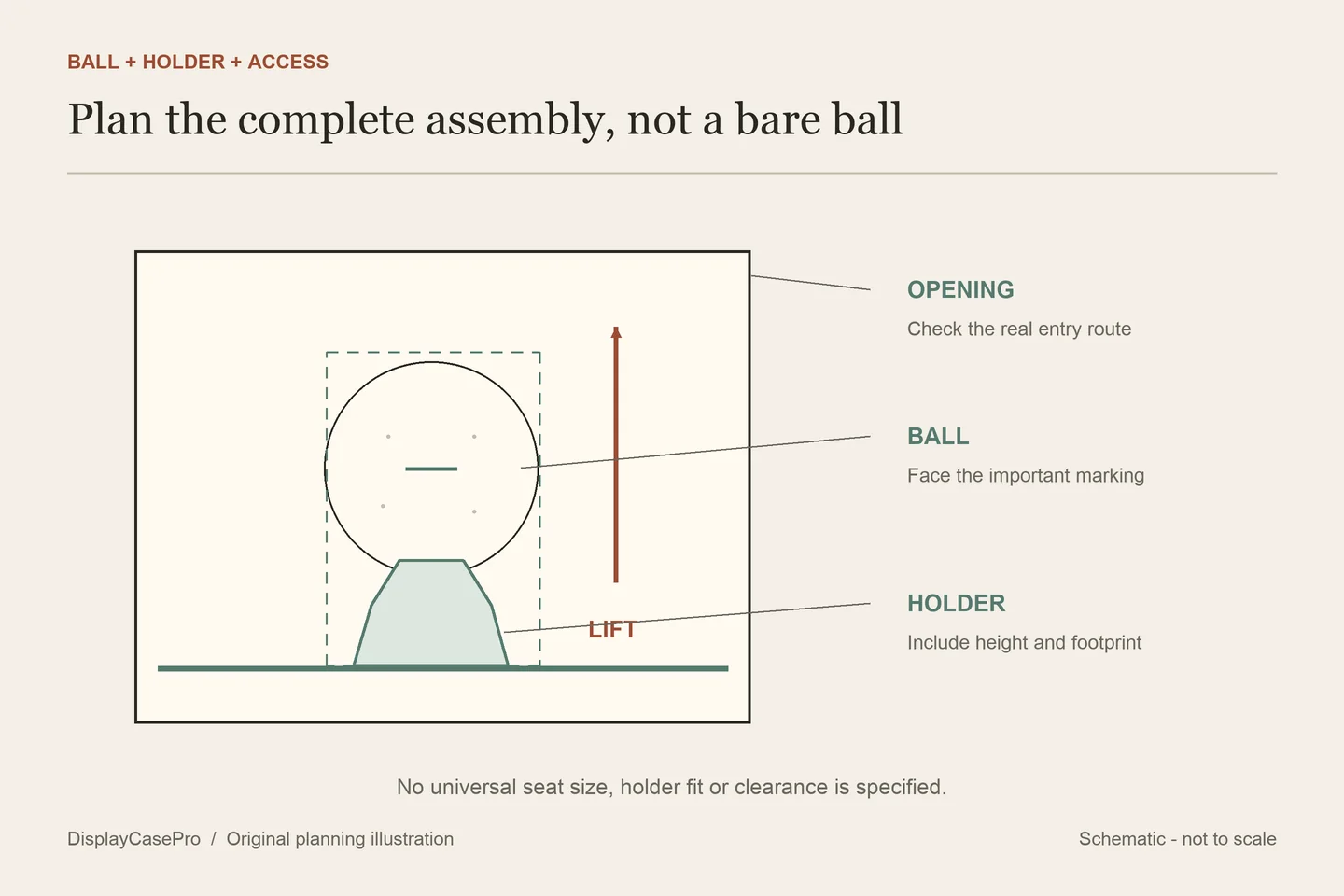
Read the ball count and the dimensions together
For a concrete example, SF Display's 70-ball cabinet listing describes ten shelves with indentations for the balls. It lists a 2-inch interior depth and 2-inch shelf spacing. These are that model's published figures, not measurements we have taken. Its ball count describes the intended arrangement of balls; it does not confirm space for seventy separate cubes, tall tee holders or your labels.
The USGA equipment rule on size specifies a minimum diameter of 1.680 inches, or 42.67 mm. That minimum is not an exact dimension for every ball in a collection. Measure your actual items, especially if the collection includes novelty balls or objects inside holders. Keep inches and millimeters clearly labeled when comparing specifications from different markets.
- List the balls you want visible now and identify any that need separate enclosures.
- Measure a representative ball-and-holder assembly, plus any larger exception.
- Obtain the usable internal dimensions and the shelf or compartment arrangement for the exact case model.
- Check labels, shelf lips, hinges and door movement against the proposed positions.
- Allow a practical way to lift out one ball without dislodging the adjacent row.
Use our collection measurement guide for recording the complete envelope. Keep the cabinet's outside measurements separate from its usable ball positions. Neither a wall footprint nor a claimed capacity tells you the other.
Make a collection map before filling every position
A grid can be visually tidy and still be difficult to maintain. Give each ball a record number and each display position a location, such as shelf B, position 3. Your record can hold the full course name, location, date played or acquired, and the reason the ball belongs in the collection. Record uncertainty rather than assigning a date or event from memory as a fact.
For a course collection, the visible label may need only the course and year. A keepsake ball may deserve a longer caption. Use the same text style within a group, and check that it remains readable through the closed door. A number on a label should link to the record even after you move the ball to another row.
Try the arrangement with paper position cards before loading the case. This makes it easier to see whether alphabetical order leaves awkward gaps, whether one trip should occupy a separate row, and where a new addition would go. Do not buy empty capacity merely to meet an arbitrary growth percentage; base it on how your collection actually changes.
Download the blank golf ball collection and display worksheet. It includes ball identity, support, displayed face, position, caption and unresolved fit checks.
Check the case with its door closed and its door open
With the door closed, look for reflected windows or lights across the logo rows. Move the proposed location or adjust the viewing angle before adding brighter lighting. Direct sunlight is a poor default for a collection containing inks, signatures and paper captions; a transparent enclosure is not evidence that all light exposure has been addressed.
With the door open, check its swing and your access to the end positions. A right-opening door may interfere with a nearby wall or furniture. A tabletop cover needs somewhere clear to lift and place it. Wall installation must follow the case instructions and suit the wall construction; do not choose a fixing from the number of balls alone.
Finally, photograph the loaded arrangement for your own records and make sure every ball still has an identity when it leaves the display. Clean the empty enclosure according to its maker's guidance, keeping cleaning products away from the collection.
Common questions
Can I use a shot-glass cabinet for golf balls?
Possibly, but its original purpose does not establish ball retention. Check the actual internal spaces, a suitable ball support, shelf loading and access. A flat compartment that holds a glass upright may still let a ball roll.
Should the logo face straight forward?
Use the face that carries the information you want to see. Check it from the usual viewing height, then adjust the support without forcing or marking the ball. Keep a record of other significant markings that the display hides.
Is a larger cabinet always the better choice?
No. A small, coherent group with readable captions can be more useful than a crowded wall of balls. Choose enough positions for your intended arrangement and a realistic next step for additions, while keeping the case accessible.
Comments
Share a display tip or ask a question.