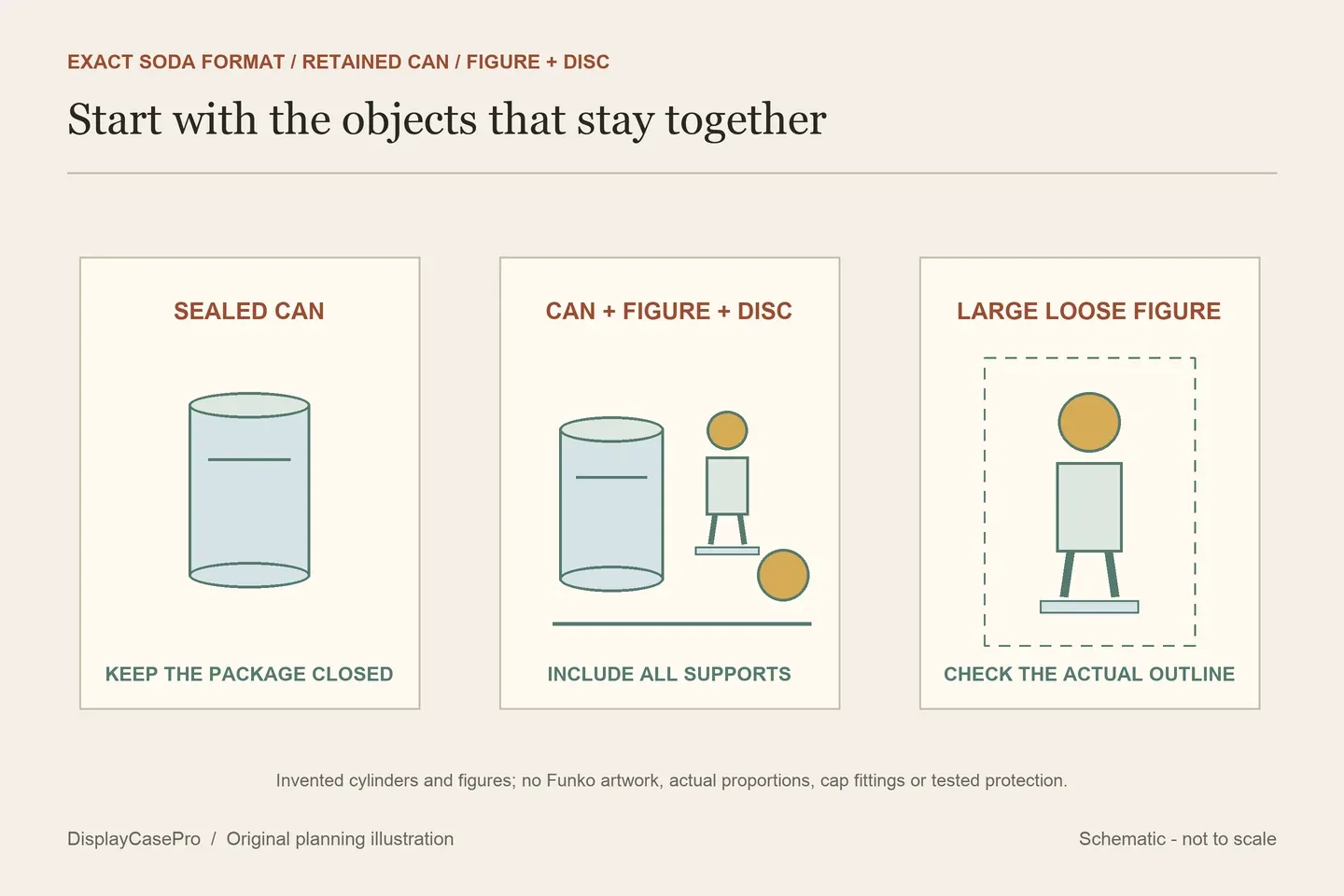
Choose a Funko Soda display case by deciding what stays together: the sealed can, a can with its figure and character disc, or a loose 3-liter figure. A disc cap, a cardboard tray and an enclosing acrylic cover solve different problems. Identify the format before applying a familiar Pop box size or a nominal twelve-position capacity.
Keep the can, figure and disc as separate objects
Start with the full release name and whether it belongs to the larger 3-liter format. Write down whether you will keep the can closed, show a loose figure beside it, or display the character disc above the lid. Include any retained outer protector and the support for the figure.
A can-top accessory does not automatically receive a figure, and a cover for a large loose figure does not automatically receive its original packaging. If keeping the can sealed matters, make that a requirement before choosing a layout. A product photograph showing loose figures is not a reason to open your own collection.
Also decide which faces should remain visible. The disc, can artwork and figure can compete for the same front view. Place the intended group on a paper plan with room to reach each supported item, rather than treating the can diameter as the whole display footprint.
Five source pages describe more than one kind of display
Product descriptions were reviewed on 19 October 2026. Funko’s cap description comes from a source snapshot reported as crawled two months earlier, so confirm compatibility, contents and instructions for the product currently offered. DisplayCasePro has not physically tested these products for fit, UV filtering, dust exclusion or load.
| Source | Observed format | Check for your collection |
|---|---|---|
| Display Geek | A stationary acrylic cover for a loose 3-liter figure. | The actual figure and support, not another box or can. |
| Undiscovered Realm | Can and figure catalogue with a separate coaster/protector combo. | The exact accessory leaf and its supplied components. |
| Funko 64932 | A four-pack of can-top disc caps. | Cap compatibility and disc position; figure excluded. |
| MK Kubbies | A corrugated-cardboard rack with twelve can/pog tray inserts. | Units, usable bay, figure placement and wall instructions. |
| BrickShell Cases | A broader Pop case and open-stand collection. | Selected receiver; Pop capacity is not SODA compatibility. |
Display Geek explicitly says the selected cover is made and shipped by Flying Box. Keep that relationship with the product record; these names would not provide two independent fitting tests. The catalogue and accessory pages likewise should not be counted as five interchangeable enclosing cases.
Two size strings still leave important fields unresolved
| Receiver | Read size record | Missing definition |
|---|---|---|
| Display Geek loose 3-liter figure | 8.5h × 5.5w × 5.5d. | No explicit units or inside/outside boundary in the read text. |
| MK Kubbies SODA rack | 21 × 20.5 × 4. | No stated units, axis labels or usable bay dimensions. |
| Funko 64932 disc cap | No numeric cap or slot dimensions established. | Exact can-top and disc compatibility. |
| Realm coaster/protector combo | No numeric clear receiving dimensions established. | The complete can/figure/disc arrangement inside its protector. |
| BrickShell Pop collection | No SODA-specific receiving size established. | Exact product and complete supported SODA outline. |
Do not silently turn the first two sequences into inches or clear interiors. Display Geek separately identifies 3 mm acrylic, but a material unit does not define the unit used for a case-size string. Ask for a labelled drawing before making a shelf or wall template.
The 3-liter name is also a product-format clue, not a measured outline for every loose figure. Record the widest prop, tallest feature and retained support of the figure you actually own. For a protected can arrangement, measure the finished protector as a second furniture-fitting object.
A disc cap and a coaster/protector combo have different jobs
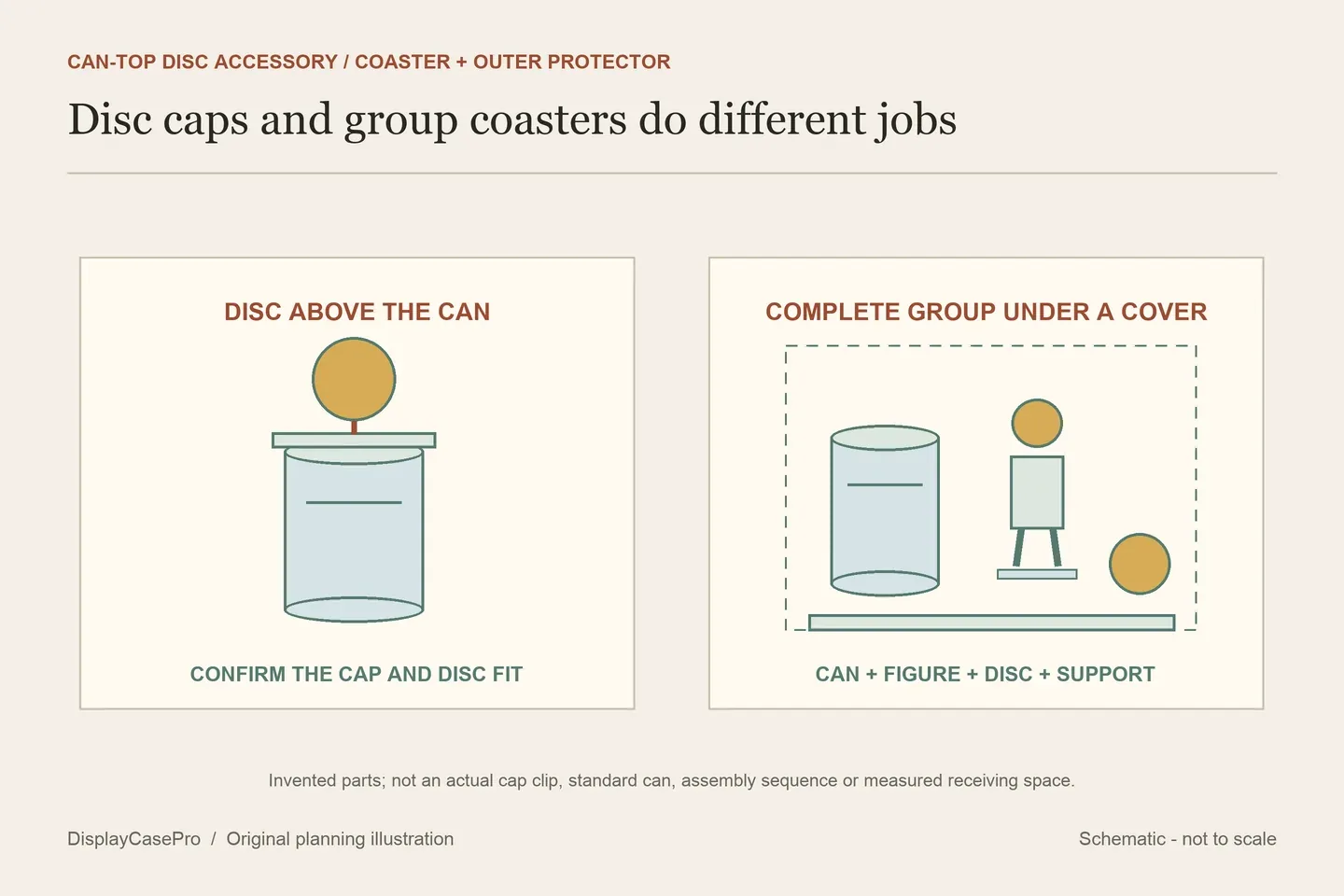
Funko’s 64932 description identifies a cap that attaches to the top of SODA can packaging and presents the character disc in a slot. It does not establish a figure platform, an enclosing front or compatibility with every larger can. Keep the cap’s intended task narrow when comparing accessories.
The observed Realm combo leaf describes one coaster and one outer protector for a can, figure and pog arrangement; SODA collectibles are excluded. Obtain the usable space and intended loading method for that whole group. Its stacking language supplies no numeric loaded limit for your proposed tower.
Twelve trays do not define every figure position
MK Kubbies describes hard corrugated cardboard with a semi-gloss varnish, an unassembled rack and twelve assembled Soda Tray inserts. The cutouts are described for the can and pog. Confirm where the figure belongs and whether the complete arrangement clears the bay above it.
The rack description does not establish a clear enclosing front. A cardboard display and an acrylic surround therefore belong in different protection and access records. Retain the actual rack material, selected quantity and supplied inserts rather than assuming that everything called a case is a clear box.
For a wall layout, obtain the product-specific mounting instructions and suitability for the actual wall. Recommended 3M hardware is not a universal loaded approval. Keep individual removal practical when a can, figure and disc occupy separate positions.
Choose the opening routine and check protection claims separately
Display Geek’s loose-figure cover uses screws and corner blocks. Ask which component is intended to open during normal access; the flat-pack assembly method alone does not answer that question. Keep space for the figure’s full supported outline to pass the opening.
Its UV percentage, and the broader Pop collection’s sunlight or dust language, are supplier statements rather than comparable tests here. A UV-printed rear and a transparent panel do not by themselves establish whole-case filtering. Choose the location and actual enclosing components before treating an accessory as protection.
Use the SODA format and receiving worksheet to retain the missing units, components and instructions. The collection measurement guide covers consistent complete outlines.
Comments
Share a display tip or ask a question.