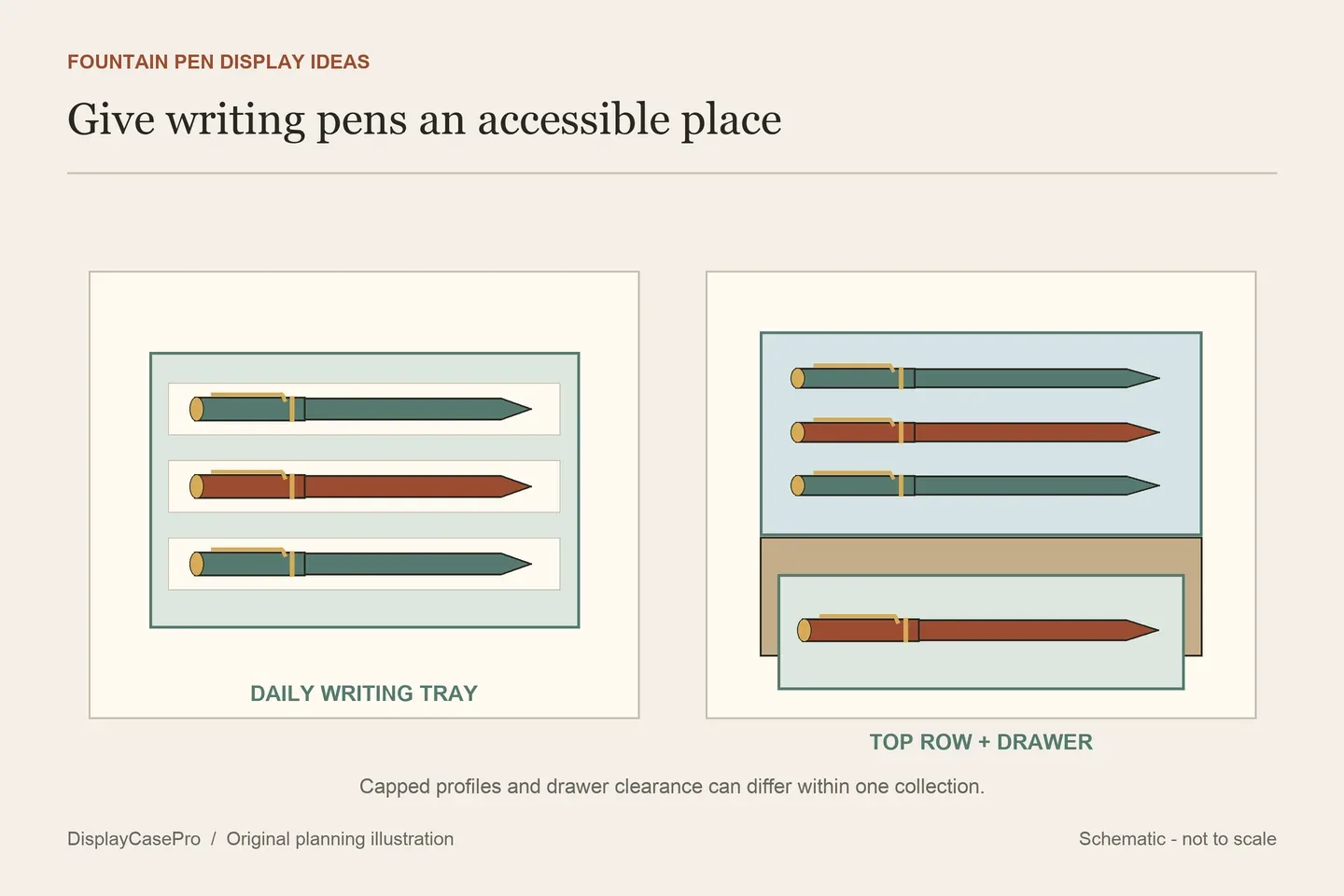
Useful fountain pen display ideas start with how you use the collection. Keep a small writing group easy to reach, give the larger collection separate identified positions, and choose a cover or drawer arrangement that accepts the complete capped pens. A long slot, a soft-looking liner or a high pen count does not answer all three needs.
Start with the pens you reach for
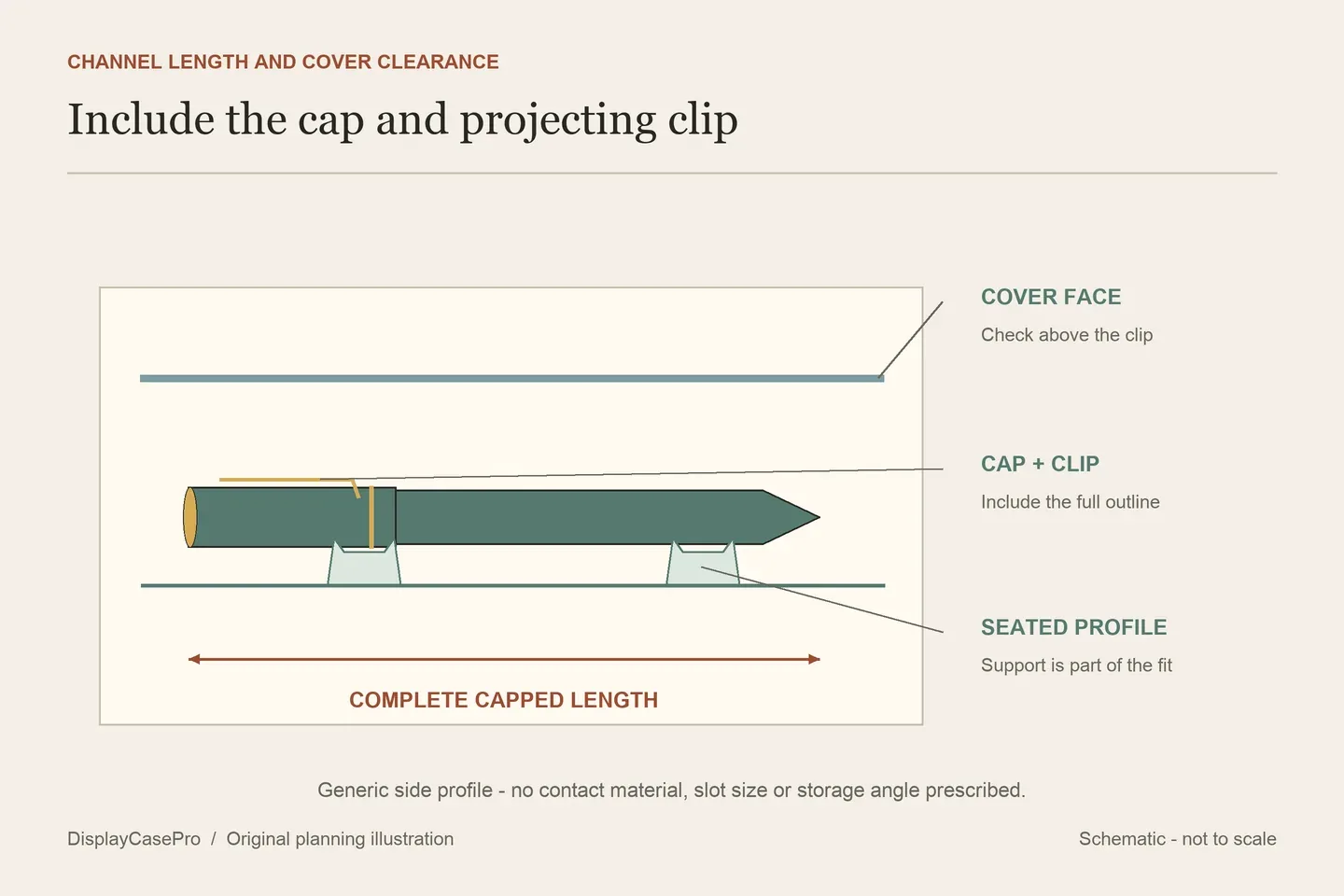
Identify the actual pen model and the position in which it will be displayed. Record the complete capped length, widest section, clip projection and any unusual end shape. The longer posted length used while writing describes another configuration; it should not silently replace the capped package when choosing a storage tray.
Keep display position and ink-care requirements connected. Follow the individual pen maker's instructions for an inked or unused pen. If that guidance requires a position the proposed tray cannot provide, choose a different arrangement. A collection photograph does not establish suitable storage for every filling system or material.
| Group | Display aim | Planning question |
|---|---|---|
| Pens currently used for writing | A small accessible desk selection. | Can one capped pen be lifted and returned without moving several others? |
| A larger collection | Individually identified positions in covered trays or drawers. | Which pens are visible, and how will the others be found and retrieved? |
| A temporary meetup or comparison group | An arrangement that can be opened for viewing and closed appropriately afterward. | Does the exact system provide transport retention, or only tabletop display? |
Four layouts worth planning
1. A small desk tray and a separate collection case
Place the writing group in a suitably supported tray or rest within reach of the working area. Keep the reserve collection elsewhere. This can make selection easier than repeatedly opening a large chest to retrieve one pen.
A pen rest serves the pen between writing tasks; it does not automatically provide long-term enclosure or travel retention. Keep the cap, nib and contact requirements appropriate to the actual pen, rather than balancing it on the clip or leaving the nib as a support point.
2. A visible top row with organized lower drawers
A clear-top chest can show a chosen row while lower drawers carry the rest. Organize the hidden positions by a documented model, maker or your own collection code. A person should be able to locate a pen without opening every drawer.
Check the lower drawers independently. A pen that clears a high top compartment may foul a shallow drawer above its clip. Include the drawer's opening travel and a place to support a removed tray.
3. A covered tray that becomes an angled display
A purpose-designed folding cover can make the same tray useful in two positions. Confirm the manufacturer's operating method and the pen retention in the displayed angle. A box lid should be used as a stand only when that configuration is part of its design.
4. Matching trays for separate themes or rotations
One tray can hold a documented series, another a current writing selection, and another an oversized group with its own fit. Matching outer formats can create a coherent arrangement without forcing every pen into identical channels.
If trays stack, plan how you reach the lower ones. A stackable design describes a particular system, not permission to pile unrelated boxes together. A covered reserve tray can also give more light-sensitive materials a different display routine, following their maker's guidance.
Compare the slot and the complete case
Two current maker descriptions give concrete examples of the information to request. These are attributed specifications, not our tests or recommendations that every pen fits.
| Maker and format | Published slot information | Display and fit questions |
|---|---|---|
| Franklin-Christoph Covered Pen Tray, CPT12 | 12 pen positions, with slots stated as 6 in long × 0.75 in wide. | The cover is designed to fold underneath for a stated 22.5° display angle. Check the actual capped pen, clip and clearance when closed. |
| Franklin-Christoph Covered Pen Tray, CPT7 | 7 in long × 0.75 in wide slots, with a separate area for accessories described. | Longer slots do not give a larger published slot-width limit. Confirm the actual pen profile and accessory arrangement. |
| Galen Leather Stack & Store box with wood lid | Up to 11 pens; pen slots stated as 2 × 15.5 cm. Tray 28 × 17 × 1.5 cm; interior 28 × 17 × 2.5 cm; outside 30 × 18.5 × 3 cm. | The opaque lid covers the collection when closed. Confirm the slot axes, depth over the seated pens and compatibility with existing system pieces. |
The Galen page notes that its current batch is about 1 mm bigger than previous batches, without identifying every affected dimension. Ask about the actual pieces you plan to combine. That notice should not be turned into a new measured slot allowance.
The Franklin-Christoph page also gives an overall height as 1.5 in and 32 mm, which are not equivalent. If the closed footprint is decisive, request a corrected dimension. Neither an overall height nor a slot's length establishes the space left above a raised clip.
Both descriptions identify an interior lining, but contact suitability still belongs to the actual pen and material. Franklin-Christoph includes a specific caution about potential staining of ABS pens in fabric-lined cases. Treat that as a reason to check your pen and the proposed liner, rather than infer that every soft lining is harmless or that every polymer behaves alike.
Check the seated pen, clip and closed cover together
A slot needs to receive the entire capped pen without making its finial or clip an unintended pressure point. Ask where the pen rests and how fingers reach it. A narrow-looking groove may leave a large barrel high above the tray; a wide trough can also leave a slim pen free to roll.
Identify the lining and any retention mechanism. Elastic loops, shaped channels and open rests receive pens differently. Follow the exact product's loading instructions, and resolve a tight fit with the supplier instead of stretching a loop around a valuable pen as an experiment.
Keep ink bottles, converters and loose accessories in assigned positions. They should not roll into the pen row or be used as wedges. A material or closure chosen for tabletop display is not proof of protection during transport.
A custom chest is another route for a collection with unusual requirements. The community-authored Fountain Pen Chest project on Instructables plans around the author's longest pieces, visible pens and removable drawers. Its author also records issues with translucent acrylic and fabric edges. That illustrates the value of a collection-specific design and a review after construction; its cut sizes, finishes and adhesives are not a universal specification for your pens.
Make the arrangement useful after the first photograph
- Assign a collection code. Keep maker, model and any documented edition connected to the position.
- Record the display configuration. Measure the actual capped pen, including clip and end projections.
- Choose its use group. Separate frequently reached pens from pieces that will remain covered or stored.
- Check the exact position. Record the slot or drawer, contact material, cover clearance and removal method.
- Leave unresolved fits visible. An oversized pen can have its own tray instead of becoming an exception hidden under a lid.
Use the blank pen-position and case worksheet to maintain the map. The collection measuring guide can help record the complete supported profile and the space needed to open the finished case.
Common questions
Will a display case's stated pen count fit my whole collection?
Confirm every assigned capped profile and the intended retention. Different clips, barrel widths and drawer clearances can reduce the positions suitable for your actual pens.
Can a covered tray double as a travel case?
Only where that exact product and loading arrangement provide the intended transport use. A cover over loose channels does not establish retention when the case is carried or tilted.
Should I display fountain pens vertically or horizontally?
Follow the individual pen maker's storage and use guidance, including its ink state. Choose a compatible display format afterward; there is no single orientation established by the words “fountain pen case.”
Comments
Share a display tip or ask a question.