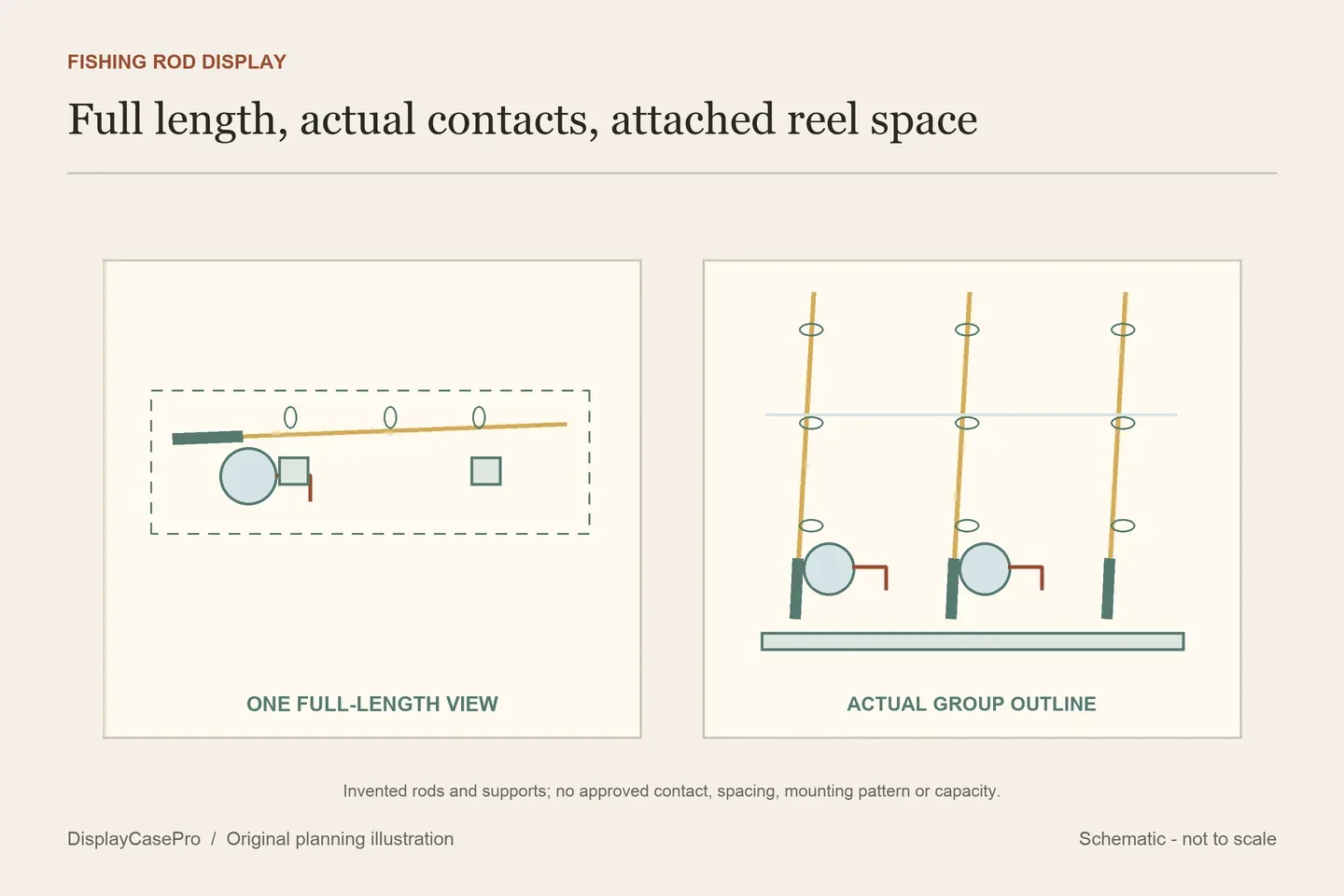
Choose a fishing rod display case or rack around the whole rod, its guides and any reel that stays attached. Two open brackets, a vertical multi-rod rack and an enclosing collector display have different limits. A slot count does not describe the space occupied by reels, projecting handles or full-length rod tips.
Choose the rod’s actual display state before measuring
Identify each rod and whether it remains assembled. A one-piece rod and a documented multi-section rod can need different arrangements. If separate sections are intended, keep their association in the record and use the rod maker’s instructions; an enclosure should not require forcing a joint or bending a tip.
Record the entire displayed length, including the tip and any projecting fitting, along with the guide positions and handle. A nominal rod-length label does not define the side-view profile of guides, a reel or the support that carries it.
Decide whether the reel stays attached in its intended connection or is displayed separately. For the combined assembly, include the reel body and full handle position in the occupied outline. Keep a separately displayed reel linked to the rod’s record rather than assuming every neighboring pair is original.
Choose the important view: the whole rod’s silhouette, handle and maker’s markings, a documented rod-and-reel group or several rods compared in a row. That choice helps determine horizontal or vertical presentation before a rack count is selected.
Open rod supports do not provide an enclosing front
| Format | Presentation to evaluate | Receiving question |
|---|---|---|
| Two horizontal brackets | One full-length rod with the guides and handle visible. | Exact contact diameter, approved support positions and complete rod-and-reel projection. |
| Vertical home rack | A group of rods with repeated lower and upper supports. | Actual support height, reel separation, tip height and individual removal. |
| Retail merchandising fixture | A branded group with graphics and repeated rod positions. | The specified commercial arrangement and whole occupied footprint. |
| Separate enclosing case | A chosen rod or supported group visible behind a closing front. | Clear full-length cavity, support system, opening and access at the intended location. |
DICK’S fishing rod display-rack category mixes wall, floor, rotating and rolling racks. Its generic FAQs help identify formats, but do not supply every model’s receiver or a universal rod-and-reel capacity. Follow the exact product specification after choosing the format.
BWS Displays’ fishing-fixture category includes two-way and two-sided merchandising racks, branded graphics and several nominal rod counts. These are retail fixture examples. A display graphic or forty-eight-rod title does not establish a closing cover or fit for a particular home collection.
A rack’s height is different from the rod’s full length
The following maker descriptions were read on 18 October 2026. They are published limits and dimensions, without physical support, load, installation or fit tests by DisplayCasePro.
| Product | Published information | Keep separate |
|---|---|---|
| Eat My Tackle Fish Framed rack | Up to sixteen rods; H31 × W17 × D10 in; connects to additional racks. | Rack dimensions are not the full occupied rod height or a clear cavity. |
| Better Display Cases A023-F-SS | Two horizontal brackets in ¼-in acrylic; objects 1⅛ in diameter or less. | Diameter applies at the receiving contact, not to the complete reel or guide profile. |
| Savior 24-slot rack | External L24 × H28.25 × W13 in; top support maximum height 26.25 in; bottom minimum height 4.75 in. | Rack/support heights are not a maximum full rod length. |
| Savior 36-/48-slot racks | External L35 / 46.5 × H30.25 × W14.75 in; top support maximum 28.25 in; bottom minimum 4.75 in. | L × H × W is the source order; counts do not specify every attached-reel arrangement. |
Eat My Tackle describes a rack that can connect to more racks to form a row. Its use of “display case” in the title does not establish a closing front in the product description. Request the actual support layout and complete occupied size for the rods you intend to place in it.
Savior’s adjustable aluminum rack separates three slot counts and gives overall sizes in L × H × W order. Preserve that order instead of automatically treating W as the long front width. Its adjustable beams and cushioned holders still need to receive the actual group under the product instructions.
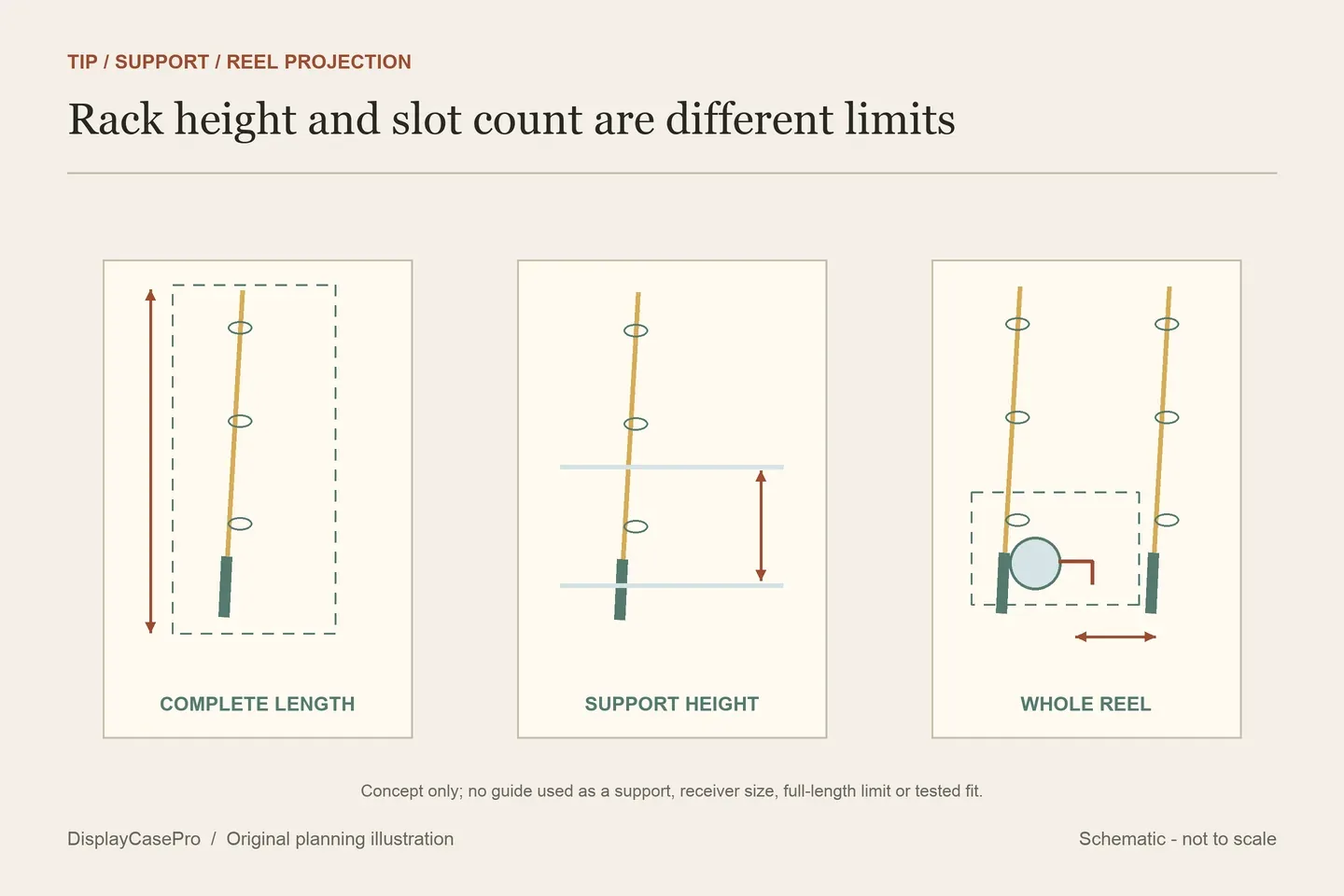
A tall rod can extend well above the support structure; the published rack height alone does not describe the scene in the room. Record the top tip, lower handle and side projections in the final supported state. Do not derive an allowable rod length from the support-height maximum.
Map the guide and reel positions before counting useful slots
Better Display Cases’ horizontal bracket description specifies two brackets and a maximum object diameter of 1⅛ inches. That figure does not establish the spacing between supports, acceptable contact positions on every rod or room for a reel projecting in front of the wall.
Request the intended contacts for the actual rod and bracket. Do not use a line guide as a convenient receiver or assume any two points along a shaft are equally suitable. Include guide positions when checking where a support can meet the rod under the selected maker’s instructions.
For an attached reel, compare the whole reel and handle with neighboring positions. A rack can have more empty slots than usable complete assemblies when a particular reel projects into the next position. Leave unresolved capacity as a question rather than squeezing rods together to match the headline number.
Use a front and side layout for the largest assemblies first. Mark the actual lower and upper support positions, then include the complete guide and reel outlines. The purpose is to identify receiving questions for the supplier, without turning a sketch into a drilling template or structural approval.
Keep space for the whole rod as it leaves the display
Establish the rack or bracket’s intended release route before placing it near a ceiling, doorway or adjacent cabinet. A full-length rod needs a complete approach and removal path, even when only two small supports occupy the wall. Follow the actual product and rod instructions.
For a separate enclosure, obtain the clear opening as well as its interior length. A long object fitting behind a closed panel does not establish how it enters through a smaller opening or leaves past a neighboring reel. Keep each supported rod independently identifiable and reachable.
If original sections, tags or packaging are retained elsewhere, link their locations to the rod identifier. Do not attach a new permanent caption to an unidentified finish merely to simplify a row. Use the rod, guides, reel and rack worksheet and the collection measurement guide for the whole supported outline and consistent units.
Common questions
Does a sixteen-rod rack display any sixteen rod-and-reel assemblies?
Confirm the actual support positions and complete reel/guide profiles. The nominal count does not establish that arrangement.
Is a pair of clear acrylic brackets a closed display case?
The cited product is an open horizontal support. Specify a surrounding enclosure separately if a closing front is part of your display goal.
Comments
Share a display tip or ask a question.