Choose a fishing reel display case after deciding how the reel will be supported. An open wall holder receives part of the reel; an enclosure surrounds the supported assembly. A shop fixture, a reel-only collection and a complete rod-and-reel display need different specifications.
Record the reel type, actual receiving interface, handle position and intended view before counting places. The sampled results include open holders, a commercial fixture and historical collection arrangements, so the word “display” alone does not establish a supplied closing front or clear case dimensions.
Decide what stays attached before selecting the display
For a reel-only presentation, identify the reel and the view that matters: the spool face, side plate, handle or documented maker's marking. Note whether its original box is displayed separately. A package record can accompany the reel without being used as its support.
For an intact rod-and-reel group, include the rod, reel and their existing connection as one display task. A holder sold for the reel alone does not establish support for the combined assembly. Likewise, a rod rack's category name does not establish a receiving arrangement for every attached reel.
Keep collecting history separate from visible appearance. A source description can be retained as “purchased as…” when its identification is uncertain. Do not assign a manufacture date, material, rarity or maker from a photograph merely because those details would make an attractive caption.
Open holders, covered groups and shop furniture are different formats
These source descriptions were read in October 2026. They explain product families and receiving questions; they are not our installation tests or a ranked list.
| Source | Actual format | Question before selecting it |
|---|---|---|
| Str8 Up Mounts | Open plastic reel holders: five individuals or one four-in-one wall panel, with spinning/baitcaster choices. | Which interface and exact holder version receive your reel? Neither option is an enclosing case. |
| Country Barn Woodworking | Cabela's commercial fixture portfolio, W76 × H54 × D30 in and nominally 35 reels, with rear stock storage. | Whole fixture size and merchandising count do not define a home collection's clear bays or individual support fit. |
| Lure Lore collector displays | Historical reel racks and rod-and-reel groups among broader fishing-tackle arrangements. | Which composition do you want? A personal fixing method is not an approved support specification. |
| Fine Home Displays fishing category | Fishing memorabilia category containing lure-case cards. | Ask for reel-specific receiving details. Lure-case dimensions do not establish clearance for a reel and handle. |
| Lukic reel-holder category | Separate Spin, Baitcasting, Fly and Conventional holders, plus a distinct rod rack. | Confirm the exact product and contact arrangement; the category does not supply numeric interface or load data. |
The commercial fixture's accessible front and closed rear storage serve a shop workflow. Its two described designs also differ, including a later version with four rollout drawers. Those features should not be converted into a universal collector-case capacity, shelf limit or home mounting plan.
The collector article, credited to Keith Bell and presented with a 2020 footer, is useful for choosing a composition: separate reel rows, a covered rack or a rod-and-reel group. Its personal rings, dowels and other fixing methods remain historical examples. This guide does not prescribe them for an unidentified reel or wall.
A reel-size number is not a receiving-interface dimension
Str8 Up Mounts describes spinning reels in the 2500–3000 range. Keep that as the maker's product wording, not a millimetre dimension or evidence that every brand using those numbers has the same physical foot and body. Ask about your exact reel rather than translating a size label into a universal fit rule.
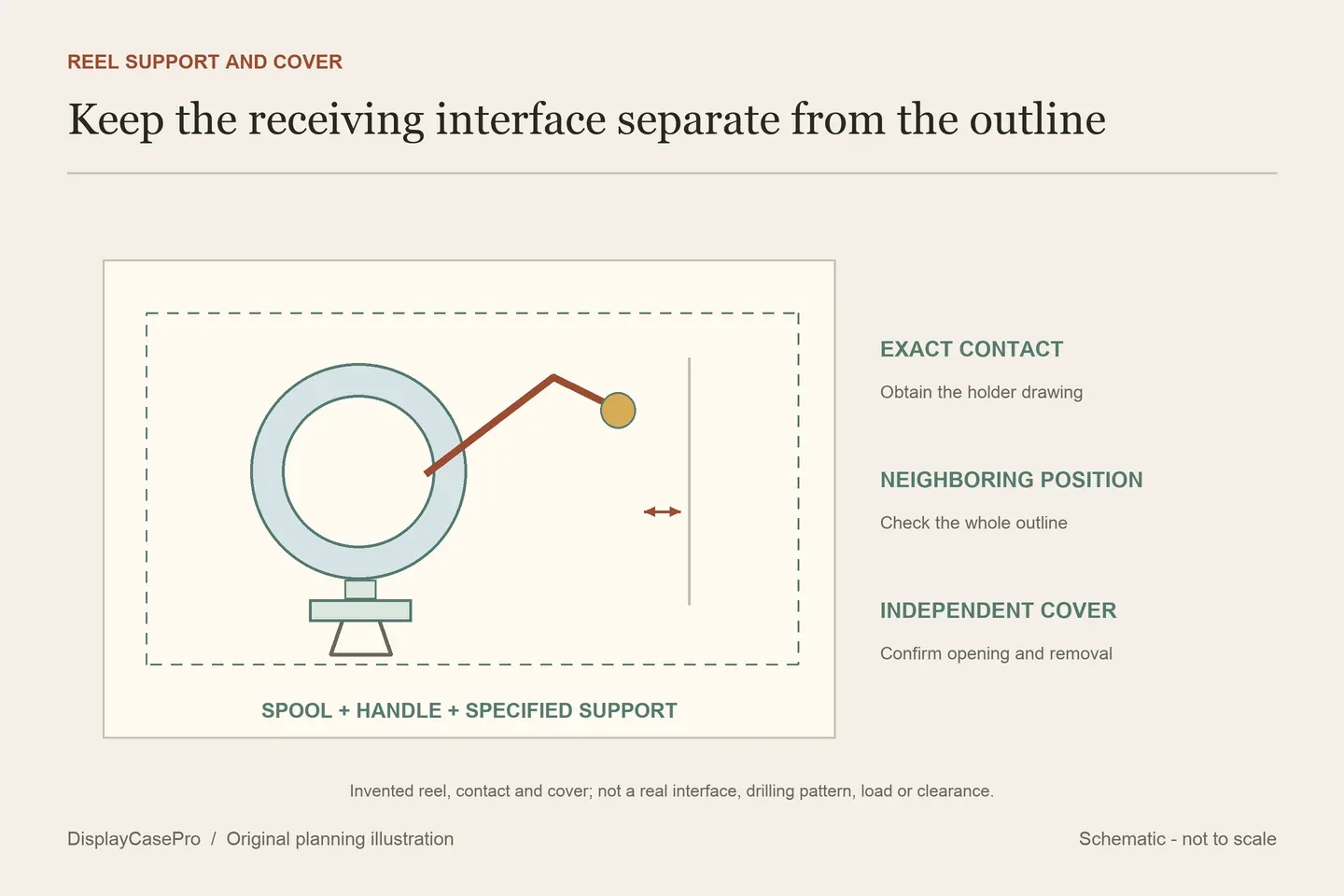
Identify the actual contact the selected holder is intended to receive. Obtain its instructions or receiving drawing and compare them with the reel in its intended state. If the foot is the specified interface, record the relevant foot geometry; do not assume a spool edge, handle or decorative opening can substitute as a load-bearing point.
Separate holder quantity from useful positions. Five individual holders and one four-position panel are different layouts. A wide handle can extend into the neighboring position even when a reel's main body looks small. Confirm the complete supported outlines, not just the repeated holder centers.
The same Str8 Up listing mentions 3.25 inches between multiple four-base wall racks. The text does not clearly define the spacing datum. It should not become a general drilling template or minimum gap between every pair of reels. Request the actual mounting pattern, intended substrate and instructions for the selected product.
Choose a cover around the supported collection
Once the support is established, record the whole stationary display outline. Include the holder or base, spool, handle, projecting fittings and caption. Keep an attached rod in the same record when it remains part of the scene. Do not use the reel's most obvious circular diameter as the enclosure specification.
For a row, check both front and side views. A handle that appears to fit between neighbors in front view can project toward a closing panel. Keep the chosen handle state explicit; the display plan should not rely on folding, unscrewing or turning a component in a way the actual reel instructions do not support.
A cover's closed size and removal route also differ. A hinged door needs its prescribed swing; a lift-off surround needs clearance above the complete scene and somewhere to rest. Confirm that one supported reel can be retrieved without reaching through the next reel's handle or disturbing an attached rod.
The collection measurement guide helps record that assembled profile. Obtain the actual enclosure's labelled interior and opening after the supports are known. An attractive cover photograph does not establish the hardware or retaining method inside it.
Connect the visible reel with its original information
Assign each position a short code, with the reel description, support reference and original-box location kept in the record. Choose labels from documentation you hold. If the collection mixes reel types, preserve those distinctions rather than forcing them into an assumed common support system.
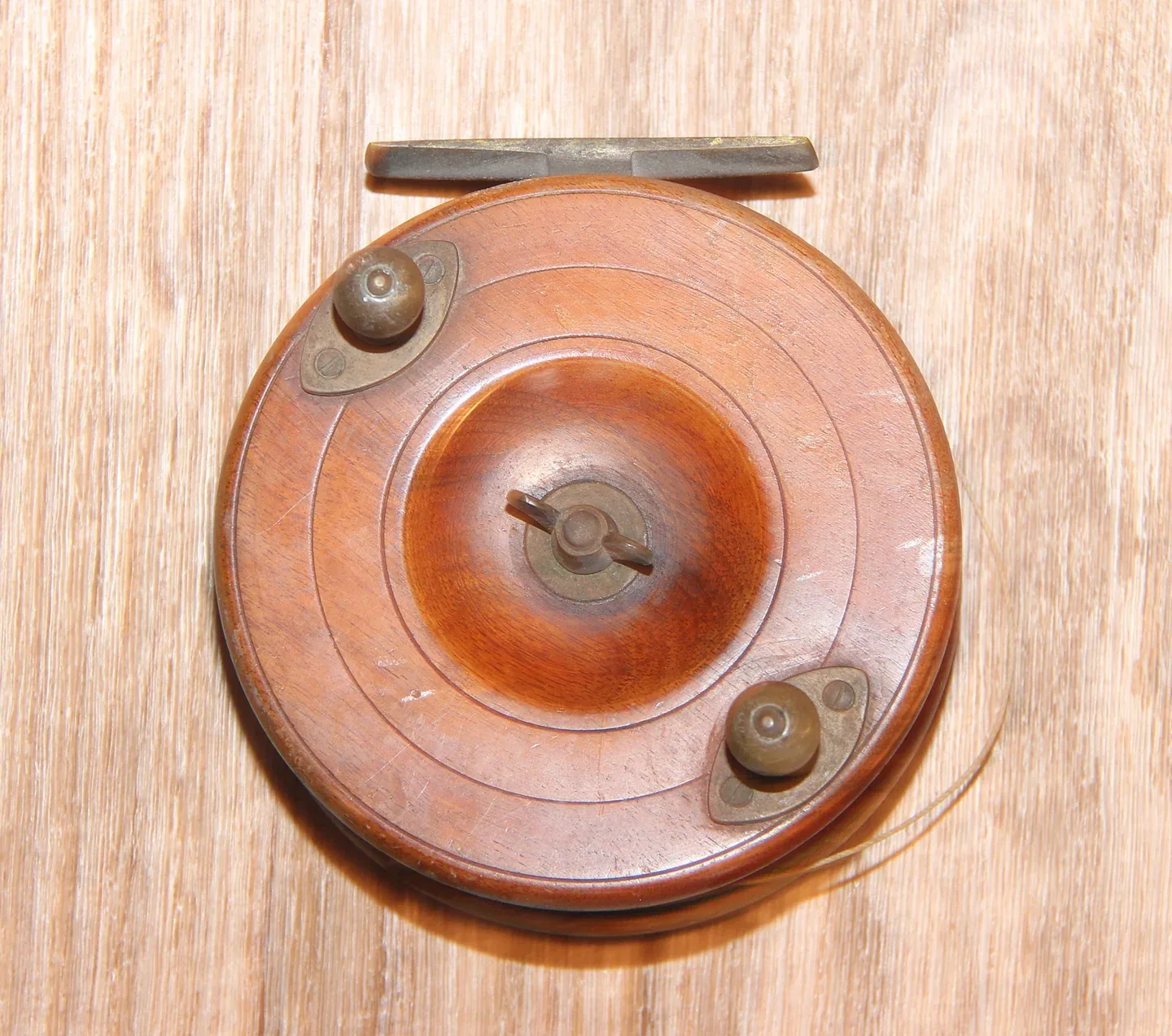
The cover photograph shows one historical reel with a projecting handle and separate foot outline. It illustrates why the complete object matters; it does not identify an approved holder, certify the reel's age or establish a diameter. No measurements or material identification are taken from the photograph.
Photo credit: Peter van der Sluijs, Old fishingreel from England, used under CC BY-SA 3.0. The full source composition is retained, proportionally resized and compressed to WebP; this photo derivative retains that license.

Use the reel support and covered-group worksheet for the receiving interface, full handle profile, group positions and unresolved case questions. Keep the manufacturer's support and fixing instructions with that record rather than reconstructing them from a collector's finished display.
Common questions
Is a wall reel holder also a display case?
An open holder supplies a support format. If you want an enclosure, specify it separately around the complete supported arrangement.
Can one holder accept every reel type?
The sampled catalogue separates several reel types. Confirm the actual interface and intended use for the exact holder and reel; a shared category does not establish interchangeability.
Does a nominal 35-reel fixture fit any 35-reel collection?
That count describes a commercial fixture's intended merchandising arrangement. It does not confirm your reels' profiles, individual support compatibility or access.
Comments
Share a display tip or ask a question.