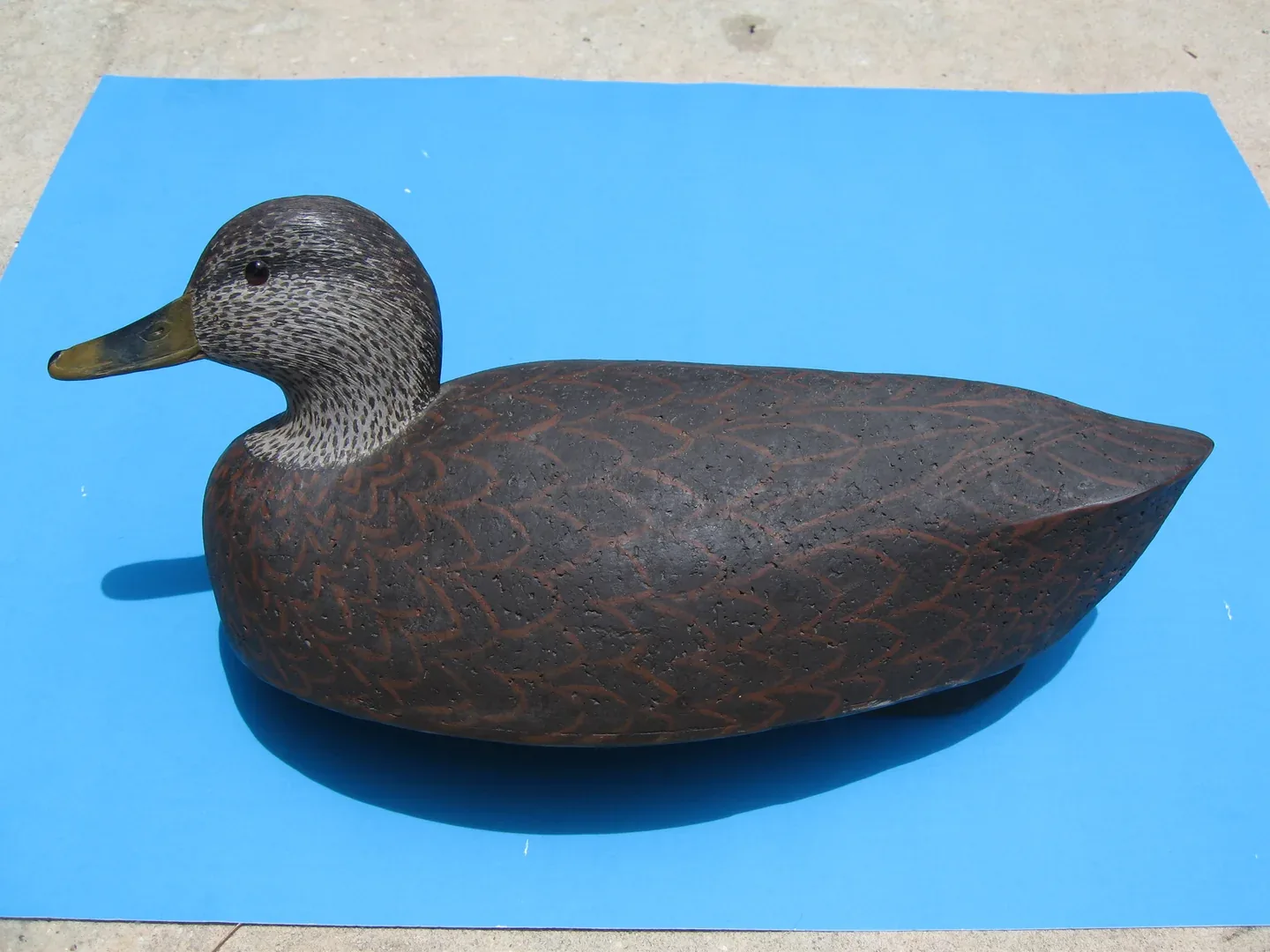
Plan a duck decoy display case around the whole bird and its intended receiver. Include the bill, tail and retained underside fittings before selecting a clear cover or cabinet bay. Peg stands, wall mounts and duck-call cabinets are different products, and none supplies a universal support for an old painted wood or cork decoy.
Record the underside as carefully as the painted side
Give each decoy an identifier and retain its documented maker, material and source. Mark an uncertain attribution as uncertain. A familiar painted species, worn surface or similar shape does not establish a maker or age.
Record the complete intended display state using existing photographs where possible. Include a retained keel, weight, line fitting or other underside component in that record. Its projection can affect the receiver even when it disappears beneath the bird in the preferred side view.
Decide which side, signature or other documented feature matters to the presentation. Keep a photograph of an underside marking linked to the catalogue if that face will be concealed in the supported display. Avoid repeated turning simply to make every detail visible at once.
Choose what receives the bird, then what surrounds it
| Format | What it supplies | Question still needed |
|---|---|---|
| Open peg or fitted stand | An intended support without an enclosing cover. | Exact contacts, peg spacing and complete bird-on-stand profile. |
| Wall receiver | A separately selected wall presentation. | Supported orientation, actual attachment and retained underside clearance. |
| Clear cover or cabinet bay | An enclosure around an already resolved supported object. | Clear floor, full bill-to-tail outline and opening route. |
DECOY’s display category separates Wood Decoy Stand, Decoy Wall Mount and Decoy Collector’s Display among its three cards. That is a useful starting distinction. The category does not supply three enclosing cases or a contact specification for every collected bird.
Confirm how the exact receiver supports the retained object before choosing an outer enclosure. Paint condition, repairs and underside fittings belong in that discussion. For a fragile or significant piece, a collections specialist can help resolve the actual contact arrangement; a clear material or rounded peg description alone is insufficient.
Keep four unexplained numbers unexplained
The source descriptions below were read on 18 October 2026. They are product statements, without our contact, stability, load or collection-fit tests.
| Source | Published information | Keep unresolved |
|---|---|---|
| JP’s Corner medium four-peg stand | 1¾ × 4¼ × 3½ × 1½ in; clear acrylic. | Four values have no axis or peg-spacing labels in the read main. |
| Carolina Decoys stand | Approx. 3½ × 4 in; pegs 1½ in tall. | Tuple axes and complete supported outline; confirm the chosen quantity/variant. |
| OnFireGuy decoy category | Six nominal stand-size cards and separate guard caps. | Names do not establish peg spacing, complete height or permitted object load. |
JP’s Corner publishes a four-number sequence rather than a labelled length, width and height drawing. Ask which measurement describes the base, peg height or spacing. Do not drop one value or choose three that happen to match your bird’s outline.
Carolina Decoys describes wood stands and rounded peg tops, with a selector for six stands, twelve stands or a goose stand. Those are order choices, rather than a claim that a single platform holds six or twelve birds. Confirm which dimensions belong to your selected version.
OnFireGuy’s category names several four-peg sizes, including a square version, plus guard caps. Keep the exact product and any cap option with the receiving enquiry. A nominal inch label does not say which direction it measures, and a guard cap does not establish compatibility with an unidentified finish.
A fourteen-call cabinet is not a fourteen-decoy cabinet
The sampled Rustic Ranch Creations product is for duck and goose calls. It describes fourteen call pegs, a lanyard hook and an optional door. These receivers address sound-producing calls, rather than the complete bodies of decoy birds.
Its whole size is H34 × W21 in, with a stated depth of four inches without the door or five with it, and minor material-related variation. Those exterior figures do not supply a bird’s clear receiving depth. Even the option without pegs needs its own cavity, supports and opening confirmed before considering it for another collection.
Keep a call and a bird as different inventory objects when both belong to the same sporting collection. The association can be explained by a caption without asking one receiver to do both jobs.
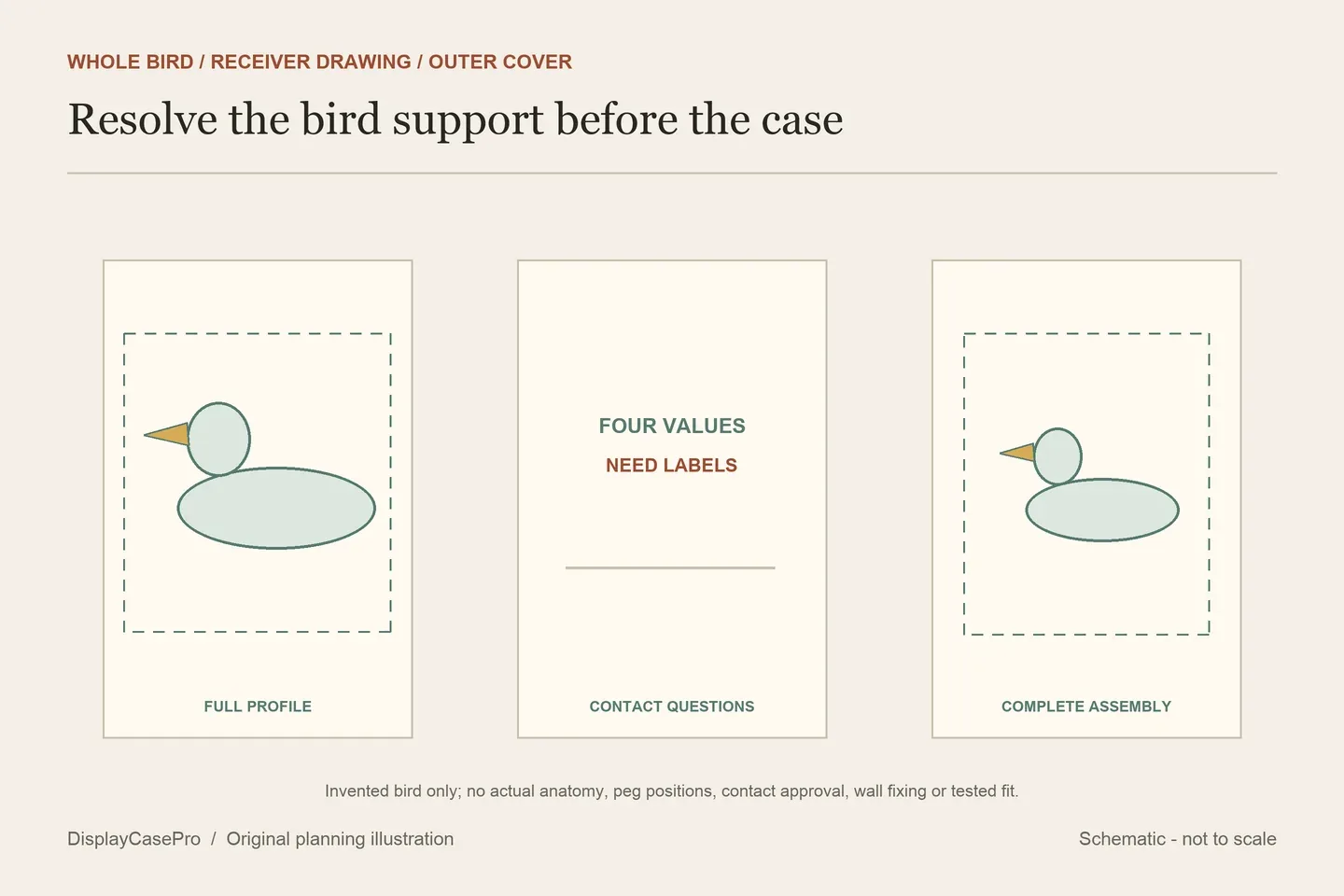
Show the full profile without using the cover as a support
Map the complete supported bird in plan and side view. The head or bill can project beyond the stand footprint, while a tail may approach a rear panel. Include the complete receiver and label in the same outline rather than sizing the case from the base alone.
Choose a cover or door routine that leaves a clear approach under the object’s appropriate handling guidance. A narrow bay may reveal the side beautifully while making a long bill difficult to pass through its opening. Resolve that route with the receiver and enclosure maker before placing the bird.
Cover photo: Leonard J. DeFrancisci, CC BY-SA 3.0. The source identifies this as a Cigar Daisey cork decoy. Whole composition retained, proportionally resized and compressed to WebP; derivatives retain the license. The pictured blue surface does not demonstrate an approved support or a compared product.

Use the decoy, receiver and enclosing-cover worksheet and the collection measurement guide for the whole supported profile and unresolved size fields.
Common questions
Does a stand’s inch label establish the largest bird it holds?
Obtain the labelled receiver drawing and exact supported-object requirements. The nominal category name is not a maximum bird envelope.
Does adding a clear box resolve the support?
Settle the receiver independently. The case panel should not become an improvised restraint for a missing or unsuitable support.
Comments
Share a display tip or ask a question.