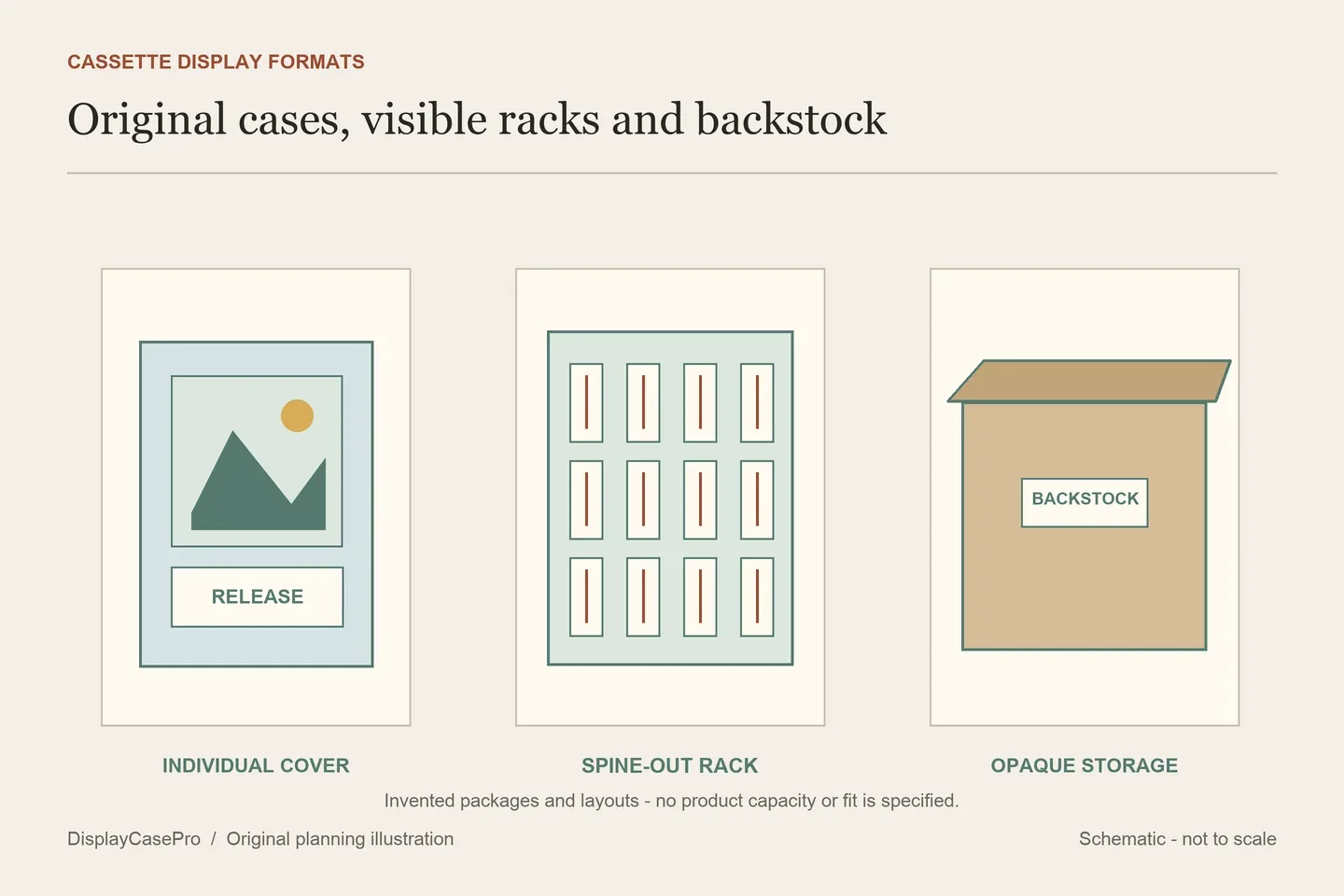
Choose a cassette tape display case for the package you want to keep together: tape, original insert and plastic case, or a tape displayed separately. Then decide whether you want one cover facing out, a rack of readable spines or closed storage for the rest. Those choices lead to different products and different measurements.
Start with the tape, J-card and original case
The word “case” can mean the hinged plastic package that holds a tape, a replacement for that package, or a second acrylic enclosure around the complete collectible. Specify which one you need. Buying an empty replacement cassette case solves a different problem from choosing a shelf display for an original release.
Record the edition and the packaging that will remain with it. Include the J-card, the folded paper insert commonly visible through the original case, rather than treating the cassette shell and cover artwork as unrelated items. A self-recorded tape with a handwritten insert needs its own identity record too; matching colours do not establish which recording belongs with which card.
Measure the complete closed package intended for the display. Include a retained outer sleeve, unusually thick case or second protective enclosure. For a bare tape, record that state explicitly and decide where the associated card and plastic case will live. Do not remove original packaging simply because a rack has narrow slots.
The visible face matters as much as the count. Spine-out storage helps you browse titles. Cover-out display lets one release's artwork lead. A bare cassette shows the shell and label, while hiding much of the packaging. Choose the information you want to see before comparing products advertised for the same number of tapes.
Separate an individual overcase from an open rack
| Format | Useful purpose | Check before choosing |
|---|---|---|
| Individual clear overcase | Give one complete release a distinct position with its cover visible. | The exact accepted package, clear internal space, opening direction and support or wall-mount option. |
| Open slotted rack | Browse a group by its spines and remove tapes for playback. | Individual slot dimensions, case thickness, displayed orientation and the route out of each position. |
| Opaque lidded box | Keep backstock together when continuous visibility is unnecessary. | Capacity for tapes in their actual cases, compartments, access to labels and the enclosure's material description. |
An acrylic rack is not automatically an enclosing dust cover. Look for an actual front, lid and closing method when enclosure is a requirement. A transparent material can describe the dividers and sides of an otherwise open unit.
For an individual enclosure, CGA's cassette display case describes a sliding bottom and a single-cassette version 3/4 in deep. The depth line does not identify an inside or outside datum or supply the complete usable width and height. Ask for those details for your package. An empty display case sold by a grading company does not itself grade or authenticate the tape.
Read slot dimensions separately from rack size
The examples below are published maker or retailer descriptions, not measurements taken by DisplayCasePro. They illustrate the information to compare rather than establish a ranking or promise that every release fits.
| Named rack | Published information | Still to confirm |
|---|---|---|
| WickerWoodWorks 100 Cassette Tape Display Shelf | 100 slots. Each slot is labelled L4 5/16 × W3/4 × Depth2 1/4 in. The shelf size is given as 19 × 25 × 3 in. | Keep the maker's slot labels attached to the figures. Request a labelled drawing and confirmation that your complete closed case is the intended package. |
| Retrospekt Acrylic Rack for 20 Cassettes | Rack H8.25 × W9 × D2.75 in. Described for a flat surface or wall, with vertical stacking. | Individual clear slot dimensions and the conditions for the selected installation or stack. The full rack width does not give one usable slot. |
| We Are Rewind 10-cassette rack | 11.5 × 7 × 21 cm, with wall/surface and horizontal/vertical wording. | The dimension sequence has no axis labels or inside/outside definition. Obtain the intended orientation, mounting instructions and slot space. |
Do not divide a rack's outside width by its advertised capacity to calculate clearance. Dividers, side panels, the arrangement of rows and the opening shape all affect the receiving space. A figure described as slot depth may also mean how far the case enters, rather than its complete front-to-back footprint.
For mixed packaging, check each distinct type. One unusually thick release can need a different position even if most of the collection fits a repeating pattern. Leave an unresolved position unassigned until the maker has answered the package question; forcing a hinged case between dividers is not a fit solution.
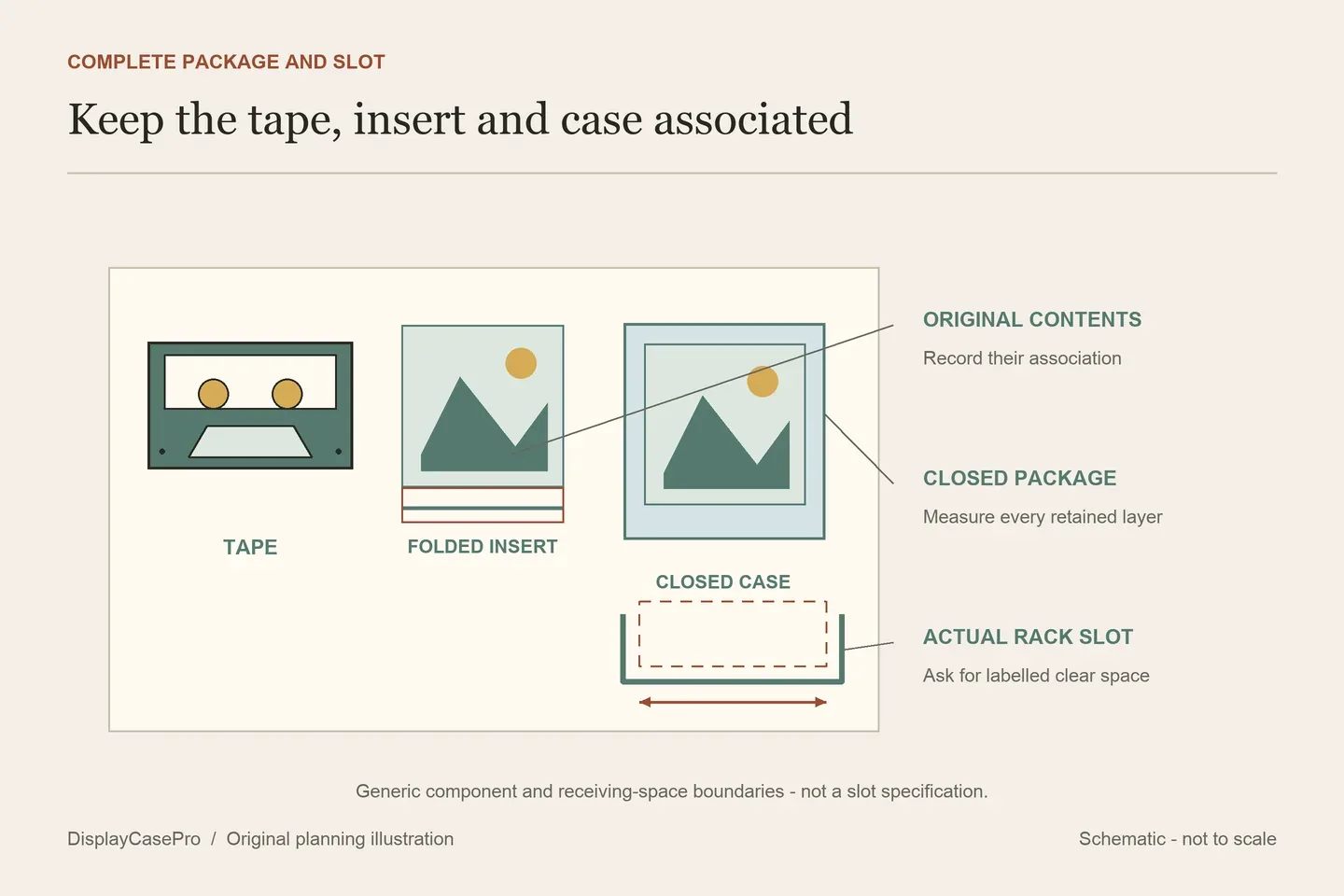
Make the playback route part of the choice
Choose a rack position from which you can grasp and remove the complete case without dragging neighbouring tapes along. Check the top row, bottom row and any position close to a wall or another shelf. A loaded display can occupy its advertised footprint while still lacking a practical removal route.
After removing the package, the original hinged case needs somewhere to open. A wall rack need not also be the surface on which you load a cassette player. Set aside a suitable working area and keep the insert with the empty case during playback. Return the tape to its recorded position afterwards.
For a single sliding-bottom overcase, establish what moves and what you support during opening. A wall-mounted option may have a different handling sequence from the same case on a tabletop. Follow the selected product's instructions rather than assuming the bottom can be slid out while the enclosure remains loaded on the wall.
A simple position map is useful for a larger rack: release ID, row, slot and temporary playback location. Mark the map or a separate caption, not the original paper insert with a new permanent label. Use the blank cassette display worksheet to record the package and the unanswered slot or opening question.
Keep visible display and closed backstock distinct
The Library of Congress audio-visual guidance recommends handling cassettes by the outer shell, avoiding the spools, and storing them on their long edge. It also calls for limited light exposure and separation from strong magnetic fields, including those associated with loudspeakers and motors. These principles inform location choice; they do not provide a universal distance from every speaker or certify a commercial rack.
Check the actual room arrangement before locating a display beside audio equipment. Keep direct sunlight, heat sources and the normal route for drinks out of the plan. A coloured acrylic rack or a finish described as UV resistant does not establish a safe display duration for the tape or its printed insert.
For backstock, BCW's 1-BX-CASSETTE box is described for 60 standard tapes in cases, divided into four compartments of 15. Its inside dimensions are W9 × L20 7/8 × H3 1/4 in; its outside dimensions are W9 3/4 × L21 9/16 × H3 5/16 in. The removable lid hides the collection when closed, and the FAQ says the box is not acid-free. Treat it as a specific storage format, not an archival or transparent-display substitute.
If grouping individual acrylic overcases on furniture, measure those complete outside footprints. The collection measurement guide can help record the combined outline. A box count specified for original cassette cases does not establish the same capacity for larger secondary enclosures.
Common questions
Does a cassette rack hold tapes with their plastic cases?
Confirm that with the exact maker and slot measurements. “Cassette” can refer to the bare tape or the complete package, and special releases can use different packaging. Keep your intended layers in the fit check.
Is a clear rack the same as a dustproof display case?
Check whether it has a closing front or lid and how the joints work. Material transparency alone establishes neither enclosure nor dust performance.
Should I display the tape or the cover?
Choose the part that matters to your collection, then retain the associated packaging in a recorded location. A spine-out rack favours browsing; a cover-out individual case gives one release more visual space.
Comments
Share a display tip or ask a question.