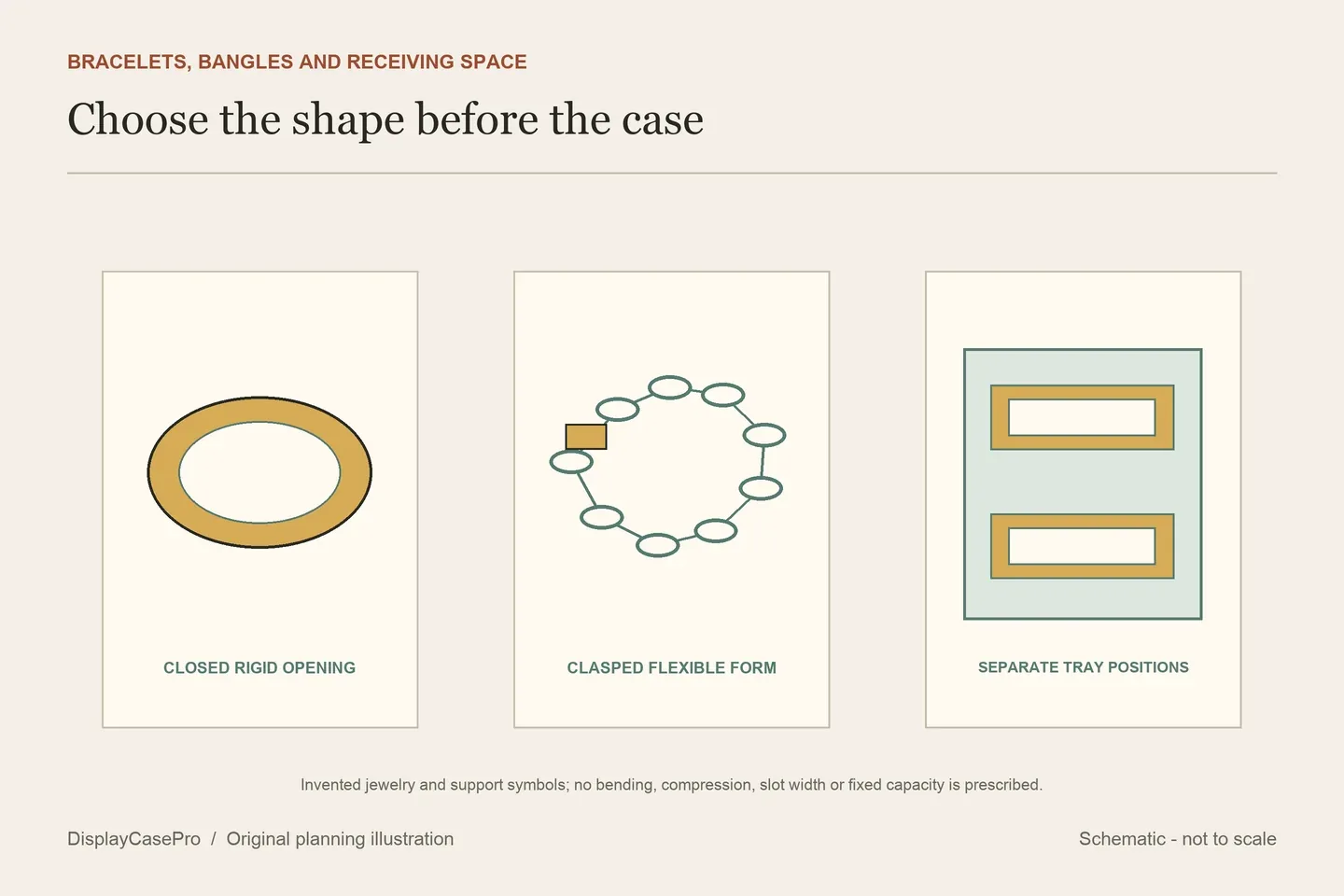
Choose a bracelet display case for the bracelet in its intended resting shape. A continuous bangle must enter its holder through an actual opening; a flexible bracelet may close around a support; a wide cuff needs its own contact and clearance plan. Select that receiving arrangement before choosing an enclosing cover, tray or gift box.
A closed bangle and a clasped chain need different supports
Record the actual bracelet, including its closure, charms, stones and any projecting ornament. Decide whether the whole bracelet, a particular decorated section or a coordinated group is the main view. Keep associated pieces identified even when they remain outside the display.
For a continuous rigid bangle, the opening's actual shape matters. A circular-looking exterior does not establish a matching circular interior, and an oval bangle does not become a flexible band. For a hinged bangle, retain the maker's intended opening method instead of assuming it can be handled like an unbroken ring.
| Bracelet | Possible display route | Question to resolve |
|---|---|---|
| Continuous closed bangle | Intended bar, individual support or assigned tray position. | How does the full bangle enter and leave the support without forcing it? |
| Flexible bracelet with a clasp | Configured around a suitable support or laid out in a dedicated route. | Where does the clasp rest, and can it be reached as intended? |
| Open cuff | A support or tray suited to its existing opening and decorated face. | Which surfaces receive the cuff without bending it to fit? |
| Bracelet with charms or raised detail | A layout retaining the chosen pendant or charm positions. | What is the complete occupied profile, including pieces below or beside the support? |
These routes do not prescribe a universal loading method. Keep the actual jewelry and holder instructions together. A support that suits an open chain bracelet may have no suitable entry route for a closed bangle.
A removable bar can change access without changing the bangle
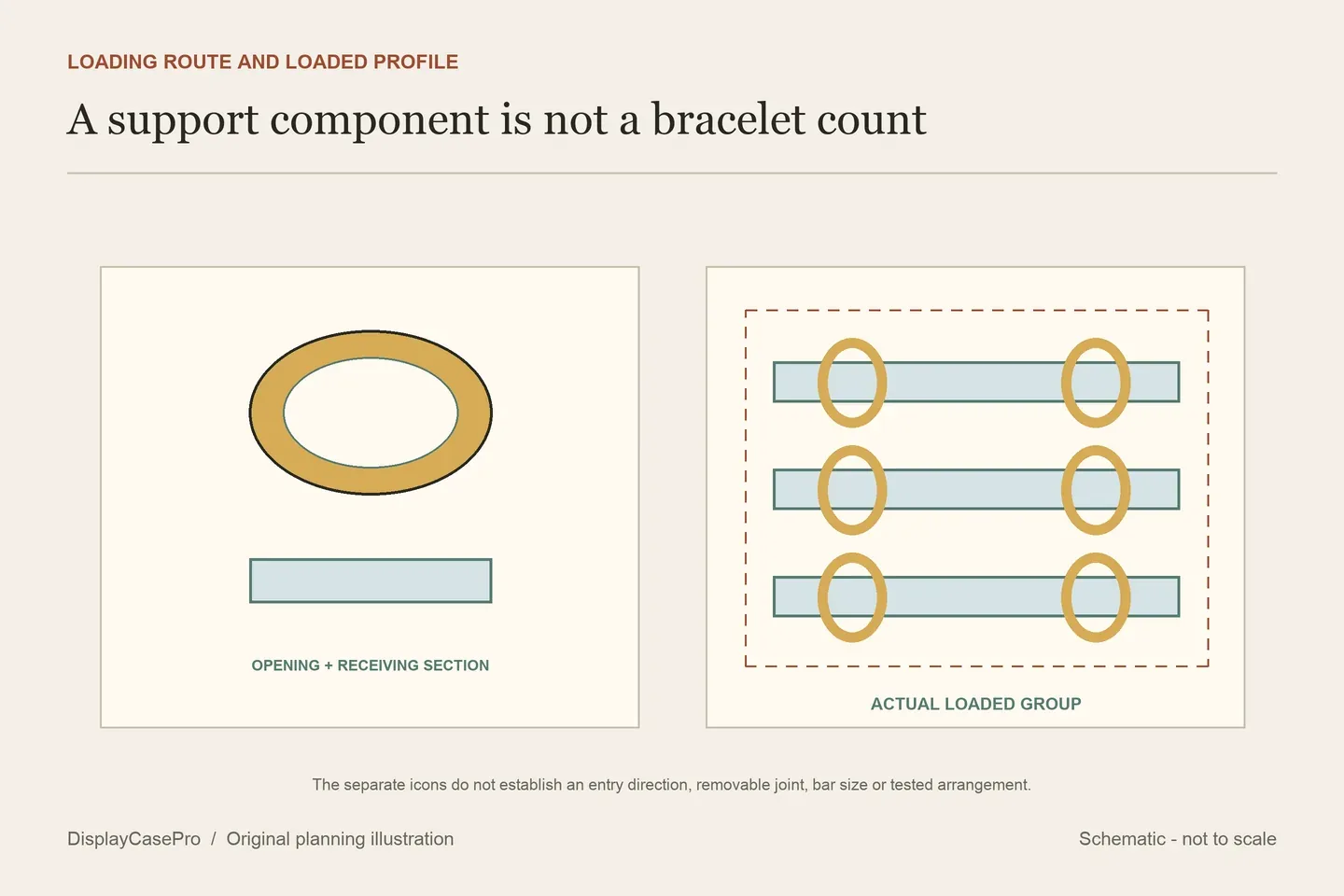
For a fixed bar, establish whether the bracelet is intended to pass over an end. Include the bar's actual section, end fittings and other loaded pieces in that question. A long clear-looking bar does not establish an unobstructed entry path.
A removable holder creates a different sequence. Confirm which part removes, how it is supported during loading and how it returns to the stand. Do not assume a product's removable-bar description authorizes dismantling a different fixed stand.
The Ikee WD9866DBR display describes six removable holders on a two-sided rotating wooden stand. That is a useful access feature to investigate. It does not specify a universal bangle-opening size or say that six holders mean six bracelets.
For a flexible bracelet, keep its normal clasped arrangement. Resolve an unsuitable pillow or bar rather than stretching the piece, changing its links or forcing its clasp solely to suit the display. Include any loose end or charm in the final profile.
Keep the support size separate from an enclosing case
The following descriptions were read on 17 October 2026. They mix open supports and a gift box because those formats coexist in bracelet catalogues. None of the figures below verifies your bracelet's fit or supplies a universal clear cavity.
| Example | Published dimensions or count | Meaning to retain |
|---|---|---|
| Gems On Display 219L white T-bar | W7 1/2 × H5 in; bar diameter 1 5/8 in. | Stand width and height are different from the bar's receiving section. The loaded bracelet can project beyond it. |
| Gems On Display 210L white bangle tray | Nine slots; size sequence 7 1/2 × 4 1/4 × H1 3/8 in. | No individual slot width or usable spacing for broad cuffs is provided in that category description. |
| Ikee WD9866DBR | W9 × D6.7 × H17 in; six removable holders, three tiers and a rotating two-sided layout. | These are stand specifications. Confirm the holder section, loaded profile and operating area; no cover is described. |
| JPI LW4 LED gift box | Matte black plastic box; size sequence 3 7/8 × 3 7/8 × 1 3/4 in. One box per unit. | The line is not labelled as a clear interior, and the actual bracelet insert and closed view still need checking. |
The 219L's 1 5/8-inch bar diameter describes the bar, not the stand's 7 1/2-inch width or the bracelet's wearable size. Obtain the intended receiving fit for the actual bangle. Those different measurements should not be substituted for one another.
The same Gems On Display category lists pillows measuring 3 × 3 inches. That flat size description does not give the pillow's circumference, compression behavior or fit inside your closed bracelet. Keep those missing fields unresolved rather than applying a wrist-size formula.
JPI describes LW4 as a gift box with an LED light. Its 1 3/4-inch listed height is not clear space above a loaded insert. The description does not provide an independent battery, continuous-operation or transparent-lid specification; ask for the actual configuration if those features matter.
Six holders and nine slots do not define your collection capacity
Count bracelets individually, then group them only where the intended holder and actual profiles allow it. A broad cuff can occupy a different visible area from a thin bangle. A charm can extend into an adjacent position even when the main bands remain separated.
For the nine-slot tray, obtain the receiving slot dimensions and loading arrangement. The tray's overall size does not establish that each of your nine pieces can sit independently, remain visible and be removed without disturbing its neighbour.
For the Ikee stand, six removable holders are six components. Decide how many of your actual bracelets belong on each one and whether the chosen faces remain visible. A tier behind another tier also needs its own sightline; total stored pieces and pieces clearly presented from the front can differ.
Store Supply Warehouse's bracelet category describes open ramps, T-bars and half-moons used inside or on top of display cases. That distinction is useful: the support and enclosing cabinet are separate items. Include the entire loaded stand when checking a separate case.
Plan the visible face, clasp and removal route together
Choose the viewing side of each bracelet. Put the intended decoration in the visible record and identify where the clasp or open-cuff gap rests. A tidy front view should not hide an unreachable release point against the case back.
For a rotating stand, check the intended loaded rotation and access at the furniture. The 9 × 6.7-inch stand footprint does not by itself describe every projecting bracelet or the space needed to remove a holder. For a covered display, establish the actual door or cover route around that complete group.
For a gift box, decide whether you want a presentation opened occasionally or jewelry visible while the box stays closed. An LED and a jewelry-box title do not answer that viewing question. Confirm the chosen insert, lid and power details separately.
Use the bracelet construction and holder worksheet. The collection measurement guide covers the finished enclosure's placement. Keep material and contact questions specific to the jewelry rather than treating every velvet, wood or foam description as a preservation specification.
Common questions
Can a closed bangle use any T-bar?
Confirm the actual opening, receiving section and loading route. Do not force the bangle over an unsuitable support.
Does a six-holder stand hold exactly six bracelets?
The number describes holders. Actual bracelet profiles, intended loading and visible positions determine the useful arrangement.
Does an illuminated gift box provide a visible closed display?
Check its lid and actual powered configuration. The presence of an LED does not specify a transparent viewing window or continuous operation.
Comments
Share a display tip or ask a question.