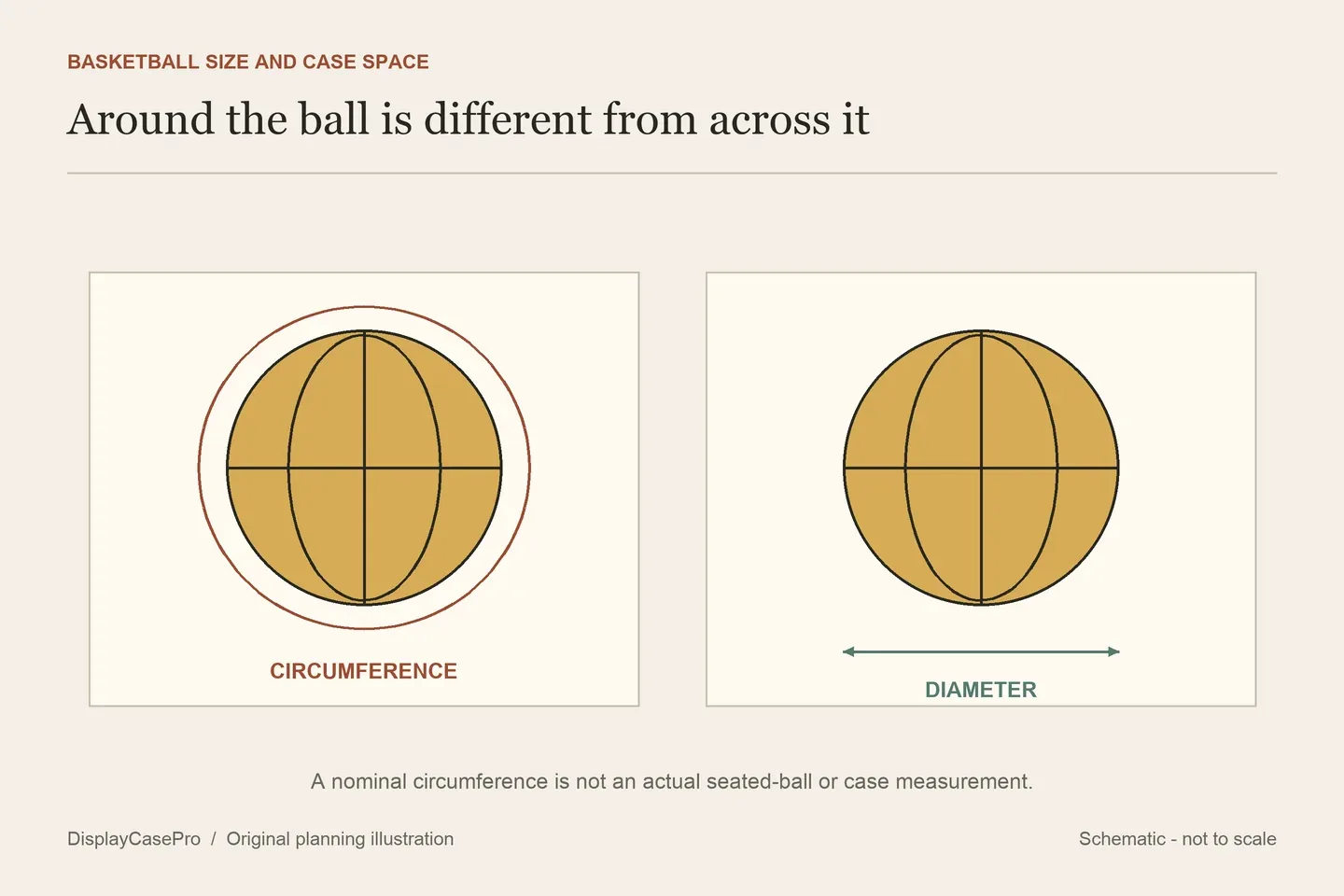
Basketball display case dimensions need to match the ball as it sits on its intended support. Check the usable width and depth, then the height above the relevant base or platform. An eleven-inch exterior cube does not necessarily provide eleven inches of clear interior height.
Also check what the ball’s size label measures. A 29.5-inch basketball description refers to circumference, rather than a straight width across the ball. Keep that around-the-ball measurement separate from the dimensions used to choose an enclosure.
Circumference is not the ball’s diameter
Wilson’s basketball sizing guide explicitly describes size 7 as 29.5 inches in circumference. The circumference runs around the ball; the diameter goes straight across it. A size number such as 7 is a product size category, not seven inches of diameter.
For an ideal circle, dividing circumference by pi gives diameter: 29.5 ÷ pi is approximately 9.39 inches, or about 9.4 inches when rounded. That is a geometry illustration, not a measurement of your particular ball and not a recommended case size.
Record the maximum width and depth of the actual ball you intend to display. Then record its seated height with the selected holder or platform. A commemorative, miniature or unusual ball still needs its own profile; a full-size label on a case does not resolve those differences.
Keep the important face in mind while choosing the position. A signature, printed team panel or personal inscription may need a particular orientation. Confirm how the intended support holds that position without assuming that any circular stand has the same contact pattern.
Compare the inside, the outside and the stated axes
The following exact products were checked in October 2026. All three provide internal figures, but their definitions differ. The original source order is preserved where a page does not label its axes.
| Exact case | Published interior | Outside or missing information |
|---|---|---|
| Hobby Lobby 2486397 | H10 × W10.69 × D10.69 in. | Exterior H11 × W11 × D11 in. The description identifies a round cut-out in the base. |
| Better Display Cases A001/B01 | L10.75 × D10.75 × H9.5 in above the platform with risers; H10.75 in above the base without risers. | Exterior L11 × D11 × H11 in. Keep the two height datums separate. |
| Michaels Studio Décor 10332834 | 9.9 × 10.9 × 9.9 in, also given as 25.2 × 27.6 × 25.2 cm. | Labeled interior, with axis order unspecified in the detail line read. No exterior size in that description. |
The first two cases show why the exterior alone is insufficient: both list an eleven-inch cube outside, while their interior heights depend on different constructions and configurations. Do not transfer one product’s usable interior to another because their outside sizes match.
For the Michaels case, ask which value is height, width and depth. The middle value should not be relabeled automatically as whichever axis benefits your layout. A labeled drawing can also identify the mirror, base and usable opening.
Use the outside dimensions for the complete case on your shelf or tabletop. If the listing supplies only an interior, the furniture check remains incomplete. Keep any base lip, feet or other projecting components within the outside outline you request.
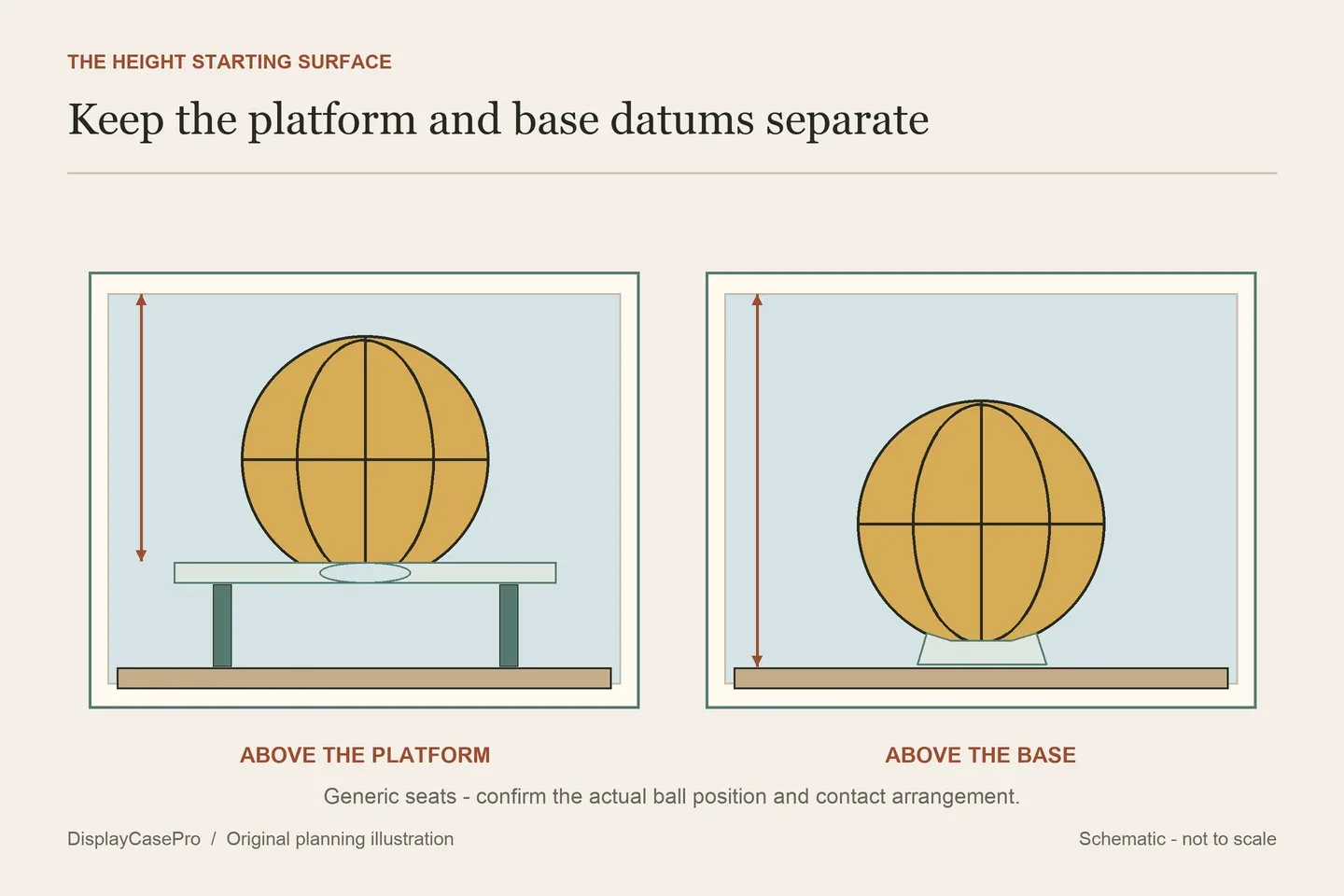
A platform changes where height starts
The A001/B01 specification measures 9.5 inches between its raised platform and the top, or 10.75 inches above the base without risers. The platform height is already reflected in the first figure. Subtracting it again would mix the two configurations.
The ball’s position in a cut-out creates a further question. Its uppermost point above that platform depends on how it is seated. A cut-out can place part of the ball below the surrounding surface, so neither the loose ball’s diameter nor a separate stand’s advertised height completely describes the seated profile.
Ask how the maker defines the intended seat and compare your completed arrangement from the same starting surface. If you add a separate cradle on top of a supplied platform, that is a changed configuration requiring confirmation. The included cut-out and a separate ring stand should not be treated as interchangeable.
Do not turn the small difference between a nominal ball diameter and a listed height into a guaranteed fit or an automatic failure. The actual seated shape, clear space and opening method need to be known together. There is no single gap in this guide prescribed for all basketballs and all case designs.
Choose the support, viewing face and opening together
A mirror-backed case can provide a reflected view, but it also introduces a particular presentation from the front. A clear case provides a different relationship to the room. Decide which actual face or inscription you want to read from your usual viewing position, then confirm how the support positions the ball.
Allow for any label or separate information plate in the arrangement you send to the supplier. It may sit outside the case or occupy part of the base inside. A size quoted for one ball does not automatically include the space for a large plaque, photo or another keepsake.
Check the route through which the ball and holder enter the enclosure. For a lift-off cover, identify the necessary movement above and around the ball and somewhere the cover can rest. For another door design, check the actual opening rather than relying only on the closed internal rectangle.
Use the intended support instructions for the exact case. A tabletop format should not be treated as a wall-mounted enclosure unless that configuration is explicitly supported. Likewise, an eleven-inch case footprint does not establish the loaded arrangement’s suitability for a particular shelf.
Size and protection are different decisions
Correct dimensions do not establish UV performance, harmless contact with an autograph or long-term material suitability. Keep those questions separate from the fit comparison and seek product-specific evidence. A material name alone should not be treated as a preservation rating.
Case-care instructions also do not become instructions for cleaning the ball or its signature. If surface condition or an inscription is important, resolve that care question before changing the arrangement or adopting a cleaning suggestion from a general buying guide.
For miniature or novelty balls, begin the same way with the actual object and intended holder. A small ball in a larger enclosure may need a different presentation and support, while a product marketed for mini balls may have very different usable dimensions. Neither label supplies your measurements.
Keep a record that makes the comparison repeatable
The basketball case worksheet separates the ball’s documented size label, actual width/depth, seated height, starting surface and each maker’s inside/outside definitions.
A useful question is: “My ball is [actual width/depth and units] and will use [your intended seat or exact holder]. What is its intended seated position, and from which surface is the listed interior height measured? Please confirm all usable axes, the complete outside size and the route for placing the ball inside.”
Use our collection measurement guide for the general process. For a basketball, the extra checks are circumference versus diameter, the seated profile and the platform datum.
Is an eleven-inch cube the standard basketball case?
It is an exterior size used by two examples above, not a universal clear interior or an automatic fit recommendation. Check the exact product, support configuration and ball.
Should I compare the 29.5-inch label with case width?
No. That circumference label runs around the ball. Compare the actual ball’s across-the-ball dimensions and seated profile with the appropriate usable interior.
Comments
Share a display tip or ask a question.