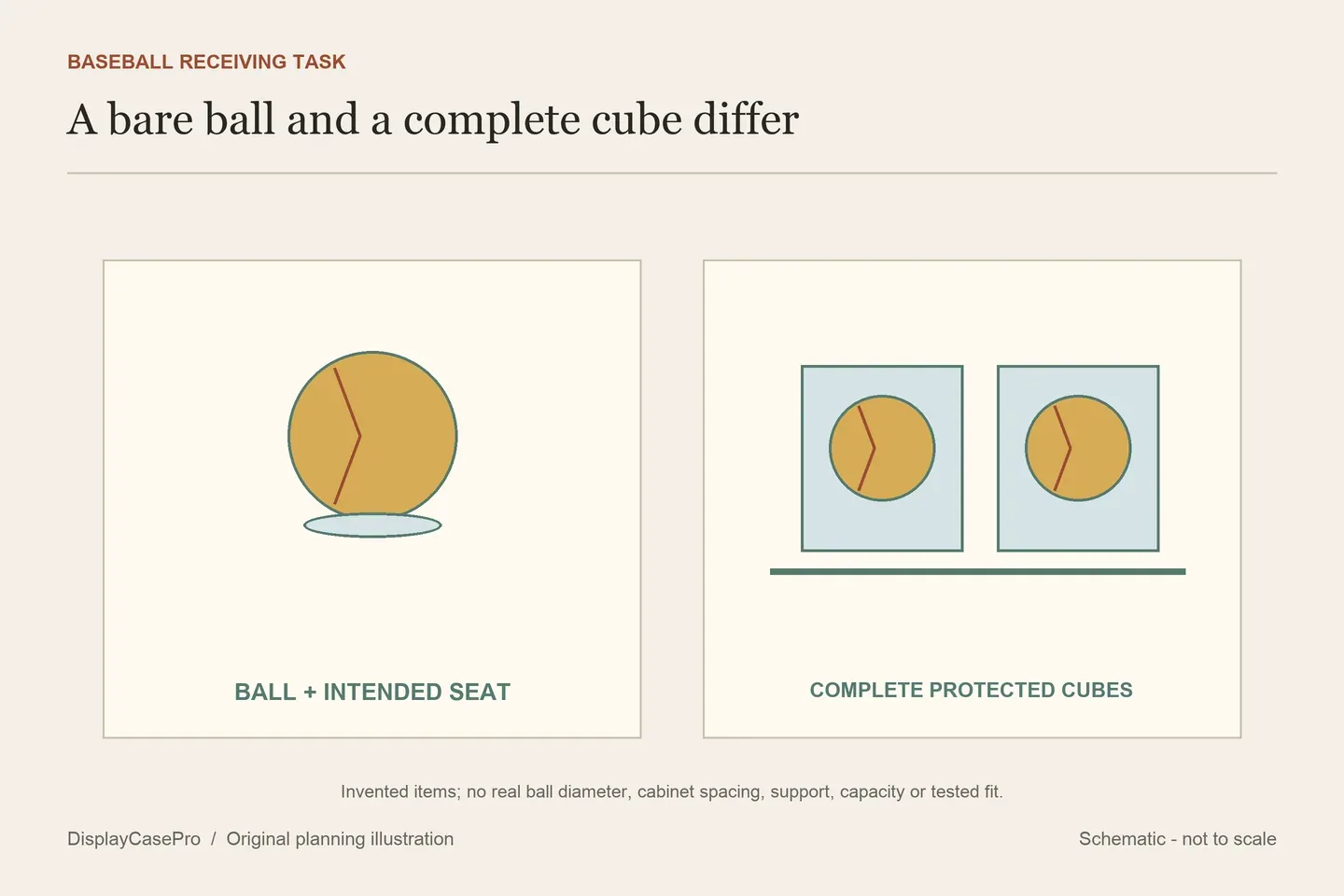
Choose a baseball display case for the object that will actually enter it: one bare ball, a ball already enclosed in a protective cube, or a planned collection. These are different receiving tasks. A cabinet’s ball count does not tell you how many complete cubes it accepts.
Decide whether the ball keeps its existing cube
If the ball already has a protective holder you intend to retain, put that complete holder in the case enquiry. Include its lid, projecting feet and any sleeve or label. Selecting a cabinet around the ball alone can leave the larger protected assembly without a receiving position.
For a bare-ball presentation, identify the intended seat: an individual ring, a moulded rest or a cabinet shelf indentation. Keep the important face and support together. A change of viewing angle can move an autograph toward a seat, front lip or frame edge.
| What enters the display | Suitable format to investigate | Keep in the enquiry |
|---|---|---|
| One ball and its intended seat | Cube, dome or single glass case. | Supported profile, important face and intended opening. |
| A ball inside an existing cube | Cabinet specifically receiving complete protective cubes. | Actual cube exterior, shelf opening and release space. |
| Several bare balls | Indented shelves or individually supported positions. | Every ball position, caption and door clearance. |
The sfDisplay baseball category includes both ball cabinets and explicitly cube-sized cabinets, alongside bats and other objects. Choose the actual product rather than treating the category’s product total as capacity.
Thirty bare-ball positions and fourteen cube positions are different
Two actual sfDisplay products illustrate the distinction. The figures below were read on 18 October 2026. They are supplier specifications, not measurements or fitting trials performed by DisplayCasePro.
| Named product | Published dimensions, inches | What the description receives |
|---|---|---|
| 30-ball cabinet | Outside H23 × W22 × D4; inside depth 3.25; shelf spacing 3.25. | Thirty balls resting on indentations in wooden shelves. |
| 14-cube cabinet | Outside H20 × W22 × D4.75; inside depth 4; shelf spacing 4. | Fourteen acrylic cubes; description says up to 4-inch cubes. |
The 30-ball cabinet describes a bottom-to-top opening door and individual shelf indentations. Its 22-inch overall width is not one uninterrupted receiving space, and the nominal thirty-ball arrangement does not establish room for thirty additional protective cubes.
The 14-cube cabinet is also 22 inches wide outside, but is deeper and organised for a different assembly. The listing excludes the balls and cubes shown. Include the cost and exact exterior of any separately required holders in your own purchasing record.
Its stated four-inch depth and shelf spacing are not extra clearance beyond a four-inch cube. Obtain the actual shelf opening and usable outline for your cube, including its lid and any projections. Do not interpret “up to” as a guarantee of convenient entry, rotation or removal at the stated limit.
Choose a single-ball case around the view and opening
A single cube can suit a repeated row; a dome changes the outline and sightlines; a glass-and-wood presentation can include engraving or a mirror. Start with the face you want to read, then compare the actual support and opening of the selected product.
BallDome’s guide describes its dome, lifter plate and base arrangement, with a locking action and personalised labels. It is the manufacturer’s promotional comparison. Its preference for domes and numerical protection claims are not independent product tests by this site.
Ask how the ball is placed, where the support contacts it and how the enclosure opens without changing the selected view. A clear shell’s shape alone does not explain whether the ball remains seated when the cover is removed.
Perfect Cases describes tabletop and wall-mounted glass formats, straight or staggered seating, optional mirrors and engraving. Those alternatives need the dimensions and contents of an exact ordered version. A mirror can reveal another side, but check its actual view rather than assuming every signature will be readable.
Give every ball a position and a separate caption
Arrange a group by season, player, event or your own collecting sequence. Give each ball a short record code and a proposed position. Retain the evidence for a signature or event description separately; displaying a ball does not authenticate it or establish game use.
The Memorabilia Displays category includes individual holders, ball-and-card formats and a carton described as thirty-six cubes. That carton count concerns separately supplied holders, not thirty-six balls inside a single enclosure. A holder labelled for a game-used ball does not establish the history of a ball placed inside it.
For a ball-and-card display, include the card in its intended holder and its own support. Check whether the ball hides the card or blocks its removal. A cabinet with fourteen ball positions does not automatically provide fourteen additional caption or card positions.
Pennzoni’s category mixes baseball-and-puck cabinets with a cap display. Use the ball-receiving product’s actual positions and depth. A shared sports category is not a specification for every object shown there.
Plan the next change before filling the cabinet
Choose a door route or cover-removal path that remains usable with the collection in place. The two sfDisplay products describe a door opening upward; that movement needs its own location check. Supplied mounting hardware does not resolve the wall and installation requirements for every room.
Keep the next addition in the position map. If it arrives in a different protective cube, compare that actual exterior before moving the existing collection around it. A nominally empty position can still lack the depth or entry route needed by a larger holder.
Use the baseball holder and cabinet worksheet to keep ball count, cube exterior, receiving dimensions and captions separate. The collection measurement guide covers the complete enclosure’s footprint. Obtain product-specific protection information separately; material names and broad UV wording do not establish a preservation result for your ball.
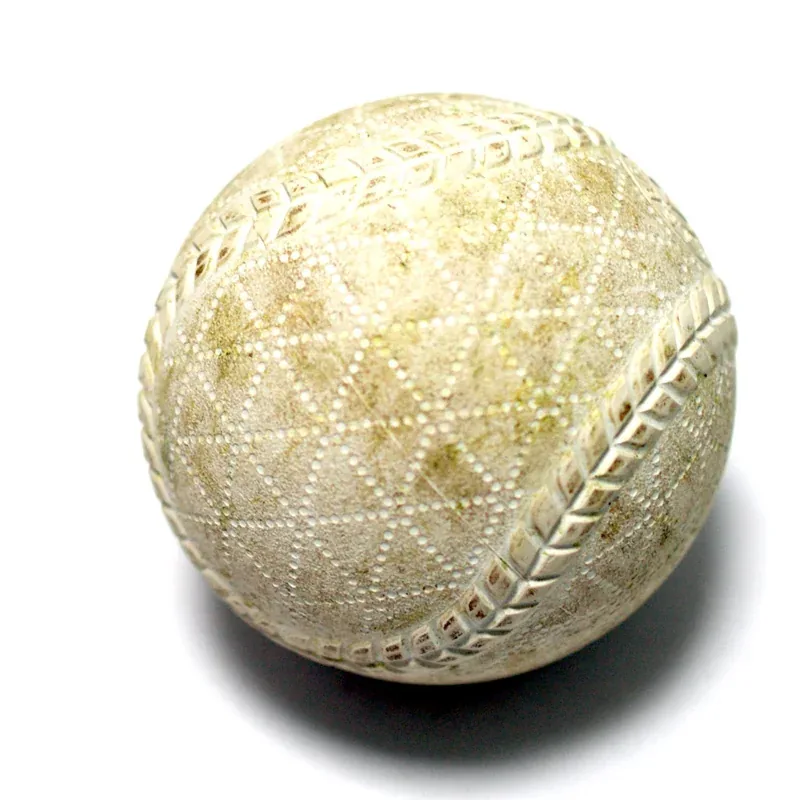
Cover credit: White Baseball by nachans, CC BY 2.0. Whole composition retained and compressed to WebP; the smaller version is proportionally resized. The photo shows a ball alone, without an enclosure or measured fit.

Common questions
Does a thirty-ball cabinet hold thirty protective cubes?
Use the named product’s receiving specification. The cited thirty-ball cabinet describes bare balls in shelf indentations; the fourteen-cube cabinet is a separate product.
Does the cabinet’s width define the cube opening?
No. Check the actual shelf opening, depth, dividers and door path for the complete holder.
Comments
Share a display tip or ask a question.