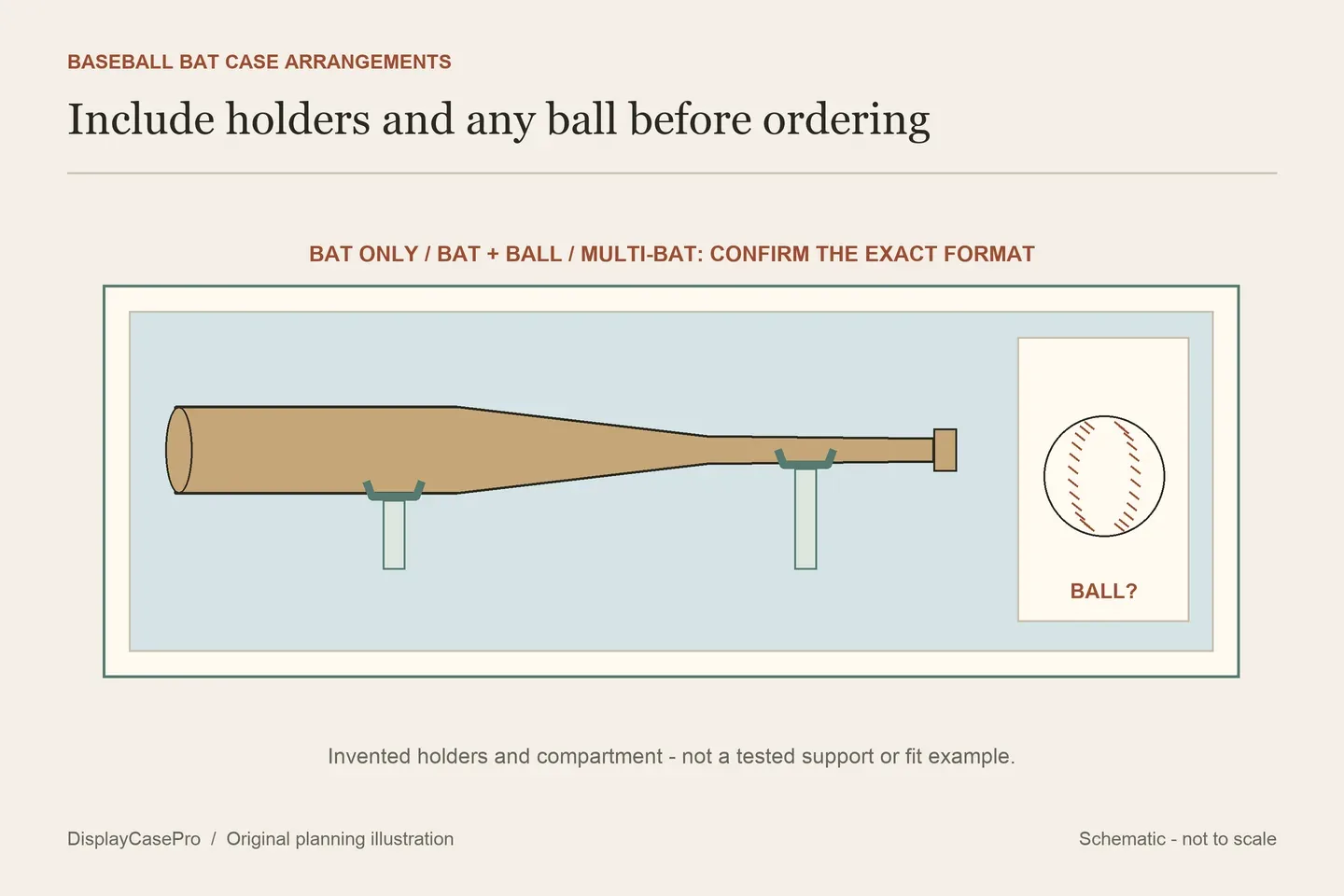
A baseball bat display case needs enough space for the complete bat, its intended holders and any accompanying ball. Check the knob and barrel as well as the length, then confirm the opening and orientation. A long empty rectangle does not tell you where the supports will place the bat.
Published listings can also contain conflicting limits. Keep an advertised maximum bat length separate from the interior dimensions until the maker explains the arrangement. The comparisons below retain those distinctions instead of choosing whichever number appears most favorable.
Measure the supported bat, not only its shaft
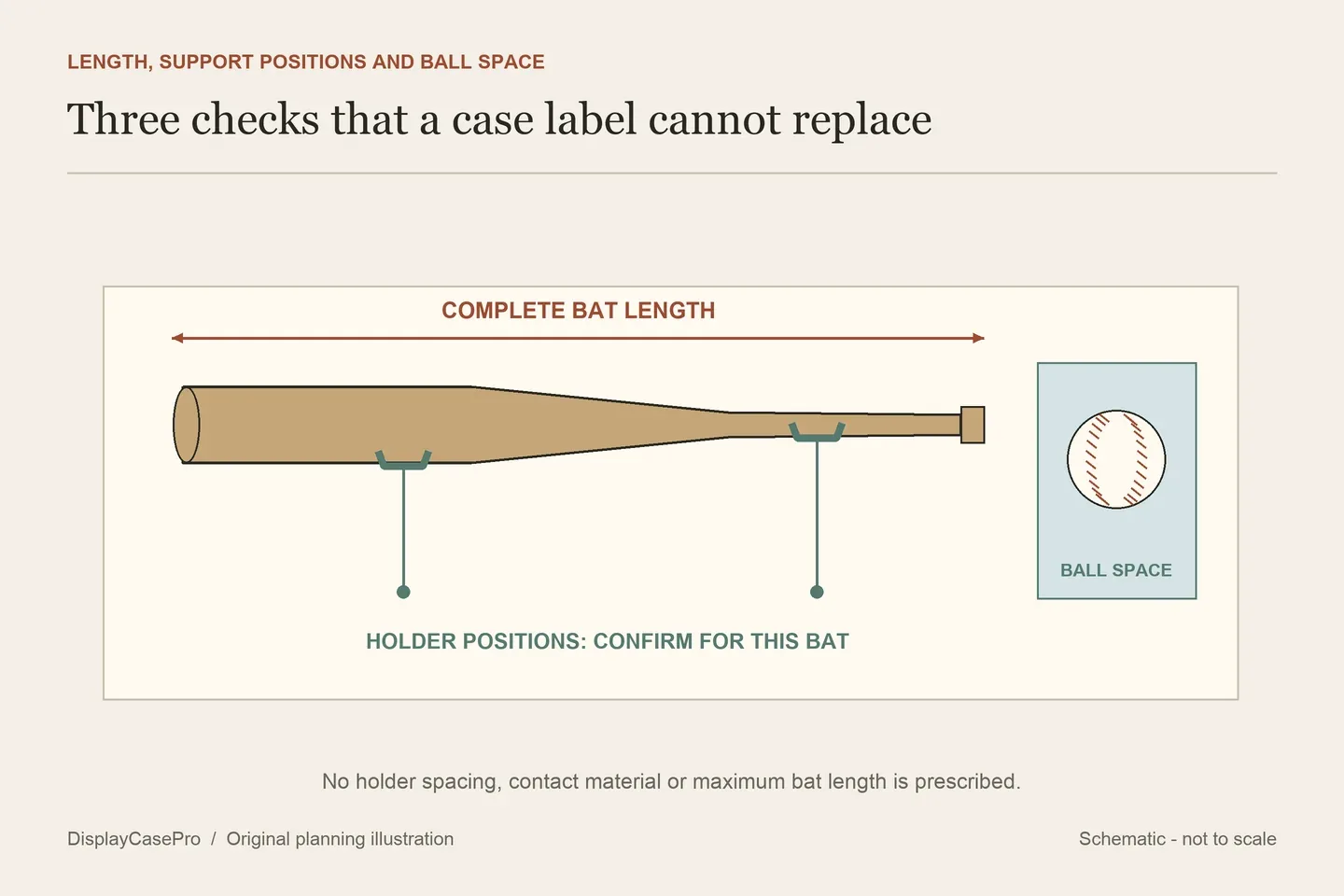
Record the bat’s complete end-to-end length, including the knob and the end of the barrel. Then record the widest and deepest profiles in the intended display position. The shaft passing through a holder does not establish that the larger knob or barrel can enter through the same route.
Choose which face should be visible. A maker’s mark, commemorative text or signature may affect where you want the holders to sit. Ask about the intended contact positions and arrangement rather than assuming that any two brackets are appropriate for any bat surface.
If a ball belongs in the display, include it from the beginning. A bat-only arrangement may use length that a separate ball compartment or holder would otherwise occupy. A photo with both objects is not evidence that your longer bat fits alongside your chosen ball.
Also distinguish one bat from a row of several bats. A multi-bat cabinet’s nominal capacity does not specify the actual clear positions for a mix of knobs, barrels, holders and balls. Request the arrangement for the selected variant.
Four formats with different dimension definitions
These product pages were checked in October 2026. Values retain their original H/W/D or W/D/H order. A long dimension labeled height by one maker should not be compared casually with another maker’s horizontal height.
| Exact product or variant | Published inside | Published outside or missing definition |
|---|---|---|
| sfDisplay one-bat cabinet | H38.5 × W4.75 × D3.25 in. Another line says inside depth 3.5 in. | H39.5 × W5.75 × D4 in. The conflicting depth lines need clarification. |
| U Go Pro one-bat variant | H38.5 × W4.75 × D3.25 in. | H39.5 × W5.75 × D4 in. The page has separate two-, three- and five-bat variants. |
| Hobby Lobby 1676386 | H4.5 × W38.5 × D3.38 in. | H5.88 × W39.75 × D4.13 in. Includes two removable holders; horizontal/vertical formats named. |
| PATHER one-bat acrylic case | Not separately specified in the size line read. | W40.5 × D5.5 × H5.5 in, with inside/outside unspecified. Sliding door described. |
For the long wooden cases, an inside rectangle still does not supply the holder span, the space beside the knob or the door opening. For the acrylic sliding-door case, the listed width alone does not tell you whether the bat enters from an end or through another opening.
The matching numerical lines on the sfDisplay and U Go Pro one-bat pages are separate published listings, not two independent measurements of a delivered product. Similar specifications do not prove a shared supplier or resolve a disagreement on either page.
A stated bat limit and an interior length can disagree
The sfDisplay description says its case can accommodate a bat up to 36 inches with a ball, or a bat up to 39 inches without the ball. Its specification table lists internal height as 38.5 inches. It also gives two different inside depths: 3.25 inches in the three-axis line and 3.5 inches separately.
Keep those statements intact and ask the maker for a current drawing explaining the intended bat position, actual maximum supported length and usable depth. Do not round the internal length upward, infer a diagonal placement or choose the larger depth without confirmation.
Ask which combination the reply covers. A maximum for a bat alone does not describe a bat plus ball, and a measurement of the empty cabinet does not establish where the included holders sit. Have the supplier identify the relevant starting and ending surfaces.
The U Go Pro page illustrates another reason to retain the variant. Its two-bat option lists inside H38.5 × W8 × D3.25 inches and outside H39.5 × W9 × D4 inches. The extra width belongs to that two-bat configuration; it does not establish the three- or five-bat interior, or an arbitrary ball layout.
Horizontal and vertical display need their own configuration
A page may offer both orientations, but the required holders and hardware can vary. The U Go Pro product includes a selectable horizontal-kit option. Confirm its scope for the exact cabinet variant rather than assuming that turning the case sideways gives the complete supported arrangement.
The Hobby Lobby product identifies two removable holders and lists both orientations. Ask how those holders are intended to be positioned in your chosen mode. The cabinet’s internal long dimension is not automatically the supported distance between them.
Outside size still matters after the orientation is decided. Use the entire case outline, its door movement and the actual selected attachment arrangement when planning the location. Included hangers or screws do not establish suitability for every wall or the complete loaded case.
For a sliding door, ask which panel moves, in which direction and how far it must move to admit or remove the bat. A case can have a sufficiently long closed interior while a neighboring frame or furniture edge obstructs its intended access route.
Choose the mounting method before copying a build plan
A custom woodworking project can be sized around one bat and its companion keepsakes, but its mounting choices may differ from what you want for your collectible. The This Old House bat-case tutorial, for example, describes a mounting method that includes drilling into the bat.
That is a permanent alteration, not a removable-holder method. If retaining the bat’s existing surface is part of your goal, settle the intended mounting approach before adopting a tutorial’s dimensions or hardware. This guide does not reproduce that build or recommend drilling a collectible.
A removable holder is a different construction choice, but the label alone does not establish contact suitability for every finish or signature. Identify the exact support and ask about the actual contact area. Do not add generic padding, adhesive or a restraint as if it were part of the maker’s verified configuration.
Separate case maintenance from the care of the bat and any inscription. Clear glazing, a lining material or a UV claim does not resolve preservation or surface-treatment questions. Those need their own evidence and are outside this dimensional comparison.
Send the supplier the arrangement you want confirmed
The bat, holder and case worksheet records the complete length, knob/barrel profile, important face, ball choice, support positions and each published dimension definition. Leave conflicting numbers visible rather than overwriting them.
A useful enquiry is: “I have this bat, with these complete dimensions, and want it [horizontal/vertical] with [no ball / this ball]. Which holder and hardware configuration applies? Please confirm the supported bat limit, clear internal axes, opening route and complete outside dimensions. Your page lists [conflicting figures]; which current drawing resolves them?”
For the general measurement process, see our collection measurement guide. For a bat, the extra checks are the complete knob/barrel profile, holder arrangement, ball space and admission route.
Does a forty-inch case fit a forty-inch bat?
The product’s nominal or exterior length cannot answer that. You need a confirmed usable interior, actual supported position and an opening that admits the complete bat.
Can I use the full long dimension when adding a baseball?
Only if the exact intended layout supports it. A maker may specify a shorter bat limit for a bat-plus-ball arrangement. Compare the combined supported display, not just the two objects individually.
Comments
Share a display tip or ask a question.