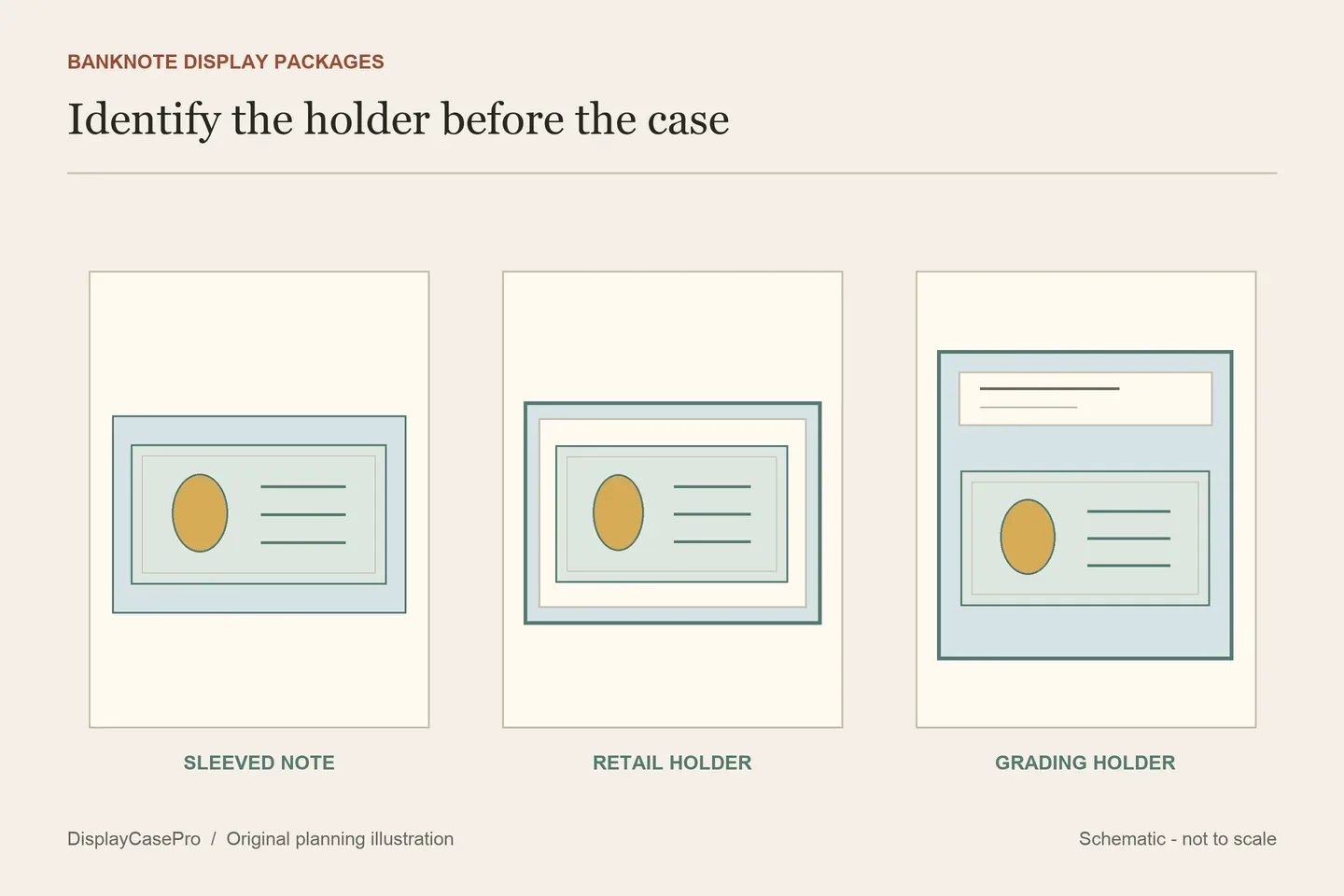
Choose a banknote display case for the package that will actually sit inside it: a bare note with suitable support, an ungraded retail currency holder, or an intact professional grading holder. Compare the complete package with the display's accepted holder space. The note's dimensions alone cannot establish that fit.
Identify the note and its present enclosure
Record the documented issue and orientation, followed by the enclosure maker, model or identifiable version. Use measurements of your own item or holder. “Regular,” “large,” “modern” and “graded” are useful catalogue categories, but they are not interchangeable dimension standards.
| Present package | Measure or identify | Resolve before choosing the display |
|---|---|---|
| Bare note | The actual complete note and its condition, without flattening it for measurement. | An appropriate supporting enclosure and how it will be retained. |
| Ungraded retail slab | The exact holder's whole exterior, including thickness and edges. | Whether the presentation insert is made for that model. |
| Professionally graded note | The intact holder, label area, outside dimensions and version where known. | Accepted thickness, label visibility and release without opening the holder. |
A rigid product sold as a “slab” does not by itself mean the note has been authenticated or graded. A retail two-piece holder and a grading service's sealed holder can look similar in a small photograph while having different shapes, closures and identification.
Keep an existing certified holder intact when planning its display. If its size or orientation does not suit a frame, choose a compatible presentation rather than opening the holder to make the note fit. This guide does not evaluate grades or determine whether a note should be submitted for grading.
Separate the note space from the slab's outside size
BCW's two currency slabs provide a clear example. Both descriptions identify polystyrene and a two-piece friction-fit construction. The maker publishes separate interior and exterior dimensions. The following are attributed specifications, not measurements taken from a delivered holder.
| Exact retail holder | Published inside dimensions | Published outside dimensions |
|---|---|---|
| Deluxe Currency Slab Regular Bill, 1-DCS-RB | 2 11/16 × 6 1/4 in. | 3 5/8 × 6 15/16 × 3/8 in. |
| Deluxe Currency Slab Large Bill, 1-DCS-LB | 3 1/4 × 7 1/2 in. | 4 1/8 × 8 1/4 × 3/8 in. |
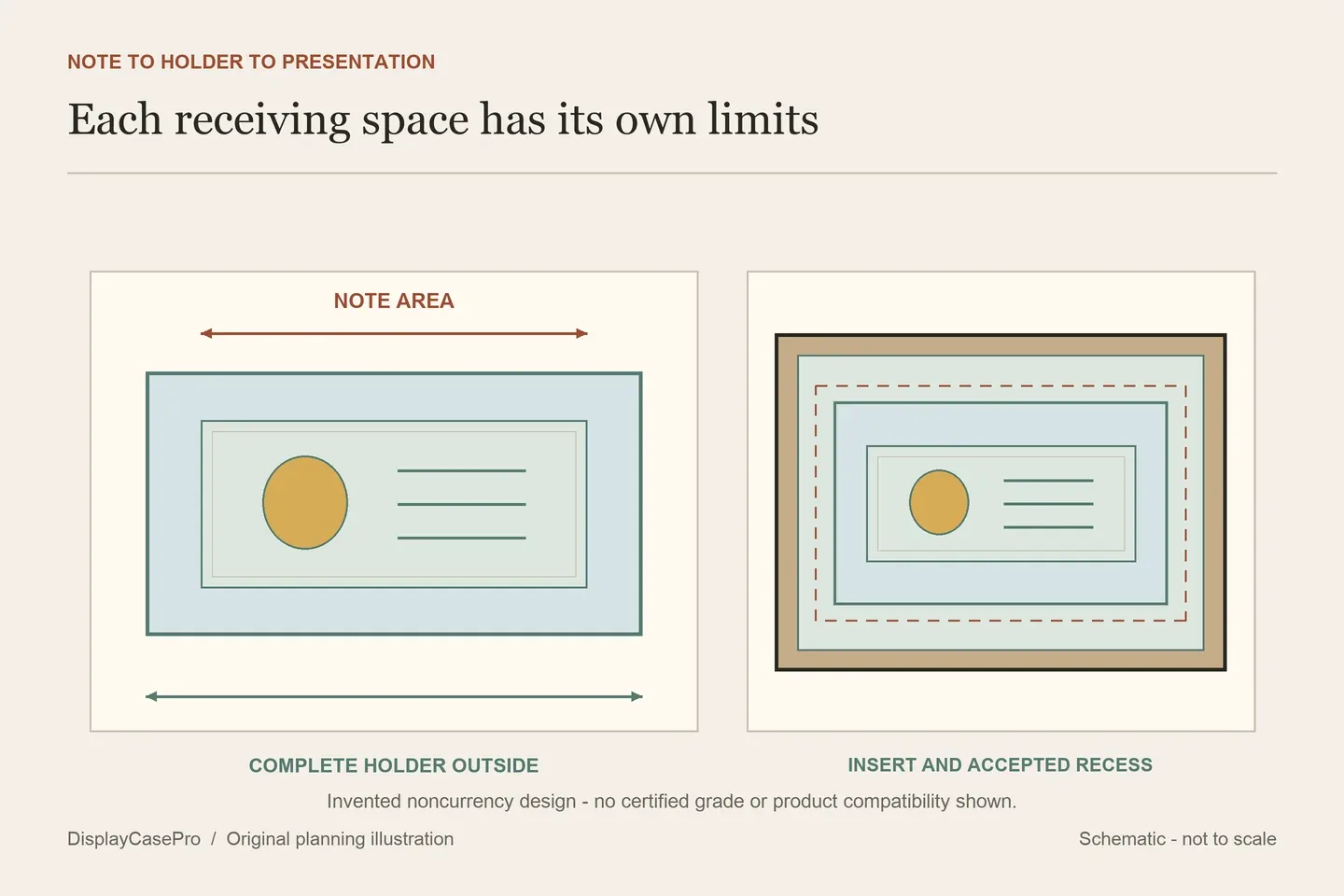
The inside pair describes the space offered to the note. The outside figures describe the larger object a separate presentation case must receive. A recess selected from the smaller figures could fail to accommodate the slab even though those numbers resemble the banknote's size.
Retain the maker's axis definitions when preparing an enquiry. For a horizontal composition, identify which measured extent will run left to right. Do not silently reorder an unlabeled size line or convert a “large bill” name into a claim that every historic or international note fits.
Material information also belongs to the exact product. These two leaves identify polystyrene; that does not establish the material of every sleeve or top-loader in the same shop. Nor does an archival description certify an entire frame package or a harmless display period.
Match the presentation insert to the entire holder
An outer box may be designed for one particular retail holder rather than for bare currency or every grading company's slab. Ask for the accepted maker/model, clear recess dimensions, maximum thickness and how the holder is removed. The size of a decorative insert can differ from its cutout.
The Transline presentation-box category makes specific relationships visible. Its modern glass-top box, product 23380, references Guardhouse 668239 and an interior insert of 176 × 91 mm. The large version, 23390, references Guardhouse 668240 and an interior insert of 209 × 106 mm.
Those are not published compatibility statements for the BCW slabs above or for an arbitrary professional grading holder. The insert figures also do not resolve the exact recess, retention lip or accepted thickness. Keep the linked holder identity with the box specification rather than combining dimensions from unrelated products.
Clarify the order unit as well. A pack of five currency holders is not automatically a display for five notes. A box with several positions needs an accepted package size for each position and enough access to remove the intended holder without pressing on its neighbors.
Plan the note view and the holder view separately
A vertical banknote design does not guarantee a vertically proportioned grading holder. In its December 2025 submission checklist, PMG says it generally uses the smallest possible standard holder unless otherwise requested. A vertical note can therefore be placed in a horizontal standard holder when it fits. That is the service's stated process, not a dimension specification for every existing holder.
Arrange the frame around the actual received holder. Keep the grading label visible if it is part of the intended presentation, and check whether a mat or retaining edge would obscure it. Rotating a frame to suit the printed design can leave the holder's label sideways; decide whether that view works before ordering.
Choose which side tells the story. A front-facing original with a clearly identified reverse image beside it can reveal both designs without turning the original regularly. If direct two-sided viewing is essential, ask for a display designed to support and retain the intact package in that use.
Keep captions outside the note and its enclosure. Use documented issue details, and leave uncertain dates or descriptions marked as uncertain. Display planning should not turn an attractive arrangement into an unverified claim about authenticity or rarity.
Specify the support, release and return route
A holder that sits correctly in a horizontal gift box is not automatically retained when that box stands upright or hangs on a wall. Confirm the display's intended orientation and retention method with the maker. An easel is an open support; it does not add an enclosure around the note holder.
For a bare note, establish suitable housing before using a decorative recess. Do not rely on the front glazing to flatten it or use tape on the paper. PMG's checklist asks for appropriately sized non-PVC sleeves for raw-note submissions; that instruction belongs to submissions and should not be generalized into a complete framing-material standard.
- Identify the receiving space. Record the accepted holder or usable recess and thickness, not only the outer box.
- Check the complete view. Include note edges, reverse-copy caption and any grading label.
- Check release. Follow the exact display's instructions for removing the whole holder; avoid improvised prying on a certified enclosure.
- Plan the destination. Have the intended storage or receiving surface ready before taking the display apart.
The blank banknote holder worksheet separates note, holder, insert, orientation and pack quantity. Use the collection measuring guide for recording the complete envelope and opening without confusing exterior and usable dimensions.
Common questions
Does a currency slab mean the note is graded?
No. The cited BCW slabs are retail holders. Record the actual grading service and certified holder when professional grading is present.
Can a regular-note box take a large-note holder?
Check the entire holder against the exact accepted recess and thickness. Neither the category name nor an insert's outside dimensions proves that fit.
Can I show both sides without opening a holder?
A suitable two-sided display or an identified reference image can serve that goal. Keep an existing certified holder intact and establish how the complete package is supported.
About this guide: Product examples illustrate dimension and compatibility questions. They are not hands-on fit tests, currency valuations, grading advice or preservation certification.
Comments
Share a display tip or ask a question.