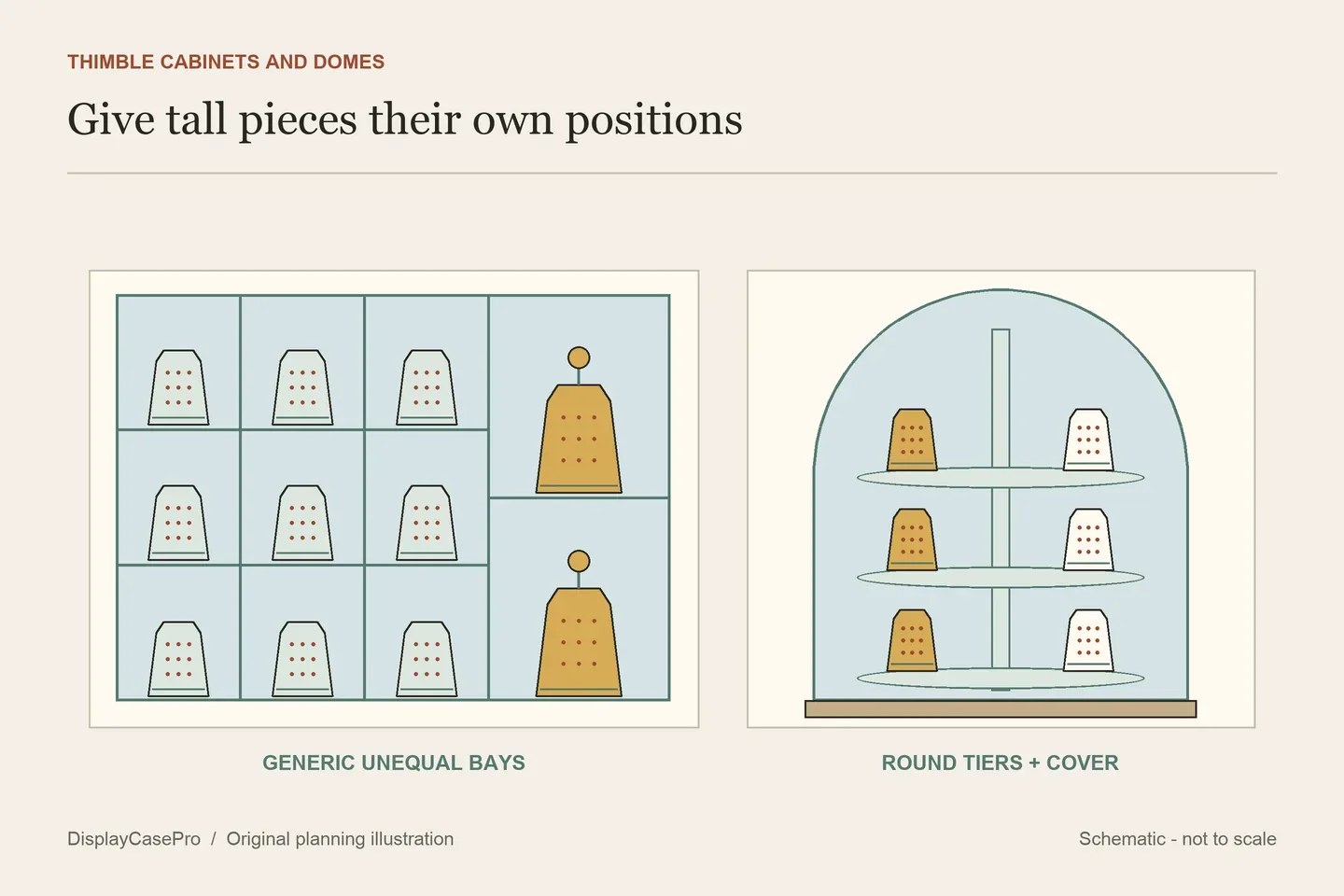
A thimble cabinet's opening count is only the beginning of the choice. Check how many positions suit ordinary-height pieces, how many accept taller decoration, and whether the rims fit the usable depth and support. A tiered dome offers another layout, with different questions about circular shelves and access.
Sort by shape before choosing a capacity
Put the collection into groups on paper: compact profiles, taller sculpted pieces and unusually broad rims or projecting decoration. Keep a record of each thimble's height and widest outline, not just its sewing size or the number in the collection. A souvenir design can project beyond the simple taper of the body.
Choose the view you want. A motif on the side, a decorated top and a mark inside the open end are different viewing tasks. Most repeated front-facing positions will not reveal all of them at once. A photograph in the collection record can show a hidden mark without requiring the displayed piece to balance in an unsuitable pose.
Record materials only as documented. A metal-colored thimble is not automatically silver, and a place name does not prove an acquisition date. Keep uncertain identifications separate from the practical questions about rim contact, stable support and space.
Separate standard bays from tall positions
The two sfDisplay thimble cabinets illustrate why a larger number does not mean every bay is equally useful. The maker gives a mixed capacity for each. The figures below are published specifications, not our measurements of delivered cabinets.
| Exact cabinet | Stated position count | Inside dimensions |
|---|---|---|
| sfDisplay 59-opening thimble cabinet | 55 standard-sized positions and 4 taller positions. | 17 in H × 13 in W × 1 in D. |
| sfDisplay 100-opening thimble cabinet | 88 standard-sized positions and 12 taller positions. | 27 in H × 15 in W × 1 in D. |
Both listings give spaces between shelves of 1⅝ inches and 3½ inches. Ask which actual positions those figures describe and obtain the clear width of the bays you intend to use. The total inside width is not a substitute for an individual cell measurement, and “standard-sized” is not a measured definition of every thimble.
The larger cabinet provides more taller positions, but both list the same 1-inch inside depth. A broad rim or a raised side decoration can therefore remain the limiting feature. Do not assume the larger outside cabinet creates deeper bays or that unused standard positions can be combined by removing dividers.
Make the proposed layout from your own profile groups. Place the unusual tall and broad pieces first, then count the ordinary positions that remain useful. A cabinet with an appealing nominal capacity can still be a poor match if most of your collection needs its few tall bays.
Domes and stepped covers answer different needs
A round tiered dome for several viewing sides
A dome can give a small group more viewing angles than a shallow wall cabinet. Check what each tier actually supports and how you will reach the center or rear positions. The curve of the cover and the central column can limit the space in ways a total width does not explain.
Achieve Display's acrylic thimble dome is described as having three 3½-inch round shelves with circular indentations and capacity for up to 21 thimbles per case. The listed size is 7½ inches tall by 4 inches wide; one order contains four cases. Keep that pack count separate from the capacity of one dome.
The description does not supply indentation diameters or clear height between tiers. Obtain those dimensions and establish how your rims rest on the intended contact points. A shaped recess can locate an appropriate piece, but its presence alone does not prove that a broader or irregular thimble will sit securely.
A stepped cover for a selected group
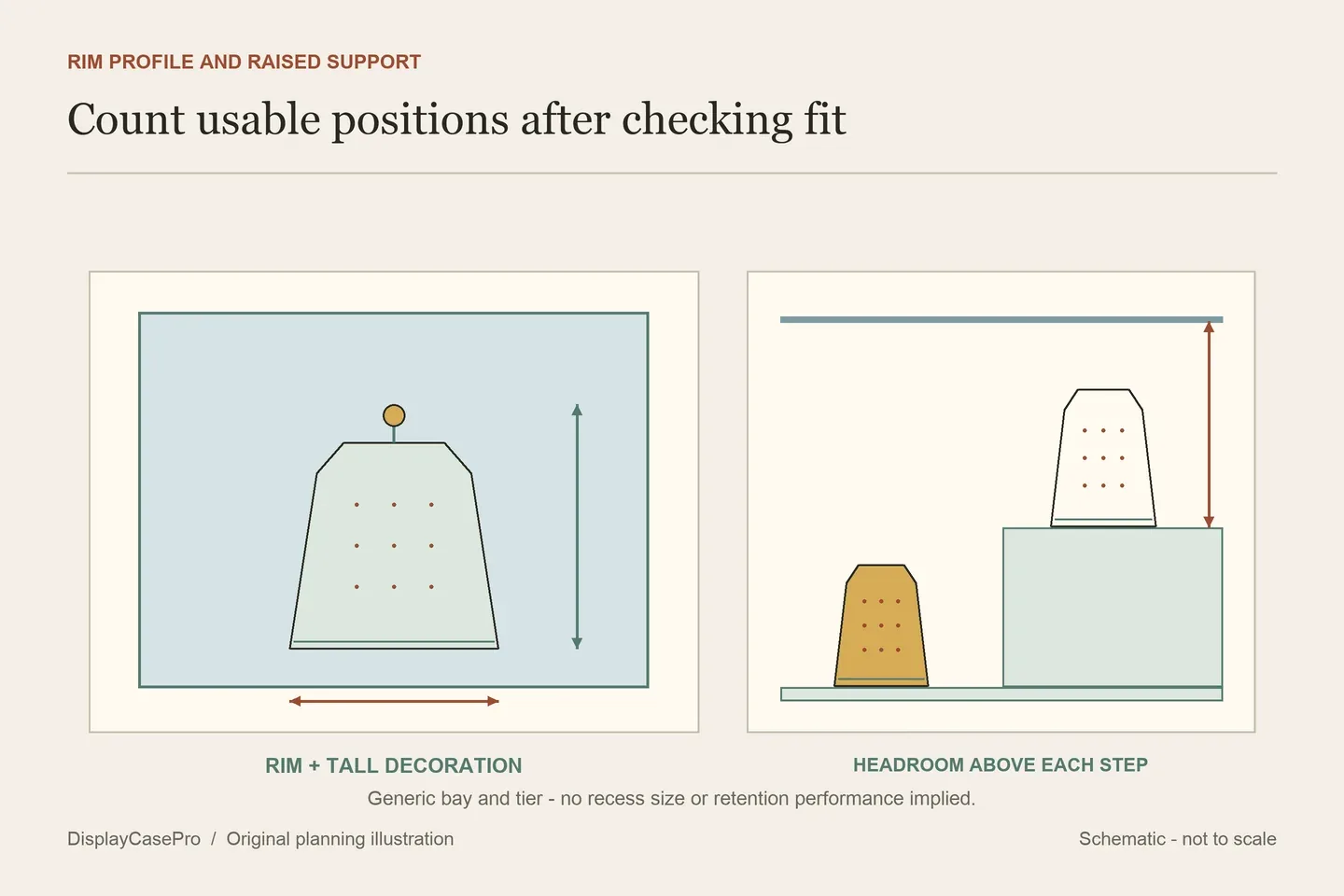
A stepped arrangement can reveal a back row without dividing every position into a fixed cell. It may suit a small selection with varied widths, provided the actual support surfaces and enclosure allow enough room. The raised row has less headroom beneath the same cover.
The SAFE 4794/4795 step-case listing makes the difference visible. Medium 4794 is listed as 7⅞ × 3½ × 4 inches overall, with a step 1⁹⁄₁₆ inches deep and 1⅜ inches high. Large 4795 is 11¾ × 5⅞ × 5⅞ inches overall, with a step 2¾ inches deep and 2⅜ inches high.
Those are overall-case and step figures. Subtracting the step height from overall height does not produce verified clear headroom: the base, cover thickness and internal arrangement still matter. Ask for usable space above each surface and the support's dimensions before assigning thimbles to a row.
Check how the front or dome comes off
A hinged front needs a door sweep; a sliding glass front needs withdrawal space along its travel direction; a lift-off dome needs room above the whole group. Check that operation at the proposed wall or shelf position, including the place where the removed cover will rest.
An individual vintage example, Aunt Gladys' Attic SKU KSSTC1024, describes a slide-out glass front and horizontal or vertical wall presentation. Its approximate 11¼ × 14-inch dimension line does not establish clear bay width, depth or the space needed to remove the glass. Use it as an access-format example, not a standard specification for all older cabinets.
Follow the instructions and mounting requirements for the exact cabinet. A listed empty weight is not its loaded support requirement. For a pre-owned case, confirm the actual fittings and condition rather than assuming it retains everything shown in an old photograph.
Plan retrieval from a populated position, not just the empty cabinet. You need to reach and support the thimble without pushing its neighbors or catching tall decoration. Do not solve an awkward position by forcing the rim onto a peg, wedging the piece into a recess or adding adhesive without a suitable mount assessment.
Make a position map before filling every opening
Use a simple front-view map for a grid, or tier-and-position references for a dome. Give each displayed thimble an identifier linked to the collection record. A row can follow a documented place, maker or design theme while still leaving larger pieces in the positions that suit them.
Keep labels separate where possible. Repeated small captions beneath a row can explain the sequence without covering the decoration or attaching anything to the thimbles. Leave uncertain dates and materials identified as uncertain rather than filling missing information to make the labels match.
The blank thimble profile and position worksheet records rim width, height, bay or tier dimensions and retrieval route. The general collection measuring guide helps keep usable interior, opening and exterior dimensions distinct.
Common questions
Does a 100-opening cabinet hold 100 tall thimbles?
The cited sfDisplay model specifies 88 standard positions and 12 taller positions. Check the actual bay geometry against your collection; the total is not 100 interchangeable tall bays.
Are shelf indentations enough to prove fit?
No. Their dimensions and contact with the thimble's rim still need checking, along with clear height, neighboring pieces and access. The nominal capacity assumes the maker's intended arrangement.
Should I choose a cabinet or dome?
A shallow cabinet provides a front-facing sequence; a dome provides round tiers with different viewing and retrieval routes. Choose from the actual shapes and decoration you want visible, then verify the specific support and enclosure dimensions.
About this guide: Product descriptions are attributed examples. No thimble has been fitted or mounted in the named displays, and no polishing, material identification or preservation treatment is prescribed.
Comments
Share a display tip or ask a question.