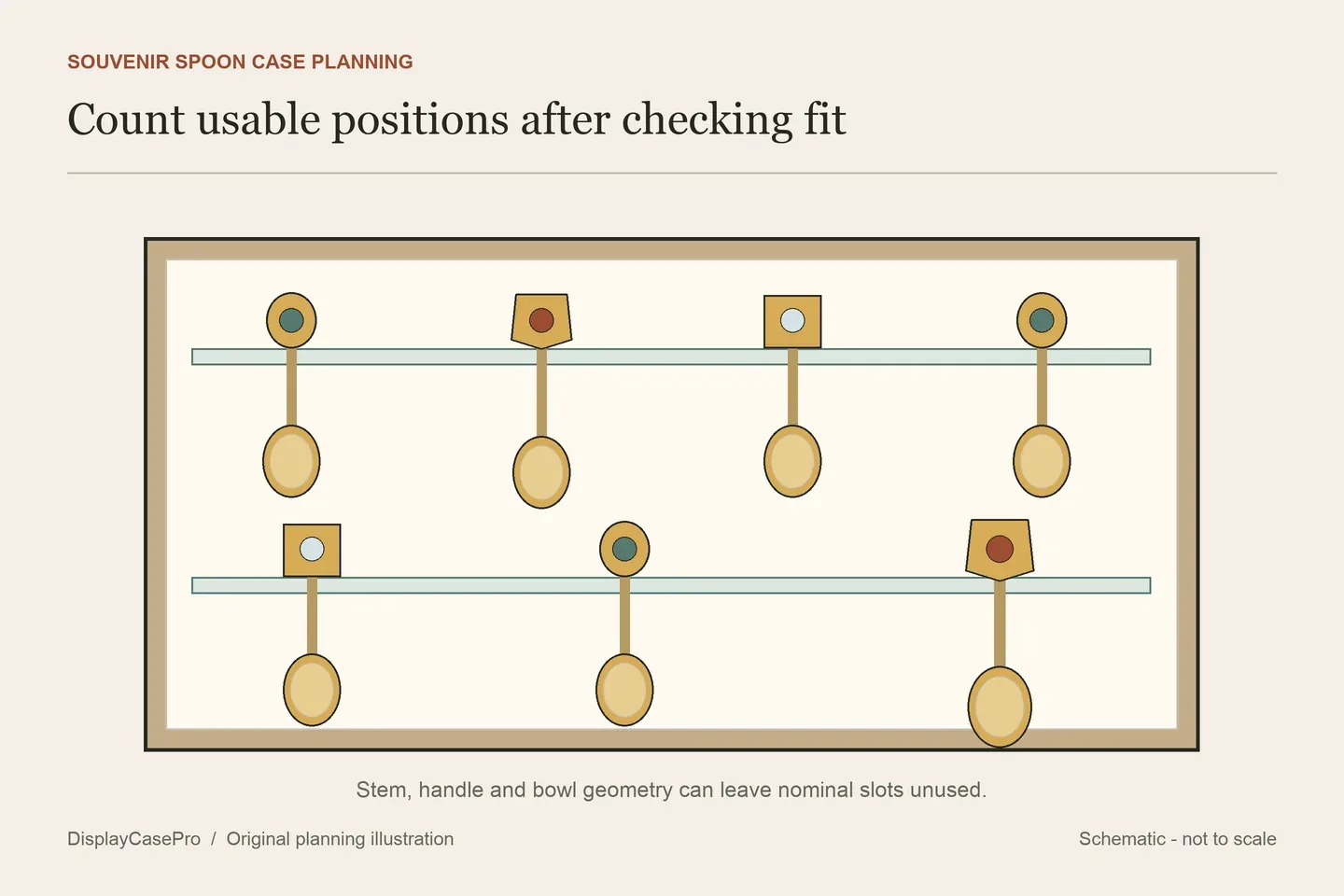
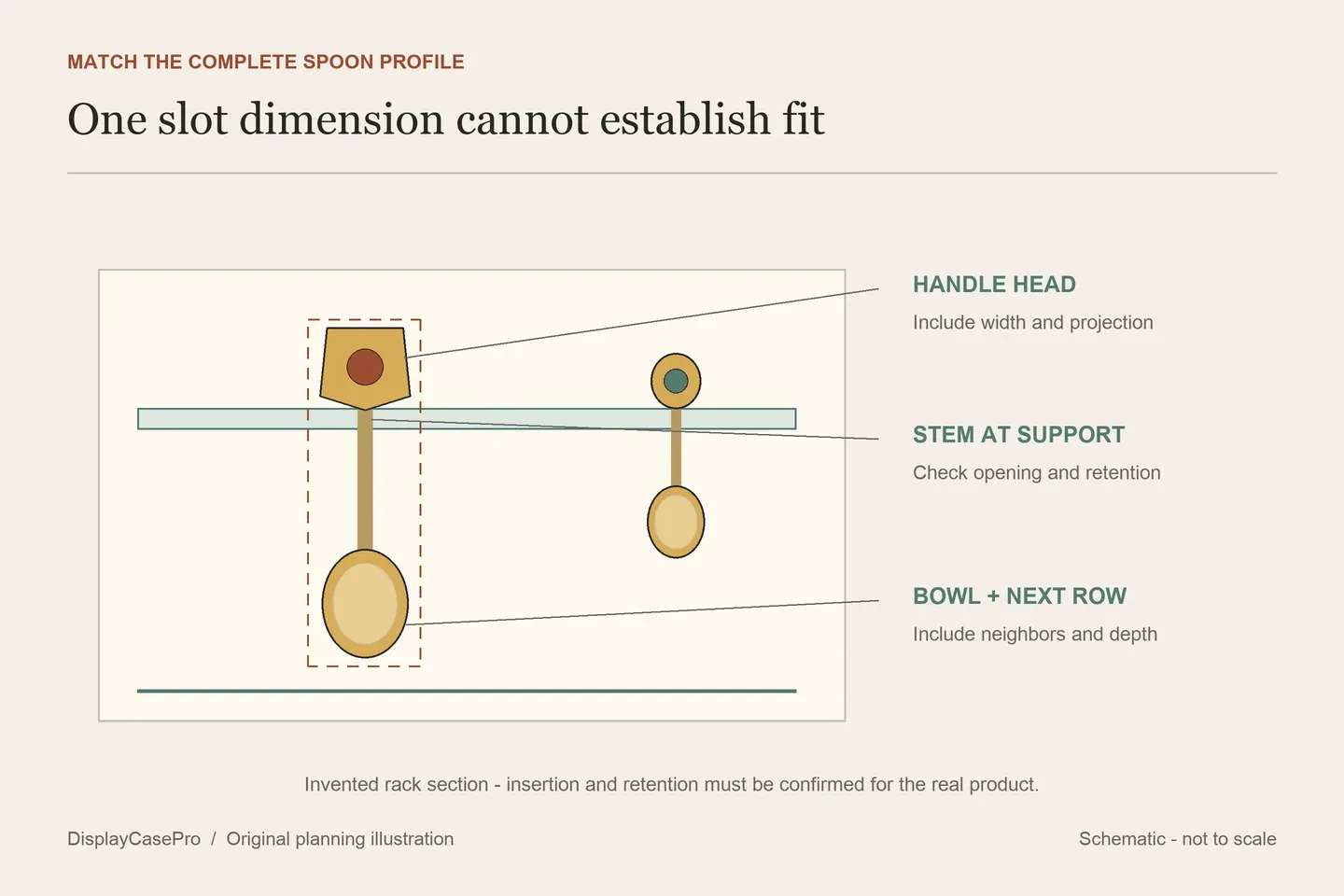
A souvenir spoon display case needs to match the spoons' profiles, not just their number. Check the handle head or medallion, the stem where it meets the rack, the bowl width and depth, and the length below the support. A “30-spoon” or “40-spoon” label describes a nominal arrangement, not guaranteed capacity for a mixed collection.
Measure more than overall spoon length
Identify each spoon by a collection code and retain the documented place, maker or acquisition information. A place name printed on a handle identifies the souvenir design; it does not by itself establish when or where that particular spoon was bought.
Record the actual spoon in the intended front-facing view. Include an enamel crest, projecting decoration or a differently shaped bowl. If the back bears a mark you want to study, photograph it for the record or plan access instead of treating the spoon as a permanently fixed front image.
| Profile or dimension | Why it matters | Ask the rack supplier |
|---|---|---|
| Overall length and intended support position | Determines where the bowl hangs relative to the row below. | Which part of the spoon bears on the support, and how much length can project below it? |
| Stem width and thickness at the intended rack position | The stem must enter the actual slot or groove as designed. | What are the clear opening dimensions and permitted profiles? |
| Handle head or medallion | A wide or projecting top can interfere with neighboring spoons or the case above. | How does this handle shape seat, and what space is available around it? |
| Bowl width, depth and any twist | Neighboring bowls can overlap even when stems fit every groove. | What is the spacing between positions and the usable depth to the closed front? |
Keep these as observations, not reasons to bend a stem, flatten a bowl or remove decoration. Choose the display around the collected object. A wider gap or an individual support may be more useful than filling every position in a dense rack.
Choose the support format for the actual group
A repeated rack for a fairly consistent collection
Rows of grooved supports can create a clear sequence when spoon profiles suit the rack. Establish how the intended support retains each spoon and how it is inserted. A slot that admits a stem does not alone show that the complete spoon will stay in the intended position.
A larger-format cabinet for mixed or longer spoons
Longer spoons and broad decorated handles may need more distance between rows or positions. Look for a specification of those distances rather than assuming a cabinet with a larger total capacity provides more space per spoon. A modest group can need a large cabinet if its objects are widely different.
Individual stands or a separate feature position
An unusually large spoon can be displayed separately, leaving the smaller travel collection in repeatable rows. Specialist catalogues such as Fine Home Displays' spoon selection include individual stands, racks and custom large-spoon cases. The format choice is useful; the exact support still needs to suit the spoon's shape and contact points.
Compare the meaning of the published dimensions
These product examples show why capacity, slot width, interior and outside size should stay separate. The figures are attributed specifications, not our measurements or proof that any particular spoon fits.
| Named case | Published information | What remains to check |
|---|---|---|
| sfDisplay 36 Spoon, dc1005b | Three grooved racks, up to 12 standard spoons under 5.5 in per rack. Inside 17 in H × 13 in W × 1 in D; outside 18 in H × 14 in W × 1.75 in D. | Actual groove dimensions, spacing and support position for your handles. Its listed top-to-bottom spaces are not a universal spoon-length allowance. |
| sfDisplay 40 Larger Spoon, dc1115b | Four racks of up to 10 larger spoons, described as having more space between grooves and shelves. Inside 27 in H × 15 in W × 1 in D; outside 28 in H × 16 in W × 1.75 in D. | The maximum accepted profile and usable row positions. “Larger” does not define every long or wide spoon that will fit. |
| Ikee Design acrylic case, COT1730 | 24 slots, each stated as 1/4 in wide. Overall 13 7/8 in W × 1 3/4 in D × 10 7/8 in H, with magnetic door closure. | Slot thickness/entry, distance between slots and rows, and clear interior depth. The 1/4 in figure is not the spacing available for a broad bowl. |
| Nile Corp wooden case, WD1731 | Up to 30 spoons and an overall 13.4 in W × 2.6 in D × 15.7 in H, with tempered-glass door. | Usable interior, groove dimensions and row spacing are not supplied in the main description read. The overall depth cannot fill those gaps. |
The sfDisplay 36 and 40 models illustrate a useful distinction: the larger-spoon version has more total positions, but fewer positions per rack. Its maker also explicitly describes wider spacing. That is more relevant than comparing the two capacity numbers alone.
Check for unresolved variant information as well. The Military Gift Store's cherry-finish spoon listing gives both 19 × 14 × 1.75 in and 19 × 22.5 × 1.75 in dimension sets, with different weights and row figures. The description does not clearly assign them to different selectable models. Request the current model and drawing rather than combining the narrow case's width with the other row layout.
Plan mixed sizes before counting filled slots
Make front-view paper outlines or use measured reference images. Mark the intended support location only after the supplier confirms how that spoon profile is held. Place the longest and broadest examples first on a proposed row map.
- Assign positions to unusual spoons. Check their full handles and bowls, not just the narrow stems.
- Check the row below. A long bowl should not obscure another handle or rest on the next rack unintentionally.
- Check neighbors. Allow for the actual widths and any rotation required by the support. Leaving a position unused can preserve a clear view.
- Place labels separately. A documented location, date or maker can sit on a separate caption strip without being attached to the spoon.
- Count usable positions last. Your collection's supported layout determines usable capacity, which can be below the nominal case count.
A place-based or acquisition sequence can provide a readable order. Keep undated or uncertain acquisitions labeled honestly. If you want to expand later, reserve a planned area or another case rather than assuming the remaining empty grooves will accept any future profile.
Check how a spoon enters and comes out
Ask the maker to explain insertion for the actual rack: which part passes through the opening, how it seats and which direction releases it. Do not infer that route from a front photograph. A decorative head that fits inside the case may still be unable to pass through a fixed opening.
Check the closed front against the spoon's most projecting part, including a curved bowl or raised emblem. For a wall cabinet, include the door's opening sweep and the space needed to reach the chosen row. Follow the exact case's mounting instructions and loaded-weight requirements; included brackets do not establish suitability for every wall.
Use the blank spoon-profile and rack-position worksheet to keep the stem, handle, bowl and row questions separate. The general collection measuring guide can help record the complete arrangement after those support positions are resolved.
Common questions
Does a 36-spoon cabinet hold 36 spoons from any collection?
No. The stated count belongs to the maker's intended arrangement and spoon category. Different stem sections, wide bowls or long handles can reduce usable positions.
Is slot width enough to establish fit?
No. It is one opening dimension. Confirm stem thickness, retention, insertion, neighbor spacing, row clearance and depth for the complete spoon.
Can a larger spoon share a small-spoon rack?
Only where the actual support and surrounding space suit it. A dedicated larger bay or separate stand can be a clearer solution than forcing it into a nominal slot.
About this guide: This is a display-planning comparison. It does not identify metals, prescribe polishing or restoration, certify supports, or report physical tests of the named cases.
Comments
Share a display tip or ask a question.