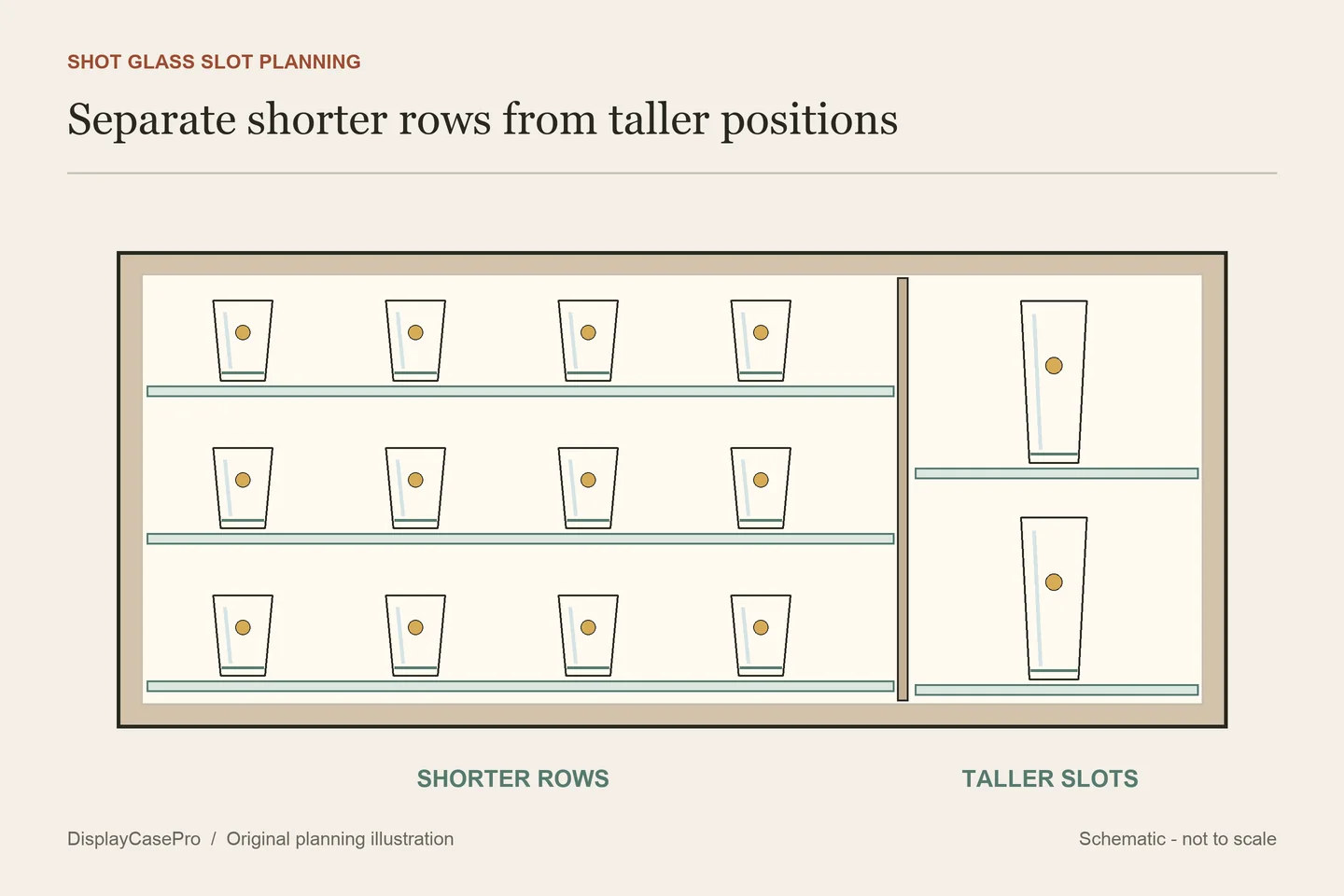
Useful shot glass display case dimensions include the clear shelf or slot opening, the available depth and the route used to remove each glass. Record the actual glasses, including tall shooters, flared rims and handles, then count the positions that accommodate them. A cabinet's advertised glass count describes an intended arrangement rather than a guaranteed capacity for every collection.
Measure the glass profile, including the exceptions
Sort the collection into ordinary-height glasses, taller pieces and unusual shapes before buying a cabinet. The terms “standard,” “shooter” and “souvenir” do not establish one shared set of physical dimensions. A glass's liquid capacity is also insufficient for determining how it fits on a shelf.
- Overall height: include a stem, foot or projecting decoration.
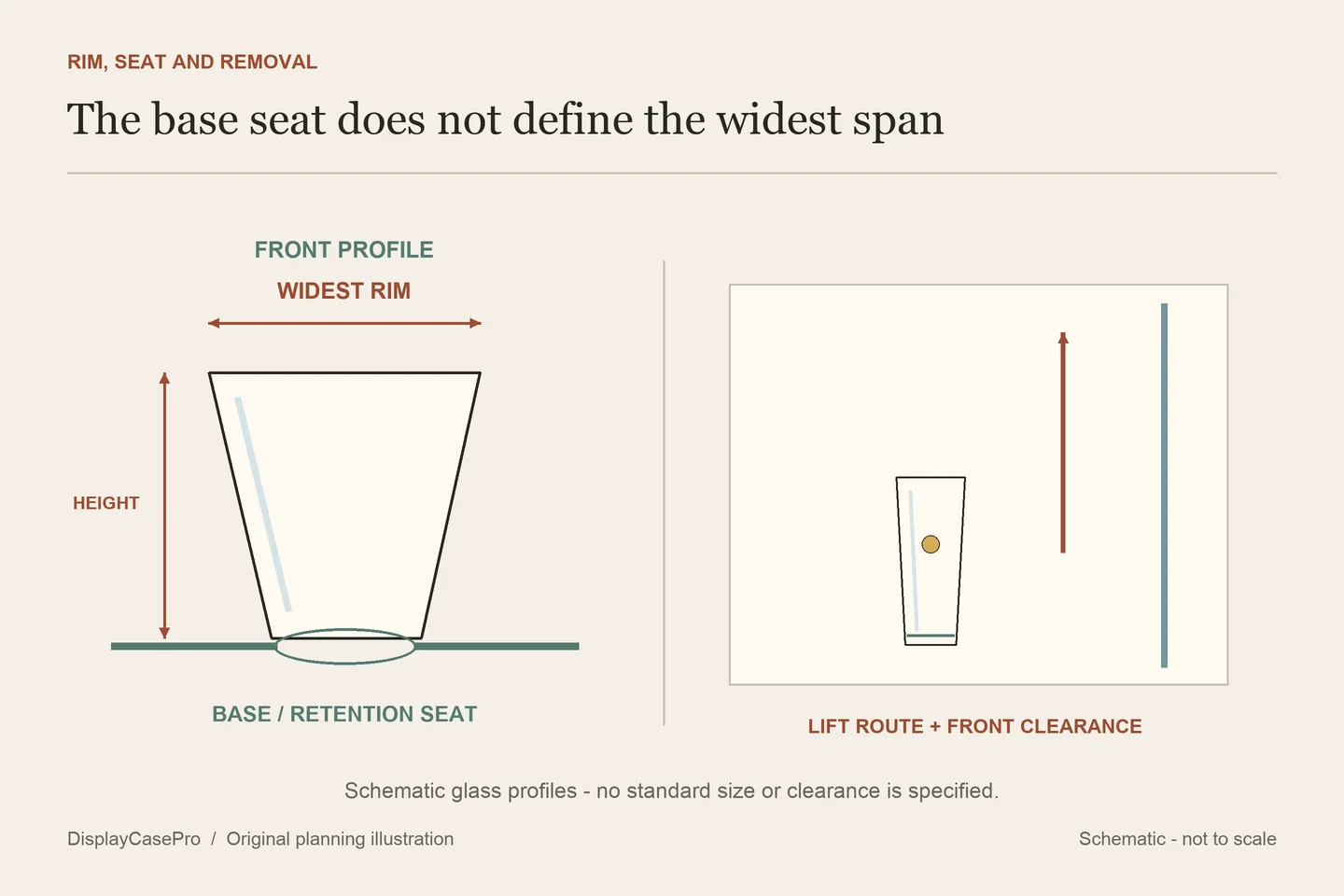
- Widest span: check the rim, handle and any applied ornament, rather than measuring only the base.
- Full depth: record the orientation that shows the important printed face.
- Base shape: note whether the glass has a flat foot, a narrow stem or another form that needs a particular seat.
- Removal space: establish how you can grasp or lift the piece without pressing on an adjacent glass.
Check more than one example of a repeated style if the collection varies. A novelty handle or flared lip can make one glass an exception within an otherwise regular row. Keep these exceptions visible in the inventory instead of discovering them after every compartment is filled.
Compare the outside, whole interior and individual slots
The SF Display 108 Shot Glass Display Case Cabinet lists two compartment heights. Its intended allocation is 96 shorter glasses and 12 taller ones. The specifications provide a useful example of why the overall interior and the individual opening need separate records.
| Specification | Height × width × depth | Planning use |
|---|---|---|
| Outside case | 35 × 25 × 3.75 in | Wall footprint and projection |
| Whole inside | 33 × 23 × 2.5 in | Overall interior, before treating partitions as available space |
| Shorter compartment | 2.5 × 2.5 × 2.5 in | Compare the complete glass profile and access |
| Taller compartment | 5.25 × 2.5 × 2.5 in | Extra height, with the same listed width and depth |
These are the maker's figures, not our measurements. A taller compartment does not automatically accommodate a wider rim, handle or deeper decoration. A close numerical match also leaves the opening and handling questions unresolved.
For a different format, the single-glass A046 option on Better Display Cases' product page lists a 3-inch outside cube and a 2.75-inch inside cube. That difference belongs to that option; it is not an allowance you can subtract from every case on the market. Check the selected variant's own interior figures and opening method.
For adjustable-row cabinets, obtain the clear shelf width and depth plus the available shelf positions. An approximate whole-interior footprint does not tell you the clear height of each planned row. Ask the maker whether “shelf width” refers to the shelf's front-to-back size or its side-to-side span when the wording is unclear.
A placement hole and a glass rim answer different questions
Some cabinets use openings or recesses to position the glass. Display Shack's 60-place cabinet lists 1⅝-inch placement holes spaced 2 inches on center and a sliding acrylic front. The hole diameter concerns the seating arrangement. It does not establish the maximum rim width of every glass that could occupy those positions.
Check both the individual seat and the space between neighboring glass outlines. A broad rim can extend beyond a narrow foot. Handles can overlap the next position, and a stem may sit differently from a straight-sided glass. Confirm how the intended base rests before assuming the piece will stand securely.
A protective front panel also needs clearance from the projecting face of the glass. It should close without using the collection as a stop. Keep any supplied retention feature in the configuration intended by the maker, and do not assume a household putty or adhesive is suitable for every decorative finish.
Count usable positions for your collection
Begin with the hardest-to-place glasses. Assign tall pieces to suitably tall positions, then check broad or handled pieces against the remaining openings. Ordinary shorter glasses can occupy some larger spaces, but doing so may use a position needed by an exception.
- Give every glass a record number and note the face you want visible.
- List the cabinet's actual row or slot types, including their clear dimensions.
- Match the tall and unusually shaped pieces first.
- Check each remaining group against its proposed positions.
- Record places that remain uncertain, obstructed or intentionally empty.
- Count the verified positions, with a separate plan for the pieces left over.
For adjustable shelves, lay out paper footprints on an empty shelf before setting its height. Leave room to grasp the glasses and read their decoration. The widest piece may dictate a row's usable count even when several narrower pieces would fit side by side.
Group a travel collection by trip, destination or acquisition date if that helps you find a piece later. Keep the full story in the catalogue and use short visible labels. A regular grid can still work when a few unusual glasses have their own separate enclosure.
Download the blank glass-and-slot fit worksheet. It records height, rim or handle span, base shape, assigned opening and unresolved access. For measuring an assembled support or enclosure consistently, use the collection measurement guide.
Check the door route and the loaded installation
A sliding front needs room to move in the direction specified by the maker. A hinged door needs a clear swing, and a lift-off cover needs space above it and a clear place to set it down. Check those movements at the proposed wall or shelf location, including access to the end positions.
For wall mounting, distinguish the empty cabinet weight from a loading limit. The SF Display 108 listing gives a unit weight of 28 lb. Confirm what that figure includes; it is not a stated loaded weight or support limit. Account for the contents and follow the exact model's installation requirements.
That listing links to the maker's heavy-duty hanging-kit instructions, which use rear hangers and lower support brackets. This is a model-provided support arrangement, not a generic picture-hook recipe. Verify the supplied hardware, wall construction and current instructions before installation.
Once loaded, check the view through the closed door. Shelf edges can hide printing near a glass's base, while a reflected window can obscure an entire row. Adjust the location or arrangement before adding more glasses or lighting.
Common questions
What shelf height should a shot glass cabinet have?
Use the tallest complete glass assigned to that row, its support and a practical removal route. Published examples vary, including different short and tall compartments in the same cabinet. There is no single shelf height established by the name “shot glass.”
Does a sixty-glass cabinet always hold sixty souvenir glasses?
The count describes the maker's intended layout. Mixed tall, broad, handled or irregular pieces may require fewer usable positions. Check the seat, clear opening and neighboring outlines before counting a position as suitable.
Can I use a deep shadow box instead?
A few glasses can form a keepsake display if they have appropriate individual support and retention. Depth alone does not supply shelves or prevent tipping. Plan the support and the viewing orientation before selecting the enclosure.
Comments
Share a display tip or ask a question.