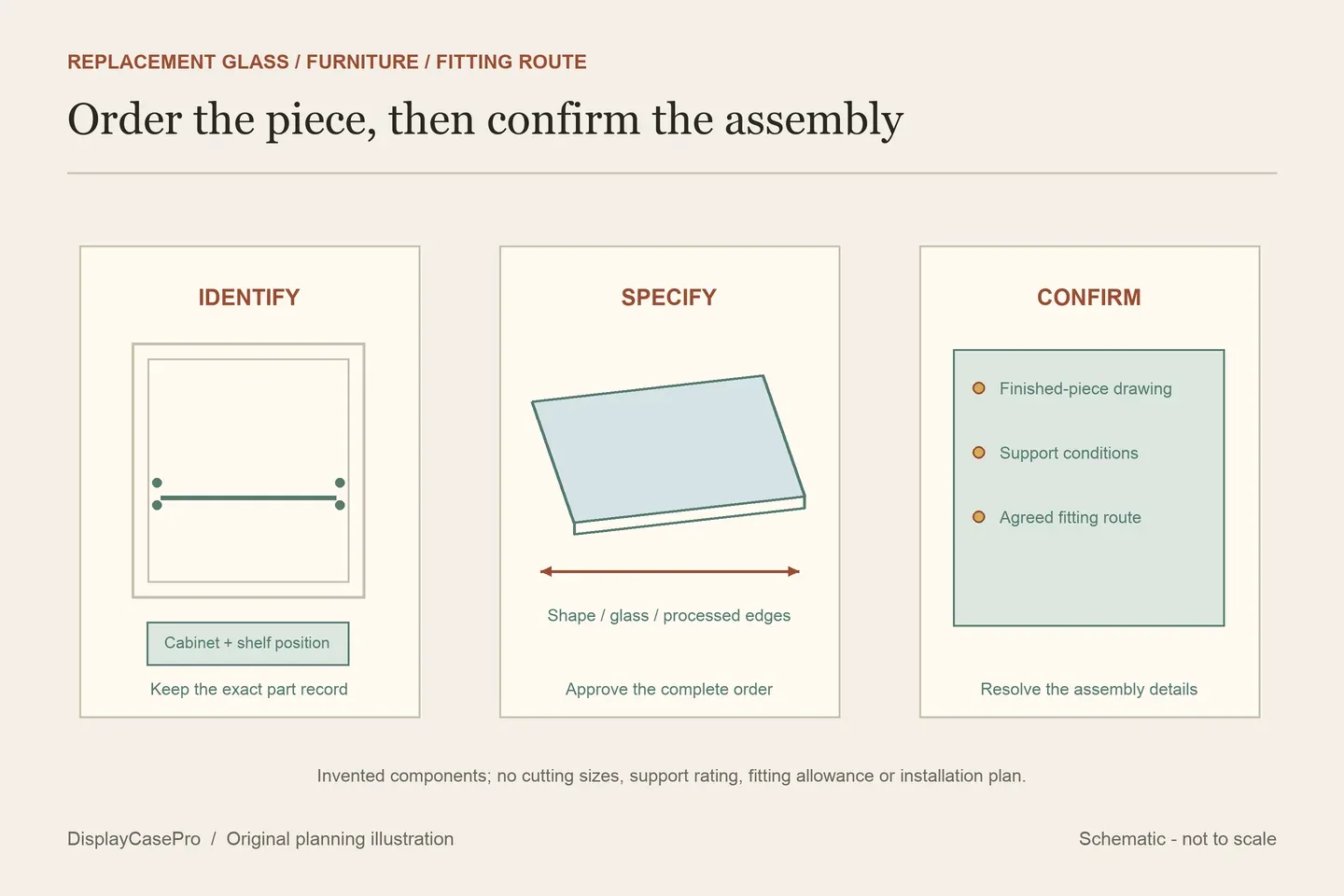
For glass display cabinet shelf replacement, identify the cabinet and original shelf first, then choose an exact stock part or a custom-cut replacement. Keep the finished glass dimensions separate from the cabinet opening. Confirm shape, thickness, edges, supports and cutting tolerance before approving the order.
Start with the cabinet model and shelf level
Find the maker, cabinet model, assembly instructions and any shelf part number. Record which level needs a replacement. Two shelves in one cabinet can differ where a back panel, door track or internal fitting changes the outline. A cabinet’s advertised outside width does not identify the glass piece.
If an undamaged matching shelf is available, ask the supplier whether it is an appropriate reference for that position. Record its finished outline and the original support arrangement. If the only reference is broken, missing or uncertain, use the cabinet drawing or an assessment by the furniture maker or glass fabricator. Do not reconstruct a cutting template from loose fragments.
Keep a photograph of the empty position and fittings with the model details. It can explain an obstruction or a shaped front, but it cannot establish dimensions without a dependable scale. The order needs a confirmed piece specification as well as a picture.
There are three different routes to a replacement
The following original pages were read on 19 October 2026. They include stock-glass categories, custom-order pages and a replacement service guide. Their descriptions explain available ordering routes; they are not our fit tests, capacity measurements or ranked recommendations.
| Source | Ordering route | What to confirm |
|---|---|---|
| KC Store Fixtures | Stock glass pieces with individual SKUs; both plate-glass and tempered products appear. | Exact part, glass type, finished dimensions and intended showcase. |
| Store Fixtures Direct | Stock tempered-glass shelves in different listed depths and lengths. | Selected shelf SKU and full specification; category membership alone is insufficient. |
| One Day Glass | Custom sizes, glass types, edgework, fabrication options and tolerance FAQ. | The final configured quote, actual thickness and support conditions. |
| Royalty Mirror | Custom replacement glass with shape, color and edge choices. | Finished-piece measurements and the allowance appropriate to the cabinet. |
| Glass Doctor | Assessment, quotation and installation service for china and curio shelves. | Who measures, confirms the shape and installs the replacement in your area. |
KC’s category illustrates why the part number matters: SKU 14024 is an 8 × 34 × 1/4 inch plate-glass shelf described for a 70-inch showcase. That does not make 34 inches the shelf width for every 70-inch cabinet. Store Fixtures Direct separately lists W-GS834T as 8 inches deep by 34 inches long. Similar length labels do not identify interchangeable parts, glass treatment or support requirements.
For an unidentified or shaped shelf, a custom or assessed service may be a more useful starting point than finding the nearest stock rectangle. Glass Doctor describes measuring on site or requesting photos and measurements, then quoting and arranging installation. Confirm the actual service offered; the published process does not verify local availability or your cabinet’s condition.
The finished piece, receiving space and insertion route need separate records
Record length, depth and thickness with units and a sketch showing the front. Add curves, corner radii, notches, holes and any groove that the intended part requires. Do not silently replace a shaped shelf with a rectangle because its longest dimensions match.
| Record | What it describes | Next check |
|---|---|---|
| Finished glass piece | The supplier’s final outline, thickness and processed edges. | Confirm drawing, dimensional tolerances and fabrication details. |
| Cabinet receiving space | Supports, rebates, side walls, rear fittings and other restrictions. | Ask how the approved piece fits this exact structure. |
| Insertion route | The door opening and permitted movement into the shelf position. | Confirm fitting instructions without assuming the glass can be bent or forced. |
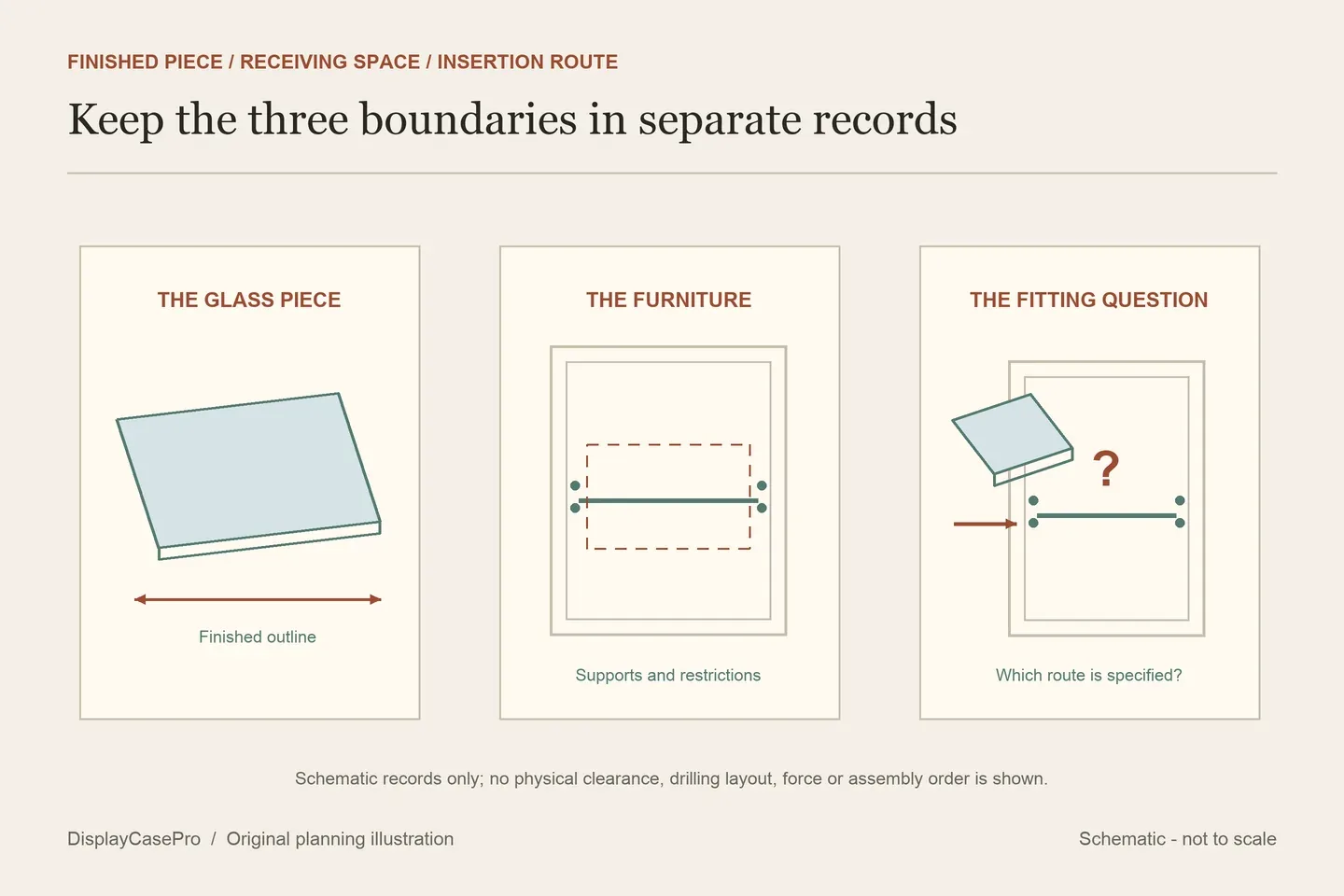
Royalty Mirror’s measurement section describes edge-to-edge glass measurements and says to use the largest value when measurements vary. Do not apply that wording automatically to a tight cabinet opening. Ask the supplier to reconcile the finished-piece size, receiving space and fitting allowance. A supplier’s ordering instruction needs its measurement context.
One Day Glass distinguishes nominal thickness from exact thickness and publishes cutting tolerances. Its FAQ lists ±1/16 inch for its 1/8, 3/16 and 1/4 inch categories, and ±1/8 inch for 3/8 and 1/2 inch categories. Treat these as that supplier’s published ordering information, not a clearance to subtract from every cabinet. Confirm the selected quote and agreed allowance before fabrication.
Specify the glass, visible edges and any processing together
Ask the cabinet maker or fabricator to confirm the required glass type and thickness for the supported span and intended load. A generic thickness-use chart does not assess the complete furniture assembly. Keep any coating, tint, patterned surface or mirror treatment identified separately.
One Day Glass offers seamed and more decorative edge finishes and describes holes and slots being made before tempering. Put required fabrication on the approved drawing before production. Do not assume a finished replacement can later be drilled or reshaped to correct a mismatch.
The One Day Glass page also has a title naming a 1/8 inch, seamed-edge configuration while its surfaced selection displayed 1/4 inch and flat-polished edges. Verify the final configured order rather than copying the page title. For exposed shelf edges, agree the actual edge finish; appearance alone cannot identify a processed edge or glass type.
A correctly cut piece still needs an approved support arrangement
Record the existing fittings, contact pads, shelf positions and support span. Include the replacement glass itself, collectibles, individual cases, stands and risers in the complete load information supplied for assessment. Neither a matching outline nor a supplier’s glass calculator independently approves the cabinet and its fittings.
If a support is missing, loose or damaged, settle that part of the repair with the maker before loading new glass. Keep the support question in the order notes instead of assuming a thicker panel compensates for an uncertain fitting. Our display measurement guide helps keep the collection, enclosure and handling records separate; the replacement drawing adds the piece-specific details here.
Approve the final piece and fitting plan together
Save the cabinet identity, shelf position, approved drawing, glass treatment, finished dimensions, edgework, tolerances, support requirements and fitting instructions in one record. Mark unresolved details clearly before approving a stock substitution or custom order.
On arrival, check the supplied identification and condition against that record, then follow the maker’s handling and fitting instructions. Do not force a mismatched piece into position or reload a cabinet while support questions remain unresolved. This guide provides a replacement-order brief; no glass cutting, installation or load test was performed for it.
Comments
Share a display tip or ask a question.