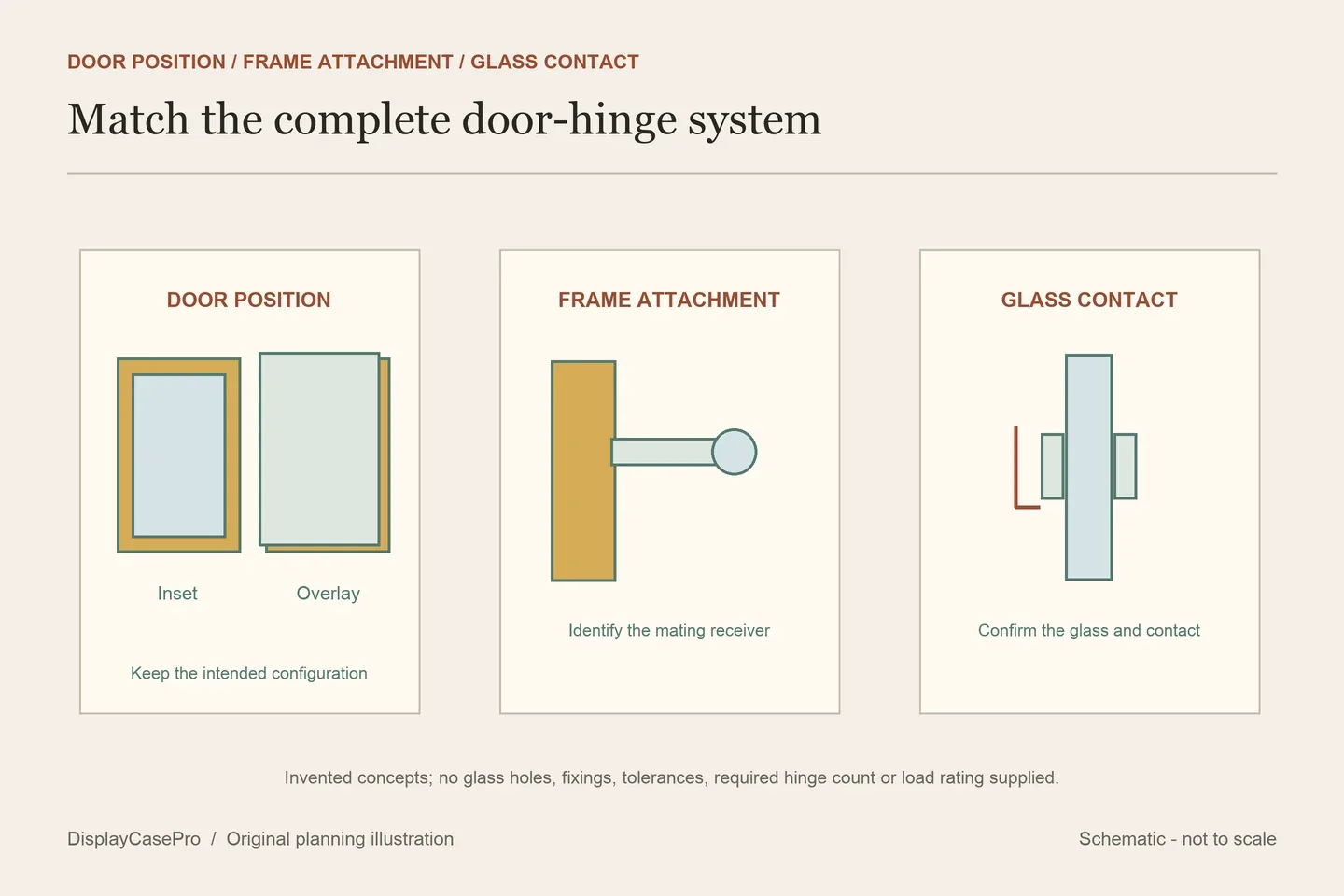
Match display cabinet glass door hinges to the existing cabinet attachment, the door’s inset or overlay position, and the glass interface. Then confirm the complete hinge set, glass thickness and permitted door size and weight. A similar finish, or the words “glass hinge,” cannot establish that two parts are interchangeable.
Identify the cabinet, door position and existing part first
Find the cabinet maker, model, instructions and hinge identification. Record whether the fitting attaches at a door edge, pivots at the top and bottom, or uses a different specified arrangement. Photograph the fitting in place and its relationship to the frame. Do not remove or loosen a loaded glass door simply to obtain a clearer picture.
Keep the door’s position in the record. An inset door sits within the cabinet opening; an overlay arrangement covers part of the surrounding cabinet face. For adjacent doors sharing a partition, identify the maker’s intended configuration rather than guessing from one hinge arm. The correct replacement depends on the complete arrangement.
Also distinguish a frameless glass panel from a framed door containing glass. A hinge attaching to a wooden door frame has a different receiving surface from a fitting intended to grip the glass itself. If the cabinet or mounting area is damaged, resolve the repair with its maker before selecting replacement hardware.
The hinge sources describe several different families
The following original pages were read on 19 October 2026. They include four categories and one selected product page. This is a comparison of published component information, not a ranked recommendation or an installation and load test.
| Source | Published distinctions | Check for your door |
|---|---|---|
| HardwareSource | Bore and non-bore fittings, inset and overlay configurations, European and pivot systems. | Selected hinge, arm, plate and other required components. |
| FHC | Surface and flush pivots, wall-to-glass fittings and different glass-thickness ranges. | Exact item number, frame attachment and glass range. |
| HingeOutlet | Inset, overlay, side-mounted, no-bore and catch-equipped variants. | Actual item material, cabinet application and purchase unit. |
| Reflect Window & Door | SH-111BL standard-mount description with glass retention and door-limit information. | Mounting drawing, supplied quantity and full rating conditions. |
| Richelieu | Several pivot and swivel families, with converted-dimension and packaging information. | Manufacturer measures for the selected part and mating hardware. |
Do not carry a collection’s general description into every product. HingeOutlet’s introduction describes stainless steel and shower-door use, while its visible cards include brass and steel cabinet hinges. HardwareSource likewise describes several systems whose plates, caps and arm configurations differ. Select the actual item before using a material or opening claim.
“No bore” needs a specific receiving surface
Separate the cabinet attachment from the glass retention. Reflect’s SH-111BL description specifies drilled cabinet-frame holes and set-screw retention of the glass. Thus, a fitting that grips a glass edge does not necessarily eliminate holes in the furniture. Ask which part of the assembly a “non-bore” description refers to.
| Interface | Record | Resolve before ordering |
|---|---|---|
| Cabinet attachment | Existing frame, plate, socket, receiver and fixing pattern. | The exact mating part and condition of its receiving area. |
| Glass retention | Specified edge grip, pads, cut-out or hole arrangement. | Glass type and thickness, contact pieces and required drawing. |
| Door position | Inset, overlay, shared-partition arrangement and opening direction. | Correct hinge configuration and normal movement. |
| Complete hinge system | Arm or pivot, plate, caps, gaskets and specified fasteners. | Everything needed to form the maker’s intended assembly. |
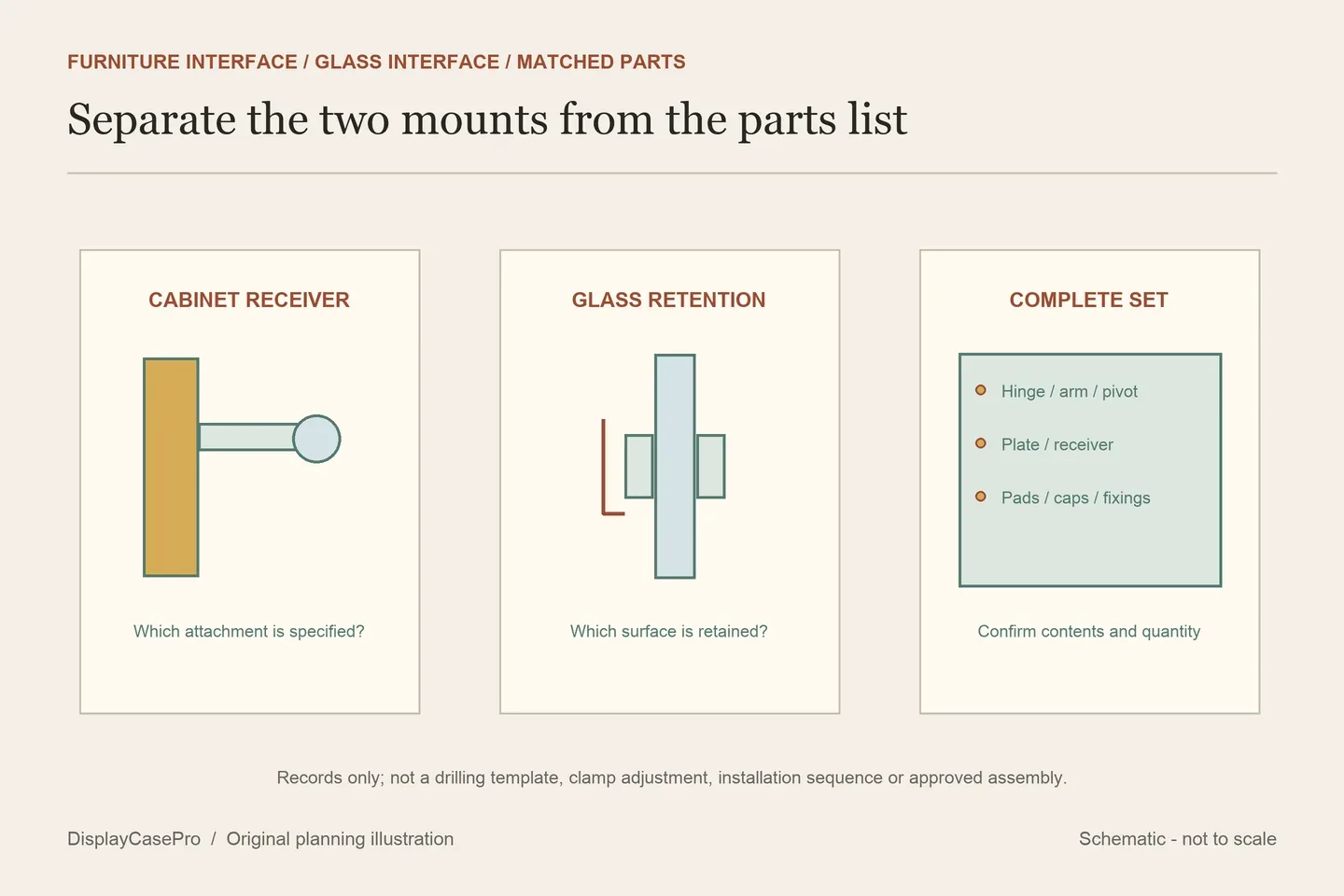
If a proposed part requires a different glass cut-out or mounting pattern, ask the cabinet maker or fabricator which replacement arrangement is approved. Keep that question open instead of treating a close visual match as permission to modify the existing panel.
Keep glass thickness separate from the supported door
FHC’s category lists EH172CH for 3/16–1/4 inch glass and EH168CH for 3/16–5/16 inch glass. The ranges belong to different items. They do not make the wider-range part a universal substitute, or establish what either fitting supports in your cabinet.
Record door width, height and documented weight separately from thickness. Reflect’s read product description lists a maximum door width of 18 inches and a 16 lb capacity. Confirm the required hinge arrangement and rating conditions with the supplier; do not interpret the figure as a per-hinge allowance and multiply it by the number you intend to fit.
Retain the original units on the selected drawing. Richelieu explicitly marks some displayed dimensions with an asterisk and says they are conversions, not the manufacturer’s official measures. A rounded displayed value is not a new fitting tolerance. Request the actual specification when comparing an existing opening or receiver.
Resolve the part list and purchase unit together
Ask whether the order includes the hinge alone, a pair, a mounting plate or a larger assembly. Reflect’s description says “Sold by: Each,” while the surfaced selector says “Pair.” Get the quantity confirmed for the selected option rather than silently choosing one interpretation.
Keep pads, gaskets, caps and mating receivers identified with their own part details where supplied separately. HardwareSource’s European-hinge discussion names several components; a matching finish does not show that a basket contains all of them. Similarly, a hinge listed with a catch has an additional function that should not be assumed for a plain variant.
The specified number of hinges and their positions must come from the complete system’s instructions. A generic category statement about using two hinges does not assess an unusually wide, heavy or differently mounted door.
Save a replacement brief that the supplier can answer
Use the glass-door hinge matching record to keep cabinet identity, door position, glass specification, receiving details, complete parts, limits and unresolved questions together. Add the selected SKU, finish, order unit, source drawing and confirmation date.
Finally, check normal opening and access against the cabinet instructions. Our display measurement guide helps record the collection and handling route; it does not approve a hinge. No door installation, alignment, retention or load testing was performed for this guide.
Comments
Share a display tip or ask a question.