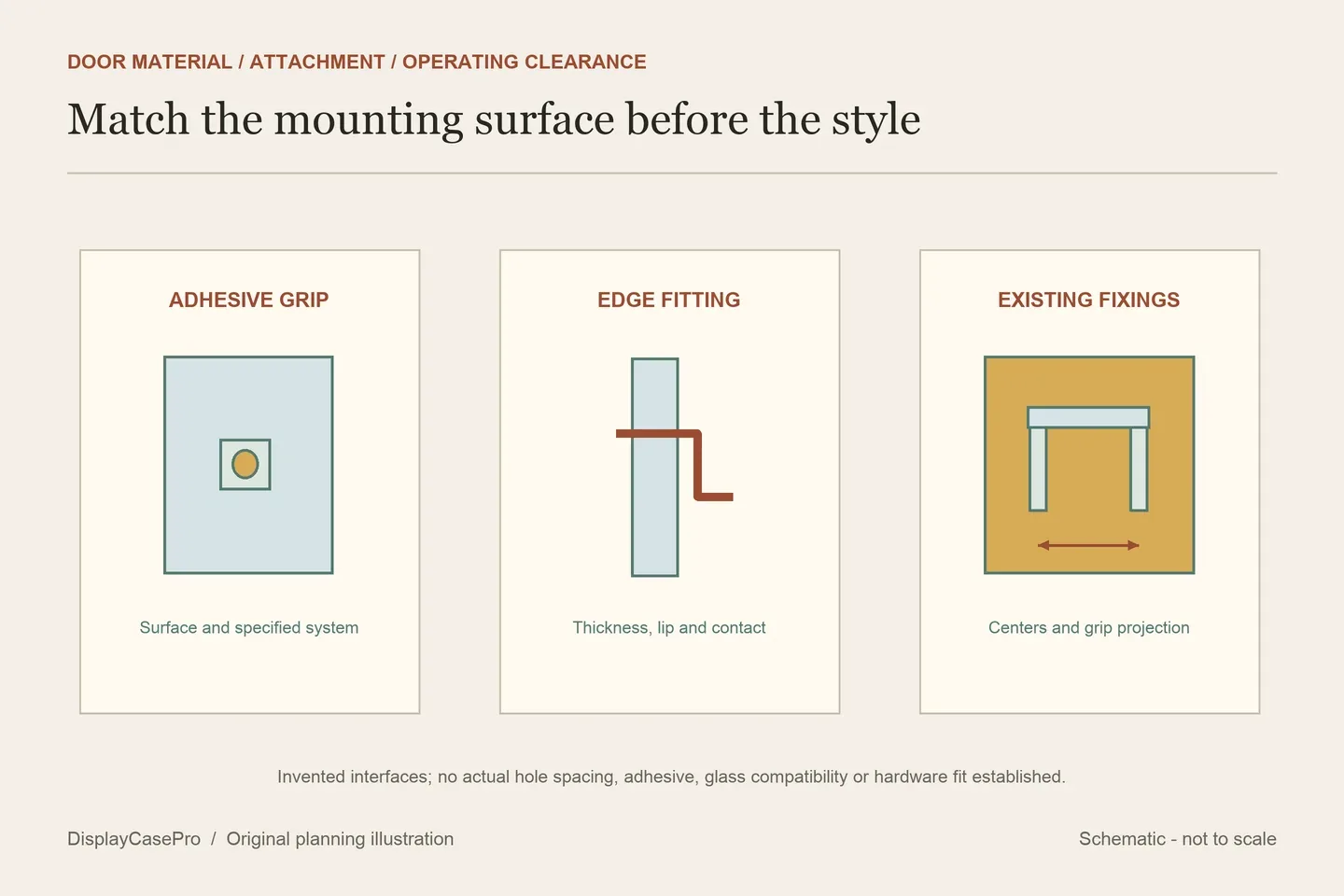
Choose display cabinet door handles by the door material and existing attachment first. A decorative glass knob and a handle designed to attach to a glass panel are different descriptions. Match the actual mount, then check hole centers, overall size, projection and the space needed to operate the door normally.
Start with the door, not the appearance of the knob
Identify the cabinet maker and model, the door construction and any existing handle number. Distinguish a frameless glass panel from a wood-framed glass door or a solid panel. Then record where the current grip attaches and whether the door slides or swings.
Photograph the fitting without loosening glass or exposing unsupported components. Note whether it uses an adhesive pad, an edge fitting, a slip-on arrangement or existing screw holes. A photograph helps identify the type but cannot establish a missing dimension or confirm an unseen fixing.
Keep two material questions separate: what is the handle made from, and what surface is it intended to attach to? “Glass cabinet knob” can describe the decorative material of the knob. It does not, by itself, approve the fitting for a frameless glass door.
The original results include fittings, decorative hardware and sales boards
These original pages were read on 19 October 2026. Their differing purposes matter when choosing a replacement. The comparison below preserves those differences; it is not a ranked shortlist or a compatibility test.
| Source | Observed content | Use it for |
|---|---|---|
| Reflect Window & Door | Showcase finger pulls, acrylic stick-on grips, an edge pull and a finger-grip strike plate. | Identifying a grip’s attachment and operating role. |
| CRL | A mixed showcase-hardware category with finished grips, extrusions, strike plates and other components. | Finding the exact handle part within its specified system. |
| Van Dyke’s Restorers | Decorative glass, porcelain and acrylic knobs and pulls, with diameter and boring filters. | Comparing handle material and selected mounting dimensions. |
| Forge Hardware Studio | Lucite and glass furniture hardware with centers and mounting-hole filters. | Checking a selected decorative fitting’s specification. |
| Hardware Resources | Sample display boards presenting hardware collections, rather than a replacement-door mounting specification. | Recognizing a sales-display product as a different purchase task. |
CRL’s read category contained 70 results, with 48 item labels visible on the first page. It also included hinges, tracks and latches. Neither its shared glazing filters nor its category load filters describe every handle. Identify the selected grip before using any range or rating.
Likewise, the Hardware Resources page’s DB-prefixed sample boards do not specify a pull for your cabinet. A board displaying a hardware collection is not a display-cabinet door fitting. Retain that distinction when following a broad search result.
Match the existing attachment before comparing finishes
| Attachment | Record first | Ask the maker |
|---|---|---|
| Adhesive or stick-on grip | Exact receiving surface, coating and specified grip. | Approved preparation, adhesive system and normal removal procedure. |
| Edge or slip-on fitting | Glass thickness, edge profile, contact pieces and return or lip. | The exact clamping or retention arrangement and permitted panel. |
| Existing through-hole fitting | Hole count, diameter, spacing and complete contact hardware. | The matching fixing, washers and substrate requirements. |
| Fitting on a framed or solid door | Actual mounting surface, existing centers and panel construction. | Correct screws and receiving structure for the selected part. |
Reflect’s category includes the SH-103AL stick-on grip and SH-106AL extruded finger pull. They are different attachment choices, not merely different finishes. CRL similarly lists FP88 as a stick-on grip and separately lists slip-on fittings and finger-pull extrusions.
Do not select an adhesive or improvise contact pads from the handle’s appearance. Confirm the instructions for the actual surface and complete part. If a candidate requires a new glass hole or a changed mounting pattern, resolve that with the cabinet maker or fabricator before ordering.
Hole centers, overall length and projection answer different questions
For a screw-mounted pull, record the center-to-center spacing of the existing fixing holes. Keep their diameter and the required fixing details in separate fields. Then record the handle’s overall length and how far the grip projects from the finished door surface.
The same number can describe different features. Van Dyke’s lists its 204021 glass bridge handle with 3-inch boring, while Reflect’s SH-106AL title gives a 3-inch length, a 1-inch lip and a 1/4-inch glass specification. Do not treat those two 3-inch labels as interchangeable measurements.
Forge’s centers and mounting-hole filters help locate candidate decorative hardware, but a filter value does not establish the whole fixing arrangement. Likewise, a long extrusion and a ready-to-fit short pull need different order details. Ask what length and finishing the selected supply unit includes.
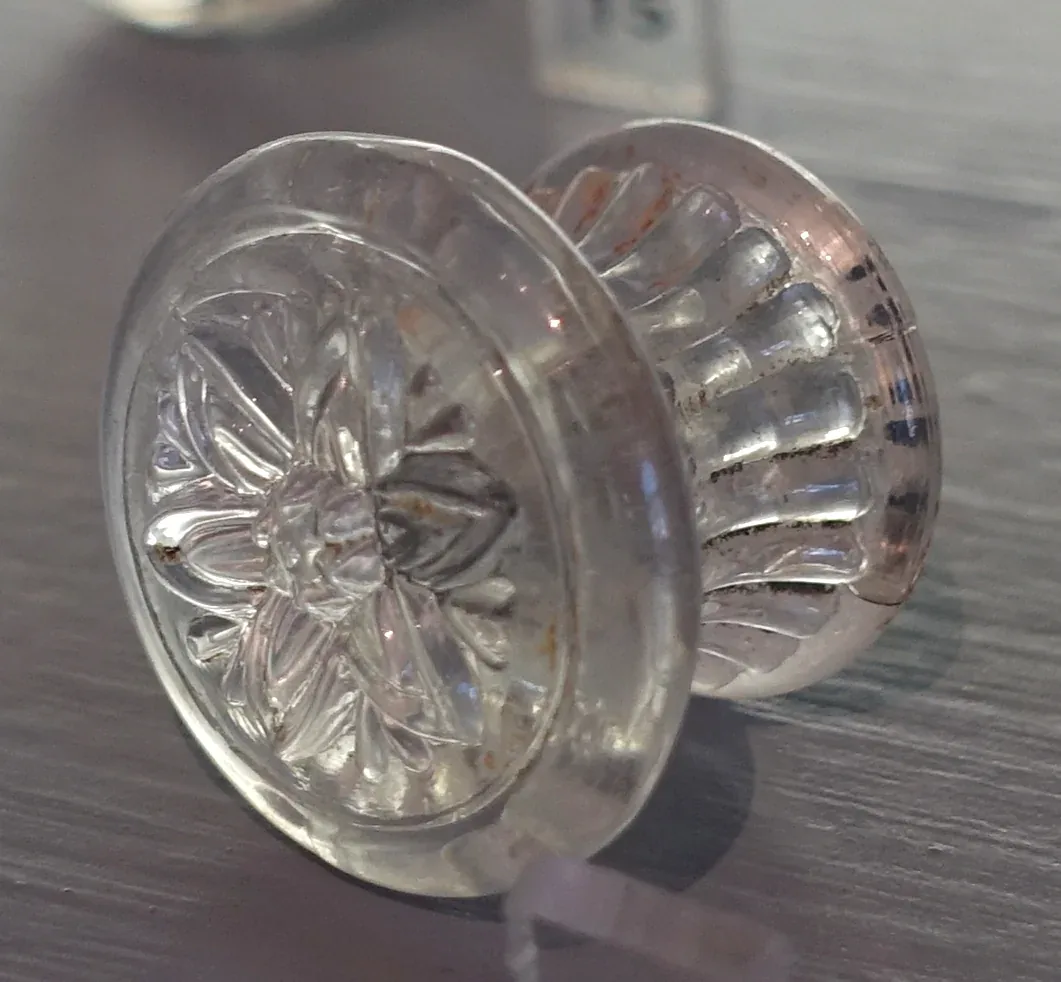

The historical knob shows why a material description is incomplete. Its decorative glass form does not supply the fixing dimensions of a modern replacement. Use the selected product’s drawing and cabinet information, not the photograph, to resolve those fields.
Check how the complete grip moves with the door
For a sliding door, record the neighboring panel, overlap and other hardware encountered along the normal travel. For a hinged door, include the handle’s projection and the furniture around the permitted swing. A grip that attaches to the panel can still interfere with another part of the cabinet.
Keep the operating function clear too. A pull gives you a place to grip; a finger-grip strike plate also relates to a latch. Reflect lists SH-105BL in that role, and CRL lists finger-grip strike plates among ordinary pulls. Replacing one with the other requires checking the complete closure arrangement, rather than matching color alone.
A grasping shape does not establish a lock or security rating. Similarly, related shower-handle cards on a decorative-hardware page do not approve those items for a lightweight display door. Ask for the exact cabinet application and required mating components.
Keep the selected part and unresolved questions together
Download the display-cabinet handle record. Save the cabinet identity, door material, attachment, hole details, projection, contact pieces, operating role, selected option and confirmation date. Confirm the pack unit and included hardware before treating the order as complete.
Use the display measurement guide for the collection and handling route, while keeping these component measurements separate. This guide supplies a replacement brief based on published sources; no adhesion, installation, grip-force or door-travel testing was performed.
Comments
Share a display tip or ask a question.