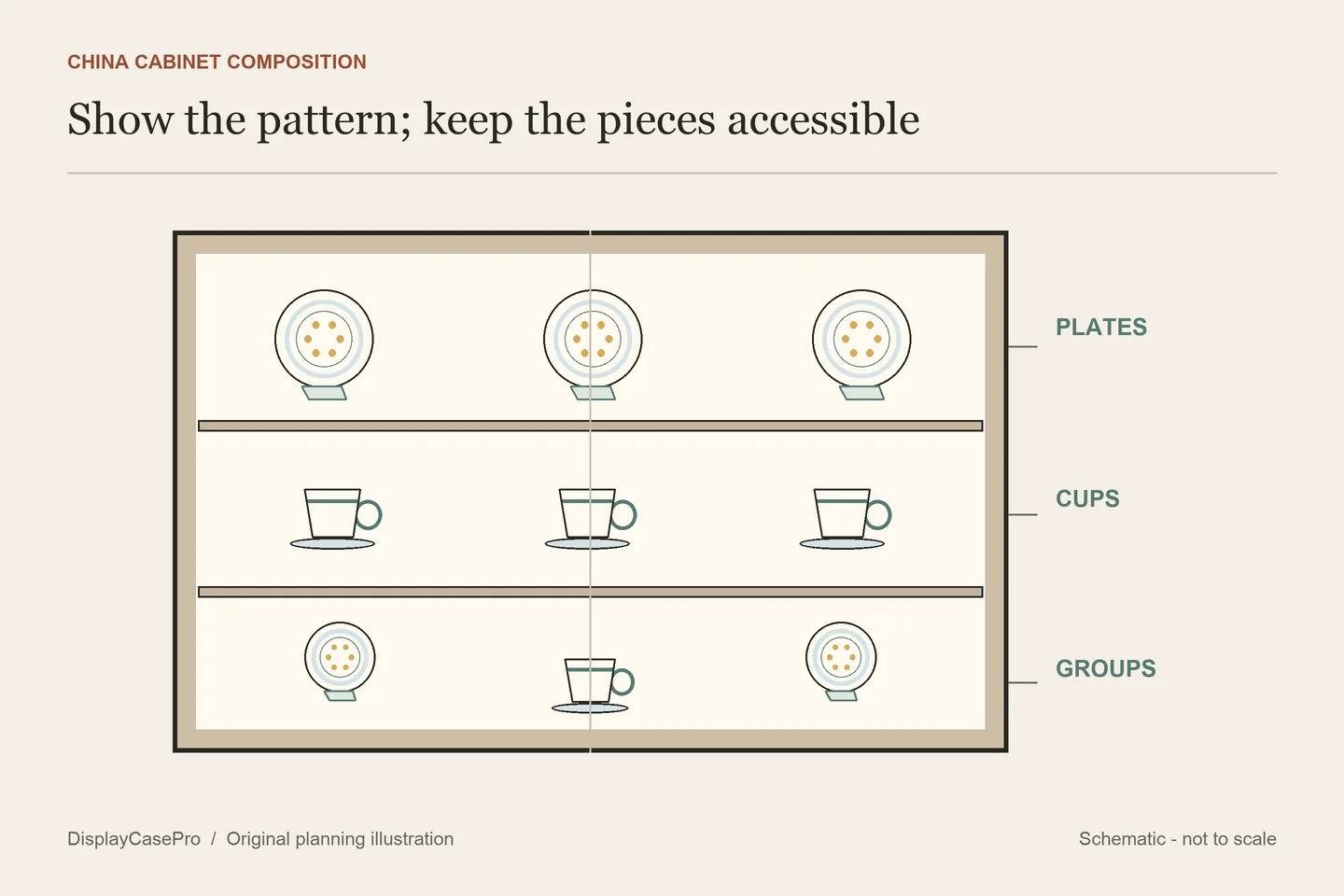
Display china in a china cabinet by choosing a few plates to stand upright, grouping smaller pieces where their patterns remain visible, and leaving a clear route to lift each item out. Plan the arrangement around the cabinet's real shelf limits and supports before filling the gaps.
The cabinet can serve two jobs: a display to enjoy from the room and storage for dishes you still use. They do not need to occupy every shelf in the same way. A useful arrangement gives decorative pieces a clear view while keeping regularly used cups and plates accessible.
1. Sort by display role and use
Start with a clear, supported work surface and group the pieces without building large stacks. Separate the plates with patterns you want to show, taller serving vessels, smaller cups and saucers, and dishes needed for regular use. Keep damaged or repaired pieces out of the trial arrangement until their support needs are understood.
Choose one visual connection for the cabinet: a repeated rim color, a single pattern or a mixture of related shapes. You do not need to match every cup to the plate behind it. Repeat the connection on another shelf so the collection reads as a deliberate arrangement instead of unrelated piles.
Make a short “display first” list. It might contain a decorated platter, a pair of dinner plates and a teapot. Put these on the paper plan before deciding where the remaining pieces belong. Extra settings can stay in suitable storage rather than compete for attention behind the same glass.
2. Check the shelves and the view through the closed doors
Read the instructions for the exact cabinet. Record shelf positions, support fittings, stated load limits and any restrictions on load distribution. Include the weight of plate stands, risers and all the dishes on a shelf; a plate count cannot substitute for that information.
Follow the cabinet's anchoring instructions before loading it. For example, IKEA's FABRIKÖR assembly document AA-1954732-9 requires the supplied wall attachment devices with wall-appropriate screws and plugs. That is a model-specific instruction, not a load rating or an installation method for every china cabinet.
Measure the usable shelf footprint, the opening for loading pieces and the space to the shelf above. Door frames, hinges and a mirrored back can make the apparent room misleading. If the dimensions are not clear, use our collection and display measurement guide to establish consistent reference points.
Then view the empty cabinet from where you normally sit or stand. Mark, on a paper sketch, where the door rails interrupt the view. Position a plate's central decoration in a visible pane rather than directly behind a wide mullion. Check lower shelves from a seated position if that is how you will usually see them.
3. Choose a china cabinet layout
Use these compositions as starting points. The number of pieces should follow the actual cabinet and safe access, not a fixed styling rule.
A formal display with repeated pairs
Place one large platter in a suitable stand toward the back of a visible shelf. Balance it with a smaller upright plate on each side where the shelf allows. Arrange cups or small bowls in front, leaving enough room to see the platter's important detail and retrieve the smaller pieces.
Repeat the sense of balance on another shelf without copying every object. A teapot can balance a group of bowls if the shapes and colors feel coherent. Symmetry is an optional composition choice; it does not require buying pieces to fill a missing side.
A display that still serves dinner
Keep the dishes you use most in accessible positions with a clear lift-out path. Use selected upright plates behind or beside them as the visual backdrop. Put pieces needed less often in a different area so retrieving one cup does not require moving an entire decorative arrangement.
Test a complete table-setting routine on the paper plan. Which items come out first, and where will you put them down? If the route crosses fragile glass stems or a tall platter, change the arrangement. A display you can use comfortably is more practical than one you avoid touching.
A mixed-pattern collection
Give each pattern a small group, then repeat one shared color or shape across the shelves. For example, blue-rimmed pieces can connect a floral cup group with a geometric plate group. Leave visible background between them so the patterns remain readable.
Use a quiet background when the decoration is busy. Try a paper color sample behind the closed doors before changing the cabinet interior. Do not paint, cover ventilation openings or add adhesive liners without considering the cabinet's materials and instructions.
4. Stand plates upright with the right support
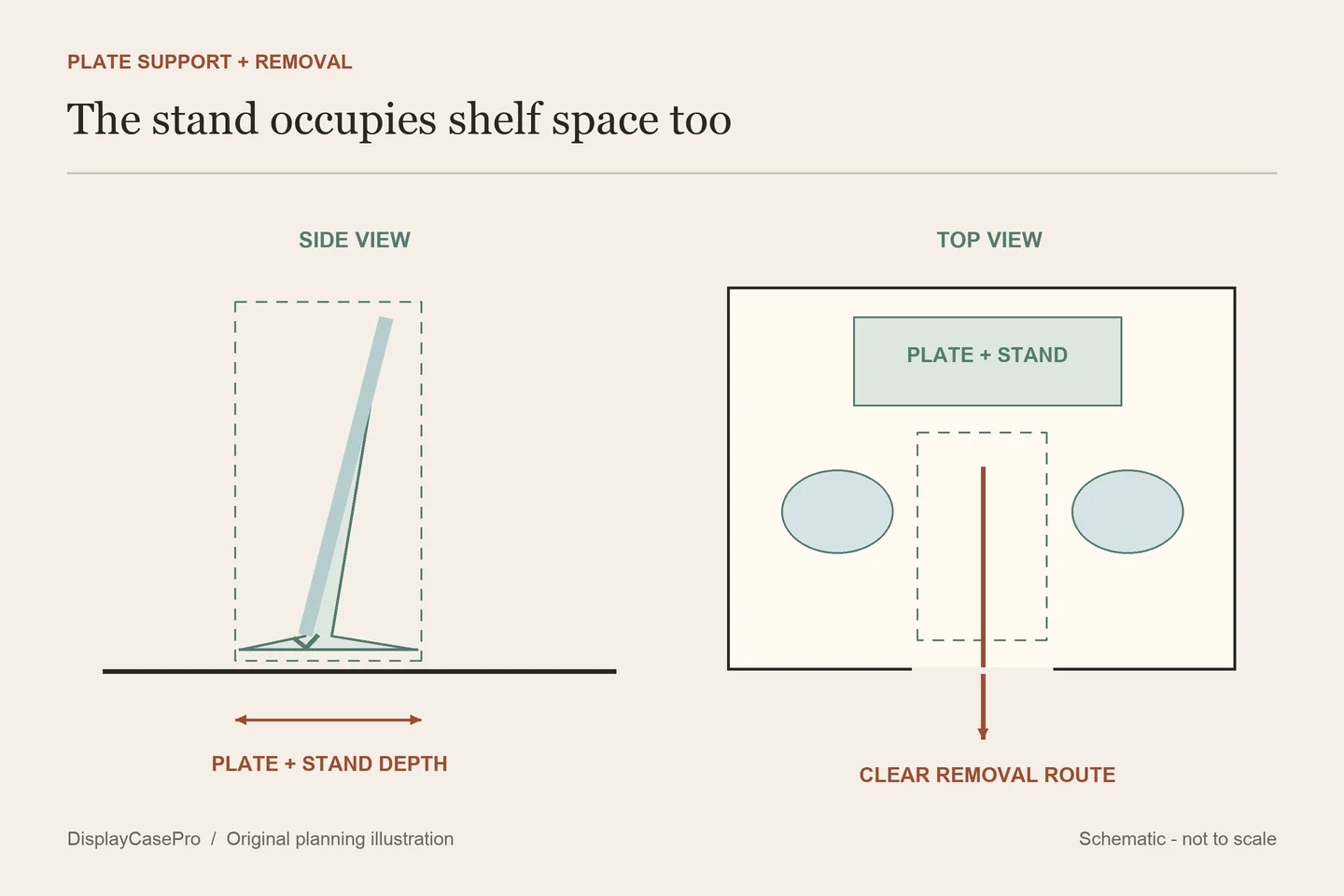
An upright plate makes its decoration easier to see, but it needs more than an attractive angle. Match the stand to the plate's diameter, profile and weight. Check the front lip, rear support and base footprint using the stand maker's information. A shallow saucer and a deep serving plate may need different stands.
The Canadian Conservation Institute's basic ceramic and glass care guidance permits appropriate wood or plastic plate stands and cautions against spring-type metal plate hangers, which can stress ceramics. It also recommends lifting with both hands rather than by handles or spouts.
- Check the empty stand. Open or assemble it as directed. Place it fully on the shelf rather than partly over the edge or across a gap.
- Check the plate's contact points. The support should not press on an unstable repair or vulnerable decoration. If the object is damaged, have its support assessed before displaying it upright.
- Measure the combined profile. A tilted plate and the stand behind it occupy shelf depth. Their highest point must clear the shelf above.
- Check the door and neighboring pieces. Allow room for handles and hinges to move without touching the plate. Keep other dishes from bearing against it.
- Plan removal. Ensure you can support the plate with both hands without reaching through a row of fragile objects.
If the cabinet has a plate groove, establish whether it is an intended display feature and what support the cabinet maker requires. A groove is not proof that every platter can lean safely against the back. If the plate slides or rocks, use another suitable support rather than improvising a hidden stop.
5. Arrange cups, bowls, stacks and crystal
Set cups on a stable surface or their properly fitting saucers, with handles clear of neighboring objects. Do not suspend an important cup from its handle simply because a decorative hook fits. A teapot likewise needs room around its spout and handle, including during removal.
For pieces suitable for stacking, use appropriate soft separation between them and keep the stack manageable. The CCI guidance recommends cushioning stacked ceramics and glass. It does not establish a universal safe count. Weight, condition, nesting shape and shelf capacity all change the answer.
Put tall stemware where you can reach the base and body without brushing the rims. Keep enough separation to remove one glass without tipping another. If a row becomes hard to access, reduce the number on display rather than moving it to an even less reachable shelf for visual balance.
A riser can reveal a small cup behind a front row, but it adds another support and another footprint. Confirm its stability and capacity, then include it in the shelf plan. A stack of decorative books is not automatically an appropriate load-bearing stand for valuable china.
6. Finish with a removal check and a record
Close the doors and assess the display from the room. Check that the main patterns remain visible and that lights do not produce a glare patch over them. Adjust the composition using fewer pieces before adding more lighting or changing the furniture.
Make a final access check for each object: can you reach it, support it and move it onto the waiting work surface without touching its neighbors? Then record the arrangement with a photograph. The china cabinet shelf worksheet includes fields for shelf limits, stands, displayed objects and removal order.
Keep routine maintenance separate from rearrangement. Remove supported objects to an appropriate surface before cleaning the cabinet, and follow instructions for its glass, finishes and fittings. A cleaning product suitable for the cabinet may not be suitable for gilding, repairs or other decoration on the contents.
Common questions
Do all plates need to stand vertically?
No. Choose a few whose decoration benefits from that position, then use suitable stacks or other storage for the rest. Upright display is a composition tool, not a requirement for every plate.
How much empty space should I leave?
Enough for stable supports, visibility and a comfortable removal path. There is no universal percentage. Assess the arrangement through the closed doors and from the usual viewing position.
Can I mix china and crystal?
Yes, if each object has appropriate support and access. Try one shared color or repeated shape to connect the groups. Keep glass stems and ceramic handles from becoming obstacles to reaching the pieces behind them.
Comments
Share a display tip or ask a question.